This week I’m continuing the exploration from last week of what it means that our church is part of the United Church of Christ, and how that can guide us and inspire us.
Last week I shared some about the history of it – basically why our church has such a long, unwieldy name: We’re a congregational church, meaning we’re from a church movement staring in the 17th century in England that tried to avoid abuses of power by church hierarchy by doing away with it and putting power with local congregations.
We’re also part of the United Church of Christ, because in 1954 the Congregationalists decided to enter a union with three other denominations to form this new entity. This local congregation voted to go along with that, and that’s why United Church of Christ is part of our name and identity.
One of the things that unified those four denominations was an allergy to church authority. One of the results of this is that the United Church of Christ is “non-creedal.” There isn’t one creed that everyone involved needs to say they believe word for word. There is a statement of belief the national body has adopted, which is a pretty open expression of Christian faith. But each local congregation can settle on their own theological orientation, thank you very much. In practice this means many congregations embrace a fairly big tent approach to faith, like I’d say we do here, but there is quite a theological diversity from congregation to congregation, from explicitly universalist congregations, to congregations that are orthodox Calvinists, and a range.
What this doesn’t mean is that the United Church of Christ is just a wishy-washy lukewarm puddle that drains into the least common denominator. No, there are spirited debates and fierce passions and bold stances and inspired actions.
One of the reasons for this and one of the things that I think is so special about the United Church of Christ, is the strong emphasis on how we live out our faith. Okay, enough talk, what are you doing about it? People are suffering and our faith calls us to action.
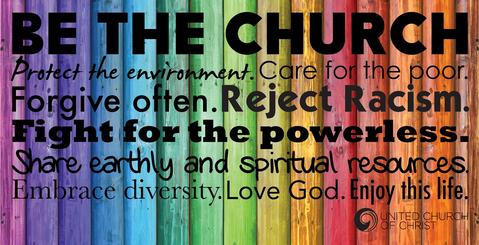
For example, here’s something from the national UCC:
“Be the Church:
Protect the environment. Care for the poor. Forgive often. Reject racism. Fight for the powerless. Share earthly and spiritual resources. Embrace diversity. Love God. Enjoy this life.”
Notice the strong action words: Protect. Care. Forgive. Reject. Fight. Share. Embrace. Love. Enjoy. Be the church in what you do and how you do.
Now, you’ll notice some of these calls are directly from the Bible and from the life and teaching of Jesus: Care for the poor; Forgive often; Share earthly and spiritual resources; Love God; Enjoy this life. Some use more contemporary language in answer to the question of “What would Jesus do?” Protect the environment; Reject racism; Embrace diversity … these are contemporary words and issues that aren’t straight from the Bible but are I think very important ways of hearing the call of the still speaking God to our time. For example, race as we have fabricated it didn’t exist in the same way back then, but Jesus and the prophets were always uplifting the humanity of those their tribe considered less-than. How does the gospel call us to act in the fact of the crises of our times?
The main criticism this banner will draw from some Christians is that the emphasis is on the doing and not on the believing. We are not saved by our works but by our faith.
Now, it’s true that it’s not our behavior that earns our salvation. That can’t be earned. “Earning” is the wrong frame of mind. Rather it is by the free and abundant gift of grace, as revealed through Christ, that we are restored to our true selves as children of the living God.
When we see this “Be the Church” we can feel inspired, but we’ll also feel challenged, because we will become very aware of how we are not doing these things all the time. We need grace.
But the funny thing is, the more we come to know that grace, the more our hearts are compelled to respond to suffering and crisis with compassion and courage. And the more we respond to suffering and crisis with compassion and courage, the more our hearts are compelled to come to know about grace.
And if there’s a kid torn from their mother and locked up in a cage, is it more important you help them get free or that you respond to that altar call?
The more activist spirit of the United Church of Christ, say what you will about it, and we’re not immune to pridefulness, but it’s part of a long lineage of rejecting a faith that’s so obsessed with the afterlife that it’s willing to trample over the actual lives of the living.
Jesus was part of that lineage. So were the prophets, and countless saints.
So let me end with two strong expressions of this activist spirit, from scripture
James 2:14-18
What good is it, my siblings, if someone claims to have faith but does not have works? Is faith able to save them? If a sibling is naked and lacks daily food, and one of you says to them, “Go in peace; keep warm and eat your fill,” and yet you do not supply their bodily needs, what is the good of that? So, faith by itself, if it has no works, is dead.
But someone will say, “You have faith and I have works.” Show me your faith apart from your works, and I by my works will show you my faith.
Isaiah 58:3-4,6-11
“Why do we fast, but you do not see? Why humble ourselves, but you do not notice?”
Look, you serve your own interest on your fast day, and oppress all your workers.
Look, you fast only to quarrel and to fight and to strike with a wicked fist. Such fasting as you do today will not make your voice heard on high.
Is not this the fast that I choose: to loosen the bonds of injustice, to undo the thongs of the yoke, to let the oppressed go free, and to break every yoke?
Is it not to share your bread with the hungry, and bring the homeless poor into your house; when you see the naked, to cover them, and not to hide yourself from your own kin?
Then your light shall break forth like the dawn, and your healing shall spring up quickly; your vindicator shall go before you, the glory of the Holy One shall be your rear guard.
Then you shall call, and the Holy One will answer; you shall cry for help, and God will say, Here I am.
If you remove the yoke from among you, the pointing of the finger, the speaking of evil, if you offer your food to the hungry and satisfy the needs of the afflicted, then your light shall rise in the darkness and your gloom be like the noonday. The Holy One will guide you continually, and satisfy your needs in parched places, and make your bones strong; and you shall be like a watered garden, like a spring of water, whose waters never fail.
Thanks be to God
 The Dandelion Way