The year is 1866.
First Congregational Church of Walla Walla is scarcely a year old, with just a small handful of members, at its first location on what is now Rose St. and 2nd.
The town of Walla Walla itself has been incorporated only for a few years. And the soldiers and miners and merchants and farmers and madames and salooners who set stakes here were not known for their church going ways. The reputation of Walla Walla was “The town so full of sin and vice they had to go and name it twice.”
That said, on the occasion in question in 1866 the First Congregational Church is very well attended. Walla Wallans have come out in droves to the to hear the Rev. Henry H. Spalding speak. He had come to Walla Walla to launch a series of lectures about the heroic deeds of the martyred missionaries, Doctor Marcus and Narcissa Whitman.
Henry and his wife Eliza Spalding had journeyed out here with the Whitmans thirty years prior. Historians know from letters that they bickered the whole way. They did not get along – there was jealousy and rivalry: Spalding had proposed to Narcissa, but she turned him down and later married Marcus Whitman. Here they are thrown in together on this mission to enter a foreign land and convert the people who lived there not only to Christianity but also to a European way of life.
They split up when they got here. The Spaldings set up with the Nimiipuu, or Nez Perce, northeast of here; and the Whitmans with the Liksiyu or Cayuse people.
As missionaries, they were not very successful. The Whitman mission, especially, failed to win converts, and mostly drummed up resentment. The Liksiyu had given them land to use, but never saw that they received any reciprocity in return. The Spaldings did a little better, because Eliza was diligent in actually learning the Nimiipuu language, and their approach to religion wasn’t quite as severe as the Whitmans.
But from the perspective of the missionary board back in Boston, all they heard in the correspondences from Henry Spalding was unrelenting complaint and accusation and paranoia. He was a very difficult character. As a matter of fact, all the Protestant missionaries in the area were fighting with each other and nursing grudges against each other, all while not managing to win over very many Indigenous souls, or becoming economically self-sufficient.
So, the missionary board back East got fed up and pulled their funding.
Marcus Whitman wouldn’t have that.
He got a couple of guides and made his way back east, in winter. He stoped in DC and advocated for sending troops to the Oregon territory. And he went to Boston where he successfully talked the mission board into restoring his funding. On his way back west, Dr. Whitman had heard about the first big wagon train going to Oregon. He traveled with them. He proved to be very helpful to them as a doctor and as someone who has experience traveling in the west. His sense of confidence is restored.
When the Liksiyu people see Whitman return to their land, it is with a thousand uninvited guests. On his return, Whitman has decided that God has ordained him not to convert American Indians – they are a lost cause, a lot people best swept from history. Instead, the purpose God has for him is to help populate this place with European American Protestants.
The Liksiyu see this plainly – the Whitman mission became a stopping point for wave after wave of Americans. Terrible new diseases run rampant through the Indigenous people. Dr. Whitman’s treatments involved mercury and blood-letting, and only hasten people’s death.
In 1847 a group of Liksiyu attacked and killed Marcus and Narcissa Whitman and nine men and boys, and two more later after taking them captive.
This kind of thing happened a lot to missionaries. And in fact, the romance of martyrdom is part of what attracted Narcissa to the enterprise in the first place. But it is a tragic event. And it gets more tragic.
The Oregon Militia and then the U.S. Army hit back and – long story short – after years of what’s now known as the Cayuse war, the Liksiyu people are dispossessed from their land and relegated to a reservation. This area is now reopened to American settlement. The town of Walla Walla springs up.
Now we’re back to 1866 at the First Congregational Church of Walla Walla. The Rev. Henry Spalding conjures for the assembled people, an epic drama of biblical scope that places Marcus Whitman as the central hero. What Spalding tells them about Whitman is quite different from the one I just told related, which by the way is based on what historians have reconstructed from letters and other documents.
“Our gracious God,” Spalding says, “when the auspicious moment came to develop His plans, took His own way, chose His own instruments, to open this overland route and secure a basis for the settling of the country …” (Quoted in “Providence and the Invention of American History,” by Sarah Koenig, pg. 48)
The primary instrument of God’s will, was Marcus Whitman. Whitman, in Spalding’s telling, was a divinely ordained hero and martyr who was singlehandedly responsible for saving the Oregon territory from a Catholic plot to trick the President of the United States into trading it to Britain for a cod fishery in Newfoundland.
No basis in fact.
But the bigger issue here is too deadly serious to be dismissed.
This is the belief, widespread even to this day, that it is God’s will for European American Protestants to fill the world and subdue it.
This is one way Spalding put it: “In the progressive development of human redemption, the great end of this created world, the allwise God had determined that these vast gold and silver mines, in and west of the Rocky Mountains and throughout the Pacific slope … should, in these last days, be developed and given to the commercial world, and by American hands … in part to speed the chariot wheel of human salvation” (Quoted in “Providence and the Invention of American History,” by Sarah Koenig, pg. 78).
Those we dispossess or dispatch along the way are just collateral damage. As my pastor once told me when I was in youth group and questioned why a loving God would sanction holy war: “Sometimes God’s gotta do what God’s gotta do.”
All this is just yet another variation on the long and tragic history of priests and preachers using God to justify their people in exerting power over another. For Christians it’s twisting Jesus into the service of the war gods of Babylon.
As our church here, First Congregational of Walla Walla, has changed and evolved over the years since then, we have come to at least try to embody a different expression of the Gospel of a servant savior who identified with the least of these, and resisted the inhumanity of the mighty. We’ve been seeking to live out an ever wider embrace and an ever deeper love, from more of a place of humility.
But in trying to do that as a church, it is our duty as well to honest and accountable for the ways this church and many of us have been formed by and have benefitted from notions of Anglo-Saxon American Protestant supremacy.
And it’s important that we’re honest about it and accountable to it, especially in relation with the people who have suffered the most from it – in this case the Liksiyu people, and the other Native tribes of the area.
In all this, I suggest that it really helps to stay rooted in a healthy understanding of Grace, of God’s Grace as manifest through Jesus. The knowledge of God’s Grace allows us to be honest about the ways we and our people have sinned and have been shaped by sin, as we allow ourselves to be renewed by God’s life-giving power.
What that means is that we can draw from what is healthy and life-giving in reformed Protestantism can help us to be mature in recognizing and being accountable for what is unhealthy and death-dealing within our tradition, while gratefully receiving and seeking to live up to what is inspiring and life-giving about what our forebears accomplished.
Because of Grace we don’t need to get caught up in guilt or shame.
Because of Grace we don’t need to get caught up in defensiveness.
Because of Grace we don’t need to get caught up in judgmentalism or in black-and-white hero/villain/victim kind of thinking.
Because of Grace we know that all humanity is complex and broken and beautiful and embraced as we are by our Creator.
Because of Grace we can have the courage and the clarity to be accountable in real terms, not just in words, for the sins of the past and the present.
Because of Grace this is all yet another opportunity to grow, in our struggle for the beloved community, in our living into a wider embrace and deeper love.
For this Grace, for the courage and clarity it gives us, I give thanks to God.
(For livestream of this sermon within worship, you can go here)
Works consulted: “Providence and the Invention of American History,” by Sarah Koenig; and “Murder at the Mission” by Blaine Harden
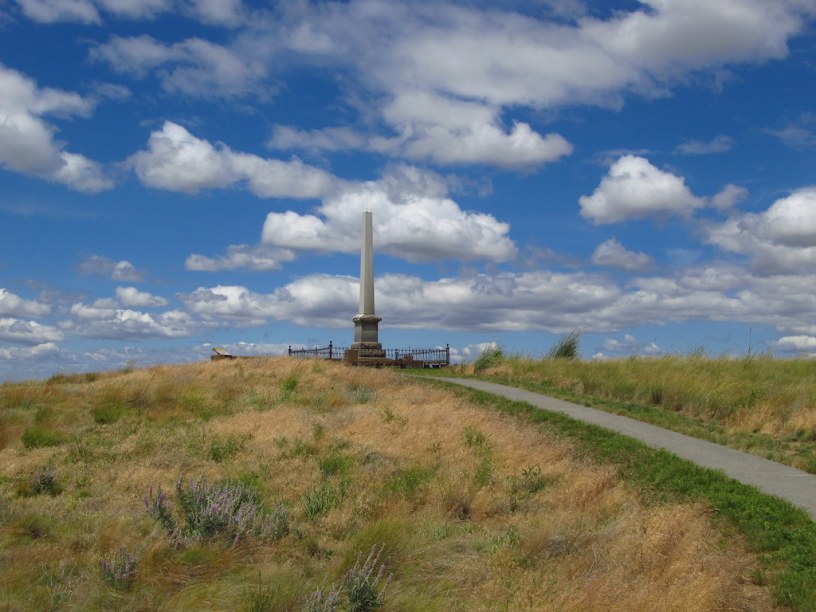
“Whitman Mission National Historic Site” by Jasperdo is licensed under CC BY-NC-ND 2.0
 The Dandelion Way