Those of us who are not on a beach right now, let’s just pretend we are, shall we?
Let’s in our mind’s eye sit on the shore of an ocean at dusk. Look out over the expanse of the waters and try to take in the enormity of the globe that lies beyond the horizon. Consider that it at twilight it is the ancient cycles of the turning earth that are once again casting our side of the globe into shadow, after another day under the sun.
Let’s allow the rhythm of the waves to beckon us to contemplate just how unceasing that rhythm has been, wave after wave, night after day, day after night, year after year-
through storms, through calm, as generations of humanity come and go, as entire life-forms on earth and sea rise and fall. Consider how the unrelenting rhythm of the waters has beat against the hardest rock the depths of the earth can forge, and year after year, broken it apart, bit by bit, and rolled its constituent elements into the finest sand. Granite billions of years old reduced to the silica that was forged much longer ago in some distant supernova.
There on the beach by the ocean, as the great bulk of the earth steadily shoulders away from the sun and twilight darkens, as the distant stars appear to your sight, lay back in the sand upon the giant body of our planet, and consider the stars laid out before you. Each star is a fiery behemoth like the sun that warms our days and centers our orbit and makes life on earth possible, many stars far, far larger than our sun, all spanning out 10s, 100s, 1000s of light-years away from us, our cosmic neighbors among the hundreds of billions of stars in the galaxy we call the Milky Way.
Then take a pinch of sand from the beach beneath you and turn it between your fingers until you have just one of the countless tiny grains.
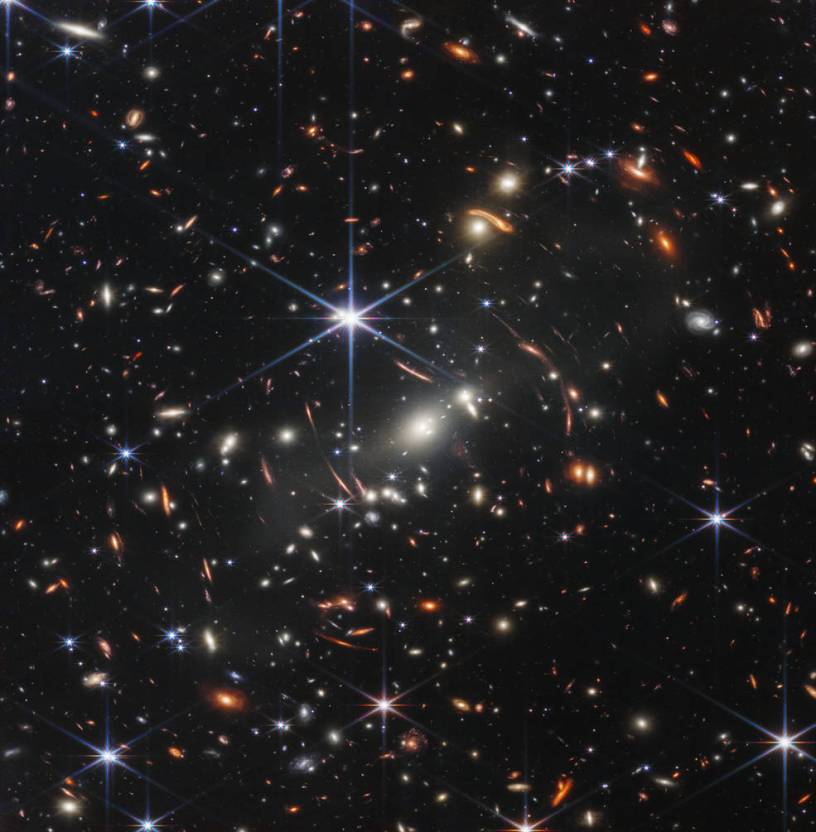
Hold that grain of sand out at arm’s length against a dark spot in the night sky between two stars. And, as the waves continue to pulse from horizon to horizon around you, try to envision that in the tiny patch of sky within the circumference of that grain of sand, there are thousands, even tens of thousands of galaxies, each containing billions of stars.
The most powerful telescope yet engineered by humans, NASA’s James Webb Telescope, recently looked out into such a tiny patch of the universe and found a dizzying kaleidoscope of swirls and eddies, galaxy upon galaxy whose light and radiation took billions of years to reach us.
In the enormous scope of all this reality, can we even begin to comprehend that all this is but an intimation of the infinity of the Holy One our God.
And can we even begin to comprehend that in in the enormous scope of all this reality, everything, everything is fleeting – the seemingly ceaseless waves of the ocean will one day cease.
Nothing endures. Nothing remains forever. Our universe, and everything in it, we ourselves with names and bones, through and through, is characterized by change.
We don’t need a telescope to know this. We don’t need millions of years of fossil records or geologic core samples. Thoughtful and perceptive people throughout human history, have beheld the truth that all things change. Some flux is quick, some flux is slow, but we can know with certainty that we and all that we touch and see will shift form beyond recognition and pass away. This can be a cause of peace; it can be a cause of fear.
At the same time the past few weeks as we were getting news of the first images of deep space from the James Webb Telescope, the United Nations announced that the world is facing an unprecedented hunger crisis. All of the forms of upheaval we have been living through – pandemic, war, climate change, failures of political institutions to serve all equally – all has compounded to hit those who are most precarious the hardest. The number of people facing urgent food insecurity globally has now doubled to 276 million; and multiple famines are likely this coming year.
For many, all the upheavals of the past few years have shaken a perhaps unexamined assumption that there are some aspects of our lives that are somehow secure from change. For some this may be the shock of seeing that our country’s democratic institutions are not stable; or that certain political rights are not assured; or that our sense of home or sense of personal health is not safe from catastrophe; or that financial well-being is not secure; or that all that we’ve labored for in our lives and society is not far from collapsing into the waves, if some bully on the beach doesn’t kick it down first.
Common responses to all this recognition are denial, or despair, or resignation.
But the wisdom of our faith is a resource for a much more life-giving response.
First of all, our scriptures and all the great teachers of our faith are pretty unrelenting in reminding us of the impermanence of all things and how futile it is for us to attach all our hopes and dreams to anything fleeting.
The book of Ecclesiastes, as we heard, famously declares, “Vanity, vanity, all is vanity.” The Hebrew word is means something more like “mere vapor,” “mist,” “fleeting breath.” The point is not that all things are meaningless, but rather that they are totally, radically impermanent.
Jesus is famous for warning us against storing up treasures in the earthly realm, where “moths and rust destroy and thieves break in and steal” (Matthew 6:19-20).
The prophets and the saints all return to this wisdom time and again.
So, our religious teaching and practice should prepare us to not be terribly shocked when we are confronted by change of one sort or the other, whether we expected it or not. And our practice of prayer and worship and study should ground us in a sense of belonging to the tremendous transcendence of God beyond the vagaries our limited existence.
As I said earlier, if we contemplate the swirling depths of deep space, or we consider that biologists say we know more about deep space than about all the life forms teeming within just a square inch of soil beneath our feet, all this can just give us an intimation of the infinity of the Holy One, who is the source and destination of all existence. The sages assure us that within the impossible vastness of the Divine we find abiding serenity.
Now, the wisdom of our tradition is also very clear that none of this removes our responsibility to act with compassion and courage in response to the urgent needs of our times. None of this should dull our joy or our grief.
On the one hand, we can’t let despair paralyze us. On the other hand, we can’t let a transcendent assurance cause us to just peace out.
The book of Ecclesiastes arrives at the advice that we stay fully present to the work that is ours to do, the people who are ours to love, the satisfactions that are ours to enjoy. And we just let go of concern for whether any of it is going to last.
To this, Jesus really emphasizes the ethical dimension. We respond to the urgent needs of the people we encounter, in a pure hearted and, in a sense, a simple-minded way. Do right by the people you encounter, and don’t over think it. The ultimate outcome is not in our hands.
In this way, we can keep on doing the long hard work for social change on behalf of a just world for all, without too much despair or anxiety over just how uncertain it all is.
In the words attributed to the first century Rabbi Tarfon, who is commenting on the prophet Micah:
“Do not be daunted by the enormity of the world’s grief. Do justice, now. Love mercy, now. Walk humbly, now. May we know we are not obligated to complete the work. But neither are we free to abandon it.”
Thanks be to God.
(Delivered Sunday, July 31, 2022 at the United Church of Christ at Valley Forge, by Rev. Nathaniel Mahlberg)
Image credit: NASA, ESA, CSA, and STScI
 The Dandelion Way