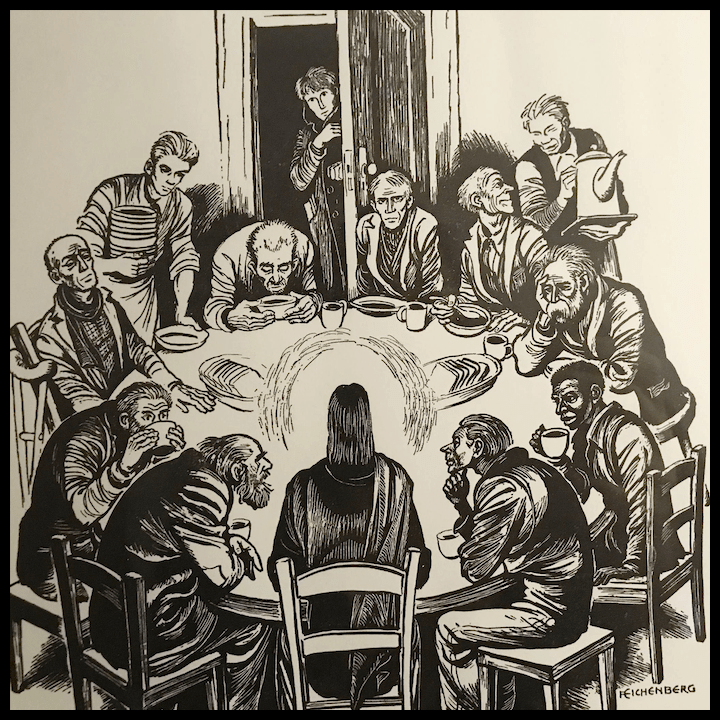
What I have to offer as a sermon reflection this morning is in response to a good question that I’ve received as a new minister here. Here’s the answer, and you’ll figure out the question: Yes, it is very important to me in how I approach ministry that our practice of sharing the sacrament of Holy Communion is done as an open table, with an extravagant welcome.
This means that everyone and anyone are welcome to Communion. Period. There are no requirements.
If you want to share in the embodied presence of Christ through this ritual of our faith community, whatever the reason, even out of curiosity, great. That’s enough. You’re welcome.
Now, I know that Open Communion has been the ethos and the practice here at UCCVF. But this open welcome to our sharing of Communion has to be announced and has to be repeated because it is at odds with the way most churches and ministers do it. That’s why I received this question recently.
There usually are requirements. At the very least, you need to be baptized already. That makes Communion an in-group ritual, for those who have already made that level of commitment marked by baptism of following Jesus and of belonging to the church. This is an understandable approach to Communion, as a ritual for those who have already formally entered the community – but I think it misses the extravagant generosity of the embodied presence of Christ that we celebrate and share in this ritualized feast. The union in Communion is a free gift that by grace is offered to each and all, all the time. And we should freely welcome anyone at any time into our gratitude for that gift – “Eucharist” means gratitude. I’ll say more about this a minute.
But first, I need to address that there are some groups of our fellow Christians who go further than the requirement of baptism in having requirements and indeed barriers for someone to be able to receive Holy Communion. For example, that you have to be in full agreement with all the established dogmas of the particular church institution. You can’t be a heretic in your beliefs, in other words.
And even forth, among some faith communities can’t take Communion if you’re considered the wrong kind of person or if you’ve made what the church considers to be the wrong kind of choices. If you’re unrepentantly gay or trans, for example, or if you’ve had an abortion, or if you’ve been divorced.
These are tests of worthiness. And if you don’t pass them you may be excommunicated, which literally means “removed from Communion.”
I dare say that most of us here, here at this dear kinda-funky church community, most of us probably would fail one of those tests, if we’re honest. I know for some that’s exactly why they’ve sought out this church, because of the painful experience of being unwelcomed from sharing the practice of a church community.
So we have here a Communion of the Excommunicated … or the Excommunicate-able.
Whether or not you have actually been excommunicated, most of us here are probably excommunicate-able by the thinking of certain church institutions. For example, if you don’t think that a loving God would condemn people to everlasting hellfire, or if you aren’t ashamed of being gay or trans, or if you celebrate the ordination of women, or if you agree with me that it’s fine to serve Communion to whomever wants it … my friend, you may be excommunicate-able.
And you’re in great company, right?
Jesus had a lot to say about who gets invited to meals and who gets excluded.
As we heard in the reading for today, this could make him into a perhaps unpleasant dinner guest (Luke 14:12-24). Imagine us inviting Jesus over for dinner and all he does to repay our kindness is hold forth about how our party is just a theater for displaying status. He’d confront us for only inviting our professional/managerial class friends friends and not the guy living under the bridge who rifles through our trash at night hungry for scraps.
Jesus even did this at the Last Supper.
As the Gospel of Luke tells the story, at the last supper Jesus broke the bread and poured the wine and gave it to his disciples – “This is my body, this is my blood.” And the very next thing that happens around that table is the disciples start bickering about which of them is the best, about who’s the most worthy and who’s the least. So immediately after Jesus inaugurated the practice of Communion, he has to school his disciples, and turn egos on their head and lay down that famous teaching that It’s the least who’s the greatest; it’s the servant who’s the leader. (Luke 22: 7-27)
It’s so important to the practice of our faith that every meal we serve, let alone our most sacred meal, is an act of radical hospitality, and of earnest humility.
I love how in the meals you all serve at the shelter at our sister church of Old First in downtown Philly, you all sit and eat with the folks who are staying there.
What are more ways we can embody this radical hospitality and earnest humility?
Jesus broke the bread to share in all our brokenness. He gives it to us to receive out of a hunger we share with all living beings.
This is a brokenness and a hunger that I share with the big-time bishop I criticize for excommunicating people. This is a brokenness and a hunger that I share with the guy who riffles through my trash looking for food scraps, who I may hesitate to invite in for supper. This is a brokenness and a hunger I share with all those I think I am better than, and with those who think they’re better than me.
What Jesus points to again and again is how the people who get it, who get what he’s trying to give, are those who know most fiercely this brokenness and hunger, who what it is like to be excluded from the table, to be denied nourishment, to be denied mercy. Because they aren’t going to hesitate to say Yes to the indiscriminate gift of grace.
Jesus gave of himself, gave of all of himself, to provide the most fundamental nourishment for all, for each and all, that indiscriminate gift of grace.
Who are we to deny anybody who would say Yes … or to even imagine we somehow have the power to deny anybody who would say Yes?
The Christ Table is an Open Table, whether we act like it or not.
What a joy it is when we do.
Thanks be to God.
(Delivered August 7, 2022, at the United Church of Christ at Valley Forge, by Rev. Nathaniel Mahlberg)
(Image: The Lord’s Supper by Fritz Eichenberg)
 The Dandelion Way