Early in the pandemic during the whole lockdown-stay-at-home phase of things, when suddenly we’re cooped up with ratcheted up stress over childcare and work and worry about health and about the community and the church I served, I came up with a little daily project to try to keep myself sane. This was something that been on my heart to do for a while. You see, I’ve regretted that I’ve never bothered to learn to identify trees. In general, I’m not inclined to pay attention to plants – I don’t have a green thumb, and as much as I love being in the woods, I’m afflicted with an overly-civilized aloofness from the more than human world. And I’d come to realize that my being so out of touch with most of Creation was a profound alienation that really causes suffering in myself and in the world. And I’ve wanted to do something about it.
So, when the pandemic hit, I decided it’d be a good practice for me to go on a walk every day where I find a tree and just hang out with it a spell. My little task would be to try to figure out what kind of tree it is. And then the next day I go back and try to remember what I learned. Then when I’m ready I hang out with a different tree and learn about it. Nothing special, just becoming a little better acquainted with the trees in my neighborhood
In this way, I learned how to name and how to notice details about leaves and needles, and seeds and cones, and bark and branching patterns, which are the details that help us to distinguish one kind of tree as distinct from another. These are details I hadn’t bothered to notice before. But I found that once I learned the name of a tree and the names of the things about it that distinguish it, it helped me to notice those details and that kind of tree everywhere. There was a whole world just waiting to be opened up to me, a dimension of the world that of course countless other people have been awake to for eons, a dimension of the world that has been around me and over me and under me all along.
I came to relish the names people have given to these amazing beings – Linden & Sycamore, Alder, Engelmann Spruce & Ponderosa Pine. These are names I had heard, of course, but now they were filled with meaning for me, which was my lived experience of abiding each day for a spell in the presence of these trees.
As I became more attentive to the reality of my tree neighbors, I overall felt a stronger relationship with the more-than-human world, the wider world of God’s Creation, which moves on cycles that are much slower and broader and more well balanced than the frenzy that can be human activity. This was a good antidote to the stifled, stresses and obsessions of human life in a pandemic.
And names were important to this experience for me
Learning the names of my arboreal neighbors was an important part of expanding my sense of relationship.
Words & names are important for us, as human beings – they are not everything, of course, the word for a being is not the being itself, trees, like people, like everything are much, much more than we can ever express with words – but words and names shape and sharpen and color what we pay attention to, what we are in relationship with, and how we are in relationship, as well as our belonging to a community of speakers with shared experience we talk about with shared language.
So, when it comes to us as a community of faith being in relationship with that Whom we call God, there is great importance to the words we use and how we use them. The names and words we use for the Divine can help us to be in living relationship with the living God; notice how aspects of how God is present in the world and in our lives; they can help us to share with each other the living giving gifts of the Spirit; and they can help us to be open to the ways that God names us and calls us to become ever more fully who our Creator has created us to be.
This week and next week and perhaps longer, we’ll see, I’ll be sharing some about the names of God in our tradition. It’s important that the ways we refer to the Divine don’t become rote, but are open and rich and full to the astonishing realities of our relationships with the Holy One.
First: The Name, the fount of all names that we in the Judeo-Christian traditions use for the God of all Creation.
When the ancient Hebrew people were suffering enslavement at the hands of the Egyptian empire, the God of all Creation witnesses their oppression, and responds. The Holy One responds by surprising a Hebrew Shepherd with an experience in the wilderness, where a burning bush draws him in and calls him by name and tells him that this is the God of his ancestors calling him, Moses, to be the human agent for the Divine One’s liberation of his people.
Moses responds, “Who am I to do this?”
The Holy One answers, “I will be with you.”
Then Moses asks, “Who are you? How do I name you when talking to my people?”
The answer: “ ‘ehyeh ‘asher ‘ehyeh “I Am Who I Am”
“Tell your people ‘ehyeh “I Am” sends you.”
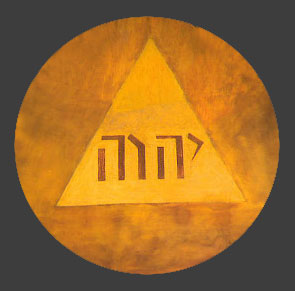
And then comes the name beyond name:
The Hebrew letters are YHWH.
The tradition is that this name is unpronounceable, it is the name beyond name, for the unnamable Holy Mystery of the Divine. Scholars refer to it as the “tetragrammaton” which means “the four letters.” Many Jews refer to it as “ha shem” which means the Name. Out of respect and reverence they don’t say more than that and try to say Yahweh or Jehovah. And Jews also when they write the English word “God”, they leave a dash in the middle “G-d” to remind us that ha shem is beyond name. Honestly, I think this is better than the Christian tendency to say God this, God that, God, God, God, until it risks loses meaning.
But, at the same time, names are important, right? Like I began by saying, the names are a way to become aware of what is beyond us, and draw us into relationship. Names for the Divine of our ancestors can be ways for us to hear how we are named and called, as Moses did, to know that God is with us, and to share that with others.
In most of our Bible translations this name, YHWH is translated as capital Lord.
Now, there is a Hebrew name for God that means Lord, or Master – that is Adonai. But most our biblical translations love “Lord” so much as a way of referring to the Holy One that they use it not only for Adonai but for the Name Beyond Name, YHWH. This can make it seem like Lord is the only way of referring to God.
A different approach is the one we heard from our reading for today, a translation by Professor Wilda C. Gafney. Rather than picking one inadequate translation for YHWH, she uses a plurality of names, which are rooted in a creative response to our tradition. In the version of Psalm 96 we heard:
“Sing to the Exalted a new song;
Sing to the Creator, all the earth.
Sing to the Most High, bless her name;
Proclaim from day to day her salvation.”
These names are all in Hebrew YHWH. In Psalm 96 Dr Gafney translates The Name as:
Exalted, Creator, Most High, Ageless God, Womb of Live, Majestic One, Mighty One, Fire of Sinai, Sovereign One, The Ever-Living God, Wisdom of Ages.
Now, I’ll be sharing more about this next week, going into more detail about the whole range of names and words in our tradition that folks have used to refer to God.
But for today let me share some more about these four mysterious letters that spoke to Moses from the fire in the wilderness: YHWH.
A couple of times already I’ve shared with you all an understanding of this tetragrammaton that has been passed down among mystical lineages in Judaism. This was shared with my by two different people I’ve had the good fortune of spending time with: Rabbi Arthur Waskow, who is a Rabbi and civil rights leader, and David Abram, who’s a Jewish slight-of-hand magician and writer and general practitioner of wonderment.
In the written language ancient Hebrew, only the consonants of a word are written down. It’s a kind of shorthand because parchment is expensive. You have to be familiar enough with the language to know the vowels that you fill in. But when it comes to YHWH, no one knows the full word to begin with, so it’s a mystery, a puzzle.
But let’s think about it. Consonants are the parts of language like “b, p, m, n, g, k, ch, r, s, etc.” These are the percussive sounds that make up words, that we use our lips and tongues to make. Vowels – a, e, i, o, u – are the breathed parts of words. Vowels are breath with the vibration of our voice.
Now, look at the consonant in the tetragrammaton: Y H W H. These are the consonants that don’t fit the rule that I just told you. They aren’t percussive sounds. They are breathed sounds.
So, there is a tradition within mystical Judaism that teaches that the name of the Holy I Am is no word, but the origin of all words,
A tremendous breath
Yeeiiiaaoouu Heeiiiaaoouu Weeiiiaaoouu Heeiiiaaoouu
To evoke The Divine, we are to
Breathe in
& breathe out.
Yes, the Holy One is beyond all name, a Tremendous Mystery, and yet Their evocation is as close to us and as constant as our breath, as the air around us and through us, as the wind beyond.
This is a Holy Reality that is always there, and has always been, whether we are aware or not – around us, above, below, within, beyond.
As the Apostle Paul says, “The Eternal Spirit in which we live and move and have our being.”
This Eternal Spirit, this Holy Creator, this Great Mystery, this Ever-Living Breath of Creation, speaks to us! Calls us by name, and calls us to liberation of our souls, the liberation of our bodies from suffering, calls us to deeper, truer relationship with each other, with ourselves, with our world, with our God. We are called from our restricted, stifled obsessions, and out into the wider world where the realm of heaven is come on earth.
And to this Divine voice, to this call, we can respond. We can evoke the Divine by name, with whatever breath, whatever voice we have:
Let the heavens rejoice, and let the earth be glad;
Let the sea roar, along with what fills it.
Let the field exult, and all that is in it.
Then shall all the trees of the forest sing for joy
Before the Wisdom of the Ages; for she is coming
Thanks be to God.
Delivered Sunday, August 28, 2022, by Rev. Nathaniel Mahlberg at the United Church of Christ at Valley Forge.
Translation of Psalm 96 by Wilda C. Gafney, from “A Women’s Lectionary for the Whole Church,” pg. 82
Image: Francisco de Goya y Lucientes. “The name of God” (Tetragrammaton in triangle), fresco detail from LA GLORIA or LA ADORACIÓN DEL NOMBRE DE DIOS (1772). Basílica del Pilar, Zaragoza (Spain) Creative Commons Attribution-Share Alike 4.0 International
 The Dandelion Way