I’m going to venture a guess that some of us here can relate to what the father in the gospel story we heard says: “I have faith! Help my lack of faith.” “I have trust! Help my lack of trust.” Sometimes this is translated, “I believe! Help my unbelief.” (Mark (9:14-29)
It’s so honest, this poignant ambivalence. I need you, Jesus. I trust you, God … I do, but … I’m not 100% sure. I wish I believed beyond the shadow of a doubt, I know I’m supposed to, right? But …
I think a lot more folks could honestly say this at times than maybe we let on. This whole “I know I’m supposed to believe beyond the shadow of a doubt” gets in the way being honest in the way that this father was so openly honest.
One of the gifts of a community of faith like ours where we strive to be open-minded and open-hearted, “who-ever you are, where-ever you are on life’s journey, you are welcome here,” where we’re not prowling around trying to sniff out heresy, is that we don’t need to be as afraid of judgment in being honest about the doubts and misgivings and puzzling or critical questions we may have when it comes to big ultimate questions like who is God and how does God work and what is prayer, and what does that that have to do with suffering in our lives and in the world. When can actually talk without anxiety about the doubts and misgivings and puzzling or critical questions, and help each other out with them, that can indeed deepen and broaden our faith and understanding.
The great 20th Century theologian Paul Tillich said that the opposite of faith isn’t doubt, it’s certainty. Faith involves leaps of faith. Trust doesn’t mean trust unless there is some risk. With religious faith there is risk. We all know that people’s need for faith, need to believe can be taken advantage of and twisted. So, our doubts and critical questions are gifts so that when we do take leaps of faith, it is in good directions.
We take a leap of faith any time we pray. Simply evoking God and saying, “God, here I am,” is a precious leap of faith.
The amazing thing is that, as more than one person has shared with me and as I have myself experienced, there is great power in a prayer that goes something like this: “God, I don’t know who you are or what you are or if you’re even there, but I feel like I’m at the end of my rope, and I’m crying out to you.” You know, this nakedly honest cry to God out of our deepest need that lays bare our own uncertainty, while not letting it hold us back from taking the risk of opening ourselves to God. In my experience, this kind of nakedly honest prayer often clears the way for something quite healing and transforming and unexpected to happen.
Tilda Norberg & Robert Webber, the writers of the book about healing prayer that our adult spiritual formation class is studying Sunday mornings say that “Whenever we are truly open to God, some kind of healing takes place, because God yearns to bring us to wholeness.” Being truly open includes being open about our doubts and misgivings, as well as our deepest needs and fears and greatest hopes. (“Stretch out Your Hand: Exploring Healing Prayer” pg. 26)
So, let’s talk some about some of the doubts and misgivings and puzzling or critical questions that may come up when it comes to prayer and healing.
Here’s one: Are we supposed to believe that if we have enough faith, God will grant us the miracles that we wish for?
This is a common view, right? Name it and claim it and petition God for it, and if your faith is strong enough God will grant it for you.
The flip side is that if you pray to be healed, for example, and you are not healed, this must be because your faith is not strong enough or you have one way or another proven yourself to be unworthy in God’s eyes. Then there’s a guilt-ridden interrogation of why are you harboring doubts? How do you need to be purified?
This kind of view is tied to the belief that the good things that happen in our lives happen because God is rewarding us, and the bad things that happen in our lives happen because God is punishing us. The New Age version of this is “You manifest your own reality.”
The first problem with this kind of view is that it leads directly to blaming the victim, which is morally twisted.
The second problem:
A huge amount of evidence is against it.
Bad things happen to good people every minute of every day. My heart swells with so many examples near and far that it brings tears to my eyes. Many of those good people pray earnestly to God to deliver them from those bad things, to no avail. Furthermore, our Christian faith is founded on the experience of something really bad happening to someone really good who prayed for it not to happen, and felt abandoned by God when it did.
Jesus also said that God makes the rain fall and the sun shine on the sinners as well as the saints. And Jesus said this to try to convince people that we ought to treat everyone, everyone, with mercy. Any belief that blames the victim for their suffering is merciless and is counter to the gospel.
What this means is that prayer is not some kind of magical ritual to try to manipulate God into granting our wishes.
So, at the risk of being a spoil sport: I regret to inform you that this pastor is not going to pray for the Eagles to win the Super Bowl. Now, I’m not going to pray for that other team to win – God forbid.
But, look, this is God we’re praying to here. God … the Transcendent Universal Holy Source of All Being whose Creative Spirit imbues every bit of the Cosmos, the Holy One Beyond Name, the Sublime, the Love Supreme whose mind-blowing Reality burns away any concept we can try to use to contain the overwhelming Everlasting Holy Presence.
God is much, much, much more than some kind of dudely deity we can court to pick sides in our little human rivalries.
So, what’s the point of prayer? And didn’t Jesus just say that all things are possible for one who trusts, one who has faith? Didn’t he respond to people’s genuine needs by healing them, and telling them, “Don’t thank me, your faith made you well”?
Prayer is a way of opening ourselves into relationship with this Holy One Beyond Name, in whose Eternal Spirit we all live and move and have our being, and whose infinite creativity opens the horizon to infinite possibilities, God in Whom we can trust, that come what may, it can be well with our souls.
And the amazing thing is that when we dare to open ourselves to God, in God’s mystery and majesty, and when we are earnestly and honestly and humbly open about who we are and what we need, in our faith and our doubt and uncertainty and hope, healing things do happen.
Many of us can testify to that. This can indeed mean physical healing, for ourselves and for those for whom we pray. It does! And, so often it is healing in other dimensions of ourselves and our relationships and our society – healing that can take a direction we may not have predicted in a timeline we may not have foreseen, but is indeed for the wellness of our souls, for the depth of the peace we find in the Holy One, come what may.
Now, our prayers are only one ingredient in what happens in the world. In the end, the universe does not revolve around us, so much turns out to be things we are powerless to change. What faith reliably does is help us to change.
Tilda Norberg & Robert Webber have a helpful approach:
“Christian healing is a process that involves the totality of our being – body, mind, emotion, spirit, and our social context – and that directs us toward becoming the person God is calling us to be at every stage of our living and our dying.” (“Stretch out Your Hand: Exploring Healing Prayer” pg. 26)
Who that person is who God is calling us to be is someone who is whole and well, in the deepest and fullest meanings of those words.
This is how I understand the healing stories that involve Jesus casting out malevolent spirits that are possessing people.
Many may be tempted to dismiss this as being just “primitive superstition.” But I see these healing stories as being about this deeper activity of the healing that can happen when we open ourselves to God, and God frees us from the ways we can identify with a false, restricted, constricted, sick sense of self. Jesus names and speaks directly to the false self in a way that disentangles it from the true self of the person who has come to him for healing. Jesus is able to call forth the deeper, truer self, who is whole and well, as God has created us to be.
When we pray in an earnest and honest way so we may become more well and whole, so others may become more well and whole, we can live into the gifts that God has created us to be. You are each a gift of God, with gifts to share.
Thanks be to God.
(Delivered Sunday, February 12, 2023, by Rev. Nathaniel Mahlberg, at the United Church of Christ at Valley Forge.)
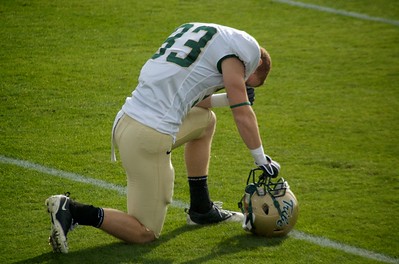
Image: “Tribe Prayer” by sethhepler is licensed under CC BY-NC 2.0.
 The Dandelion Way