Darkness sought to overcome the light
But Christ is risen! Halleluiah!
Fear sought to cloud God’s peace
Hate sought to destroy love
Death sought to triumph over life
But Christ is risen! Halleluiah!
Halleluiah!
This Easter morning, this is our prayer, this is our cry before the majesty and mystery of the Resurrection: “Halleluiah!”
“Halleluiah” means “Praise God!”
“Praise God! God is good!”
“Halleluiah” – It’s an ancient cry, of rejoicing, of relief, of awe and astonishment before the tremendous, transcendent, transformative power of the Holy One Beyond All Name.
“Ha lle lu iah.”
But let’s not forget what we were singing and praying last week, during Palm Sunday, and through all the troubles that Holy Week brings us through: “Hosanna!” That’s what we were singing and praying and crying out.
“Hosanna!” Which means “Help us! Save us!”
Help us, Jesus! Save us!
That is the prayer of distress, of desperate hope.
The journey of Holy week, this ancient sacred cycle that leads us to Easter, begins with Hosanna and ends with the triumph and relief of Halleluiah – it is about the metamorphosis of Hosannas into Halleluiahs.
And you know what? You can’t get to Halleluiah any other way.
Halleluiah has no meaning without Hosanna.
We wouldn’t need Resurrection if we lived in a world free of crucifixion.
You can’t get a butterfly without a caterpillar, and without a chrysalis.
Every metamorphosis requires a chrysalis. The metamorphosis of the incarnate Creator into resurrected form beyond the bounds of a single life: this is the ultimate metamorphosis, at it took a very dramatic chrysalis.
So, let’s talk about metamorphosis.
You start with a caterpillar. It goes into a chrysalis, where it metamorphoses into a butterfly. But when a caterpillar builds a chrysalis around itself, it’s not like that chrysalis is just a cozy sleeping bag for taking a nice nap while pretty wings sprout.
No. A chrysalis is a kind of crucible. Enclosed in that chrysalis the entire body of that caterpillar brakes down – it liquifies. It dissolves into – well, the scientific term is “bug goop.”
The caterpillar turns into bug goop. It’s like death and decay all at once.
But then something amazing happens.
Held in that chrysalis, the liquified being of what was once a caterpillar gets knit back together into a new form with new life and a new horizon of possibilities.
What was once bound to the earth is now bourn up into the sky.
And the chrysalis is cast off …
What looked like a tomb was actually a womb for new life – new life in a new realm.
So, a for caterpillar to become a butterfly…
It must first die as its old self …
And then get knit together again in a new way … and emerge again, reborn … then it can cast off that chrysalis … and fly.
So too with the metamorphosis of Jesus into the resurrected Christ. He had to be crucified, die, and be buried. That tomb became a womb for new life. Which he cast-off, like a chrysalis, empty, to rise in full glory.
Christ’s metamorphosis serves as a pattern and a promise for us, for the transformation we participate in when we follow in the way of Jesus.
In the words of Richard Rohr:
“In the resurrection, the single physical body of Jesus moved beyond all limits of space and time into a new notion of physicality and light – which includes all of us in its embodiment. In the resurrection, Jesus Christ was revealed as the Everyman and Everywoman [the Everyperson] in their fulfilled state.
“As the theologian St. Maximus the Confessor (580-662), put it, ‘God made all beings to this end, to enjoy the same union of humanity and divinity that was united in Christ.’”
St. Gregory Palamas (1296-1359): ‘God revealed the Christ in Jesus so that humanity could never be separated from the pattern that he portrayed.’”
Athanasius (298-373) put it this way: ‘God in Christ became the bearer of flesh for a time so that humanity could become the bearer of the Spirit forever.’”
- From Richard Rohr “The Universal Christ” pgs 177-179
This is what is accomplished through Christ’s Resurrection.
By grace, as followers of Jesus, we each get to grow into this astonishing potential, in our own ways, in our own time. But this is not always comfortable. Because it means we must pass through the chrysalis of transformation. We must start with Hosanna to be re-formed into Halleluiah.
To paraphrase the Apostle Paul, in following Jesus, we follow him through the passion and death and descent before emerging reborn:
Our old selves die with Christ so that with Christ we rise,
transformed into new life,
full to overflowing with the power of the Love Supreme,
the Eternal Spirit in which we live and move and have our being.
But … let’s be honest … sometimes that old self feels pretty comfortable. We’d rather not have to change, it’s alright to just mooch along eyes down, in endless cycles of slow self-centered suffering.
Or else, yes, there’s the risk of getting stuck in the liquification stage of metamorphosis. Have you ever felt like bug goop? When you’re feeling like bug goop it can be hard to imagine feeling any other way again.
Now, this isn’t just abstract and metaphorical. If we dare to witness Christ’s passion, we must confront all the forces in this world and within ourselves that crucify. And we have to feel something of all there is to feel about that: agony, guilt, rage, despair, abandonment, distress, dread, disillusionment, dissociation. As Psalm 22 puts it, we can feel “poured out like water … bones all out of joint, heart turned to wax, melting out …”
So, thank God we know that’s not the end!
Thank God we know that by God’s grace and goodness and creative power manifest through Christ, what can look like the end is not the end, but the chrysalis for resurrected life.
So, if we dare to cry out Hosanna – God help us! Save me, Jesus! – God takes it and reforms it and gives it wings.
Now, if we have not yet experienced this resurrected life, we can still claim it just the same. Hope against hope.
Sing out “Halleluiah!” as an act of defiance.
Have faith in a resurrected Christ as an act of refusal, refusal to allow the forces that break us down to break down our courage to hold on and keep going.
But if we have indeed experienced this transformation in our lives, even just glimpsed it, then we know this “Halleluiah!” What is there to say, to sing, but “Halleluiah!”
Darkness sought to overcome the light
But Christ is risen! Halleluiah!
Fear sought to cloud God’s peace
Hate sought to destroy love
Death sought to triumph over life
But Christ is risen! Halleluiah!
Thanks be to God
(Delivered Easter Sunday, 2023, by Rev. Nathaniel Mahlberg, at the United Church of Christ at Valley Forge)
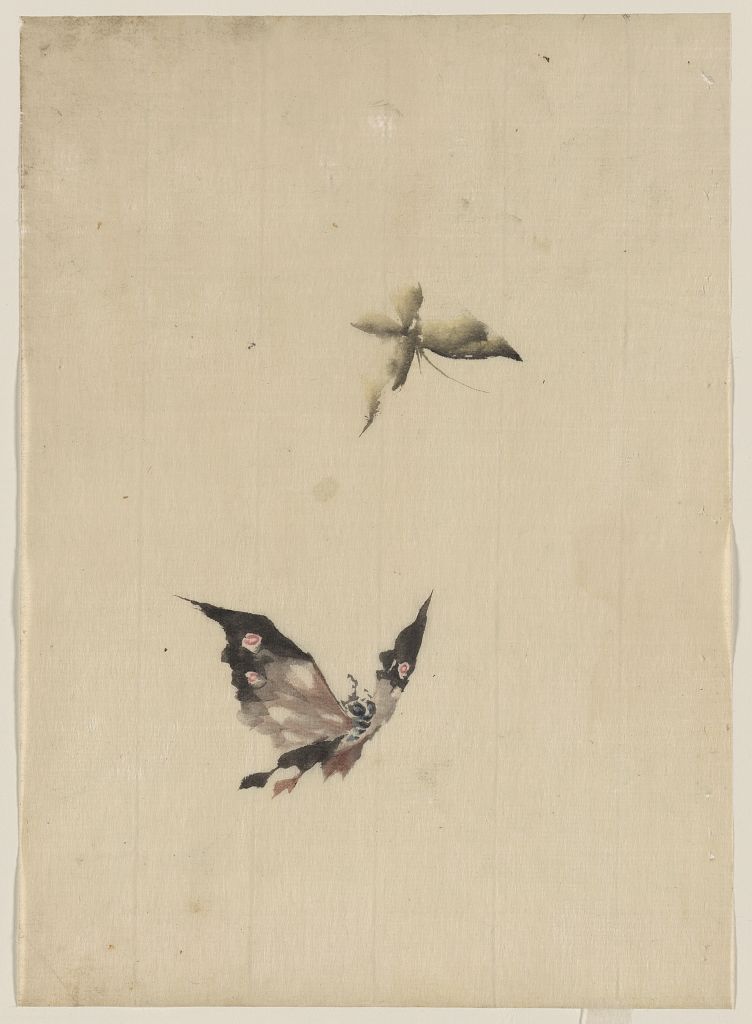
Image: “Butterfly and Moth” by Katsushika Hokusai (1760-1849), Library of Congress
 The Dandelion Way