A few weeks ago, Leigh Murray hosted a beautiful retreat focused on silence, centering
prayer and reflection for an evening and day together. At the end of our time, Leigh asked
us how we had been doing with our centering prayer practice. After 18 hours of silence, I
said with great confidence and a wee hint of humility “I’ve nailed it!”
A quick look through Instagram and Facebook and we see a lot of highlight reels, including
those we post ourselves, of us living our best life, living the high life.
But how real is the highlight reel? How much time do we wish to spend with someone who
is always living the high life or living life perfectly? How do we keep the highs from being
too high?
What I failed to say at the retreat was that I thought “I’d nailed it” for a few minutes across
18 hours of silence! The comedic open goal was too hard to resist! Revealing the
challenges of my wandering mind would require vulnerability, not to mention humility, to
share my true experience.
On the other end of the spectrum, we have our daily annoyances and grievances of a light
bulb blowing, or your Xfinity cable box not working again or setbacks in your daily
schedule, your kids getting sick, a flat tyre, parents taking a fall, or your own health
concerns. How do we keep the lows from being too low?
A dear friend of mine, Sholeh Dadressan who was born in Iran, introduced me to the term
‘Sabook begeer’ which means to hold it lightly. Holding fast and not getting too carried
away with any successes and not getting too despondent when things don’t work out or fail.
It’s all learning and gives us the courage to try new things and put them out in the world.
This idea is one of detachment or setting ourselves apart from the outcome. In his book
Think Like a Monk, Jay Shetty says that “detachment is not that you own nothing, but that
nothing should own you. The greatest detachment is being close to everything and not
letting it consume or own you.”
My wise friend Kass will often say ‘fortunately / unfortunately’ and I think a lot about that.
Unfortunately, softball was rained out on Sunday but fortunately we got to stay home,
make dinner together and enjoy a rainy Sunday afternoon.
Unfortunately, Matt lost his job in May 2007 but fortunately he was totally present and
available when I was on pregnancy bed rest and delivered Grant and Jenny.
Unfortunately, my position was eliminated at GSK but fortunately I received a severance
package and launched my own company.
Sometimes we need to take a moment to see the other side of the story.
Humankind has wrestled with these questions of balance and detachment across time,
history and cultural traditions and there are many fables around this in literature. My
favorite is an old Chinese parable about a farmer who lives on his farm with his teenage
son. He also has a beautiful stallion that he lovingly cares for.
The farmer enters his stallion into the annual country fair competition. His stallion won
first prize. The farmer’s neighbors gather to congratulate him on his big win. He calmly
says, “Who knows what is good and what is bad?” Puzzled by his reaction, the neighbors
go away.
The next week, some thieves who heard about the stallion’s increased value steal the horse.
When the neighbors come to commiserate with the farmer, they find him again very calm.
He says, “Who knows what is good and what is bad?”
Several days later, the spirited stallion escapes from the thieves and finds his way back to
the farm, bringing with him a few wild mares he has befriended along the way. To his
neighbors’ excited rounds of congratulations, the old farmer once again says “Who knows
what is good and what is bad?”
A few weeks later, the farmer’s son is thrown off one of the new mares and breaks his leg.
As the neighbors gather to commiserate with the old farmer, he once again reminds them
“Who knows what is good and what is bad?”
The following week, the imperial army marches through the village, conscripting all eligible
young men for the war that has just started. The old farmer’s son is spared due to his
fractured leg. The neighbors no longer bother to come around because they know what he
will say. “Who knows what is good and what is bad?”
Now we can anticipate that the farmer’s immediate reaction to each of these things was
reactive and mercurial, but he quickly restores himself to perfect balance between the highs
and lows, focusing on “what is” and having the wisdom not to waste too much energy
judging the moment.
“It’s neither good nor bad but thinking makes it so” as Edmund Burke famously said.
My point is that life is about balance. The good and the bad. The highs and the lows. ‘The
pina and the colada’ as Ellen Degeneres says.
But what is life balancing on? How do we build our ability to detach and recover quickly
from reacting to the moment to restore that balance?
I would like to propose that God is the fulcrum on which all things balance. Stable,
central, and constant in his unconditional love. The definition of fulcrum is “a thing that
plays a central or essential activity.” It came from the Latin word ‘fulcire’ (full-Qu-Ray)
which means to ‘prop up.’
In the scripture passage from Peter, he says ‘Cast all your anxiety on him because he cares
for you.’ We can pass on our anxieties because God cares for us as the ‘children of God’
and he will prop us up. ‘Your brothers and sisters in all the world are undergoing the same
kinds of suffering.’ We share the burdens of the world.
Look around our sanctuary and to those who joined us online – these are your brothers and
sisters in the world who are undergoing the same kinds of suffering. We share the burdens
of the world. And as Brene Brown said “the antidote to shame is saying ‘me too.’”
As I mentioned earlier, we have daily highs and lows but we all know they are not created
equal. There are some days that are memorable for their joys – marriages, graduations,
births while others are unforgettable for their tragedy, their pain and sorrow- the loss of a
dear one, a redundancy, a diagnosis, a home fire. And then there are the anxieties and
burdens of the mind and heart. How do you deal with the darkness and the dark night of the
soul?
Our scripture says “And after you have suffered for a little while, the God of all grace, who
has called you to his eternal glory in Christ, will himself restore, support, strengthen and
establish you. To him be the power forever and ever.”
What if we truly trusted that we are being restored even when we can’t see it or feel it?
What if we believed our darkness, anxiety and burdens can build our muscles of compassion
that we might know and share our experiences with those who walk with us?
What if I assumed that even in the depths of my despair, in the darkness of the dark night of
the soul, that God was supporting and strengthening me, rather than abandoning me.
Carrying me rather than letting me walk alone.
What if God is truly our fulcrum to balance us, to restore us, to support, strengthen and
establish us forever?
Author and Life Coach Alaric Hutchison gives us a response to this. “Your call to power is
to slow down and reflect within. Gather the peace within yourself before you go out and act
among the world. The feel-good feeling that lasts is only achieved when you yourself know
peace. Nothing is more powerful. This is why you have the highs and lows, the mood
swings, the transcendent ecstasy followed by the crash. It is because you have yet to
develop a foundation of peace for yourself that acts as an unmovable anchor in your life.
Establish this peace in your life and you will experience a whole new reality of the world
that flows with you in every way possible, rather than against you.”
If I follow his advice, I’d best get back to my centering prayer practice with humility and
daily, joyful diligence, and find the foundation of that peace, the fulcrum of faith within
myself and with God.
In our ups and downs, we are glorious, and we are united. With the grace of God and our
faith as our fulcrum to balance our highs, and lift our burdens in our lows, we can be
restored to wholeness and peace. Strengthen our faith in you dear God and our help us to
‘hold it lightly’.
Thanks be to God, Amen
By Angela Steel, delivered Sunday, May 22, at the United Church of Christ at Valley Forge
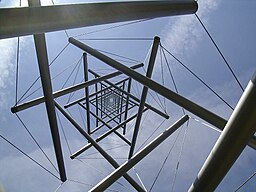
Image: Staka, CC BY-SA 4.0 via Wikimedia Commons, photo of Needle Tower II (1969) by Kenneth Snelson in Sculpture Garden at Kröller-Müller Museum
 The Dandelion Way