A mentor of mine when I was training to be a chaplain, Rabbi Leah Wald, taught us that the more we try to avoid emotions we don’t like, the more we constrict ourselves from feeling fully the emotions we do like. In other words, if we prevent ourselves from feeling our sadness or from being empathetic when someone we care about is feeling sadness, we are likely also closing ourselves off from feeling fully our happiness or from feeling empathetic when someone we care about is feeling happy. There’s an overall numbness and dampening in the life of our heart, that drains the depths out of everything we feel, both “good” or “bad”.
The good news is that the more we open our hearts to the emotions and the realities we may want to push away, the more our hearts are open as well to joy and to gratitude and wonder and delight. We can live more fully and wholeheartedly. Living fully and wholeheartedly means that, like the Apostle Paul said, we weep with those who weep and we rejoice with those who rejoice … and through it all we can know a peace that surpasses understanding – a deep peace, not a superficial peace, that comes with inviting God in to the mix and feeling our soul’s expansiveness beyond whatever emotions we feel in the moment.
This understanding of wholeheartedness and of peace goes against what I think a lot of us in our culture have been trained to believe. When Rabbi Leah taught it to us, it certainly challenged me. And it has helped me tremendously. I for one have had to learn that if I deny my sadness and if I fear my anger, they’re going to slowly eat away at my ability to live fully; and there’s no way to stay numb to sadness and anger and whatever else that doesn’t also slowly eat away at our ability to live fully.
I have also found the gift of prayer and of loving supportive relationships and accepting religious community in learning to experience the kind of liberating mercy that allows us to be honest about what we’re going through, about what we are feeling, without judgment, to hold space for what other people are going through and are feeling, without judgment, and to be embraced in all of that, in all our beauty and all our brokenness – to learn to allow ourselves to be embraced as we are by our Holy Creator, by the “Love Supreme” who brings true peace.
This is quite a different approach than one that is about suppressing and denying and condemning and covering over with shame and judgment the parts of ourselves that make us uncomfortable, for whatever reason.
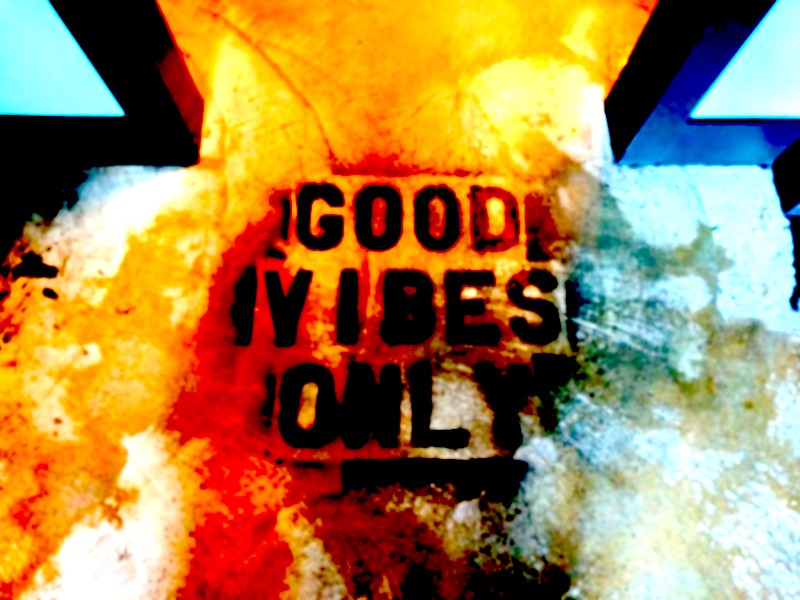
Last Sunday I did a kind of send-up of a “Good Vibes Only” ideology. “Good Vibes Only” has become a popular kind of lifestyle brand slogan. I thank God that’s not the slogan of our church, and it’s not our practice. But it’s very prevalent in different forms in our society, and I think many of us have some unlearning to do. At least that was the feedback I got after last Sunday.
So, this is part two. If you missed part one, I’m sorry, it was apparently funnier than this sermon is turning out to be. I hope this isn’t me just overthinking the whole thing, but this is so important, I want to be sure we explore this thoroughly …
Oh, but that does remind me of something funny someone told me recently. So, I do have one joke for you:
If you’re happy and you know it, overthink.
If you’re happy and you know it, overthink
If you’re happy and you know it, give your brain a chance to blow it
If you’re happy and you know it, overthink.
Anyhow, “Good Vibes Only” – that sounds nice, am I just overthinking it? Here they are just trying to make everyone feel happy all the time, and I’m this grumpy Gus coming along saying, “Ugh, c’mon, that’s delusional and damaging.” But, you know, it is. And it is important to say.
In a world with floods and fires and famines and pestilence and war and torture, we had better be allowed to cry for what is sorrowful, and to cry out for what is unjust, if we are to keep our hearts from hardening. Hard hearts, after all, cannot fully feel love or compassion, joy or delight, or awe before the astonishing beauty of this broken world.
Any ideology that denies us the full range of human experience is wrong, both morally wrong and psychologically wrong and theologically wrong.
So, let’s explore this some more.
In our culture there are new age-y versions of “Good Vibes Only,” and there are churchy versions, and probably others.
One new age-y version is the “Law of Attraction.” They call it a “law” as if it’s like a law of physics, which it isn’t. It’s a worldview that may not be a clear view of the world. According to this worldview, there are negative states of mind and positive states of mind; like attracts like (supposedly); therefore negative states attract more negative state, and positive attracts positive; we manifest our own reality (supposedly); so if negative things are happening to you, it’s because you have been harboring negative thoughts or feelings or beliefs; conversely, if you want positive things to happen to you, you need to keep it positive and don’t give energy to the negative. Among the feelings that “law of attraction” people say are “negative” are such things as grief, anger, fear, overwhelm, powerlessness, doubt. We must drive these out of our hearts.
“Good Vibes Only!” Or else.
Religious versions of this come in different flavors. In general, they say that everything that happens to us, happens to us because God has chosen to make it happen to us, according to what we deserve. This means that all good things that happen to us are rewards for our faith or virtue; and all bad things that happen to us are punishments for our lack of faith or lack of virtue. But we have a chance to change the outcome by praying to God for what we want; and if our faith is sincere enough and we are virtuous enough God will grant us our wishes.
Things like sadness or anger or disappointment or fear or overwhelm or doubt are signs of our lack of faith or lack of virtue. We must drive them out of our hearts.
“Good Vibes Only!” Or else.
Now, things like sadness, anger, fear, overwhelm, doubt, are all basic, fundamental responses to our human condition – you could also say our animal condition – in a world where plenty of things happen regardless of whether we like them or not, regardless of whether we deserve them or not, a world where good things happen to bad people all the time and bad things happen to good people all the time, regardless of whether they’re keeping it positive or not, and where most things that happen are kind of a mix of good and bad, negative and positive – who really knows? – the same goes for most people.
So, what these worldviews do is set us up for failure and then blame us for that failure.
They are elaborate ways to tell people exactly what abusers tell their victims: “You deserve this bad thing that’s happening to you.”
It’s a circular logic that blames the victim and blesses the victor.
There are countless heartbreaking stories of the consequences of this. For example, one that someone recently told me: someone getting hauled before their congregation at church and shamed for not having strong-enough faith because they have been praying and praying for God to cure their cancer, and their cancer has only spread.
There are so many ways that this is damaging. It’s important we unlearn it.
Now, let’s be fair. Can someone be so attached to pessimistic beliefs that they sabotage themselves? Absolutely.
And is someone stomping around spoiling for a fight very likely to find that fight? You bet.
And aren’t there ways that you reap what you sow? That one lie leads to another and another and another until you’re in a whole pit of trouble, and you really have no one to blame for or yourself? And isn’t it true that if you keep pushing people away you’ll end up alone? Or that if you live by the sword, you’re much more likely to die by the sword?
Yes, there’s truth to all that. But do people always get the comeuppance they deserve? Not in this world, apparently. And do bad things always happen because we are over-identified with “negative” feelings? Not close.
Now, on the “positive” side: We’ve probably all discovered that if we’re putting ourselves down that makes it harder to do hard things; but if we tell ourselves an uplifting story that makes it easier to do hard things.
And hasn’t there been research that shows that having a hopeful and resilient mindset can improve things like health outcomes and performance at school? Yes, there has. That’s why the placebo effect is real, for example.
But we’re talking about percentages of difference, on average. Plenty of people despair yet still get better; plenty of people hope and don’t. This falls far short of being a law of the universe that explains why everything happens.
We manifest some fraction of our own reality. There are billions of other factors at play, many or most of which are simply out of our control. Now, this fraction is an important fraction for us, because it can be something we have some power over. We can manage our responses to what’s happening to us in ways that are more or less helpful. And if we cooperate with others to work on larger social issues with some hope and perseverance we can have more impact on changing the conditions of our lives. And if we open ourselves up and invite God into the mix, we can discover doorways where we thought there were walls.
I hope you appreciate the point I’m making, and why it’s important.
We do not become more hopeful or resilient by judging ourselves when we have perfectly natural and valid feelings about a world that can be really hard. And how much of our own reality we have power over to manifest has a lot to do with privilege. And it’s just wrong to have a worldview that leads to the conclusion that kids in Ukraine or Ethiopia or Myanmar or Yemen are manifesting the bombs that are raining over them, or that they are somehow being punished by God. There are much more valid explanations for those sorts of things that we should feel sad and mad about. These are feelings that we should bring to God in prayer, and allow God to move us to action.
The way our scriptures model prayer is the opposite of a “good vibes only” spirituality. Our tradition invites us to be completely honest before God in fully expressing what is on our hearts, even – or especially – when that is messy.
“Blessed are those who mourn” Right?
“Blessed are those who hunger and thirst for justice, righteousness, right-relations.”
One of countless examples is the opening of the book of Habakkuk. The prophet does not turn away from what is distressing in his world, the violence and injustice. Nor does he turn away from God. But rather he turns to God in his anguish and cries out to God and even against God with raw honesty.
What Paul teaches about prayer in Philippians (Philippians 4:6-9) is about bringing all of ourselves before God, all of our needs, to then become blessed by a transcendent peace of Christ that embraces and pervades it all. He doesn’t say, “don’t worry about anything, just pray to God about it and if you’re worthy enough God will grant you your wishes.” No, he says that when we make our needs known to God, then the “peace of God, which is beyond all human understanding, will stand guard over your hearts and thoughts, through your union with Christ Jesus.” Our connection with Jesus will lead us to a peace that is beyond whatever we may be feeling at the moment.
Does this peace lead to complacency?
Not at all.
It leads to compassion. It leads to love. It leads to gratitude. It leads to virtue and truth and courage. These are all qualities to keep front and center in our hearts and in our minds, and to put them into practice, while also returning time and time again to the mercy of the Love Supreme who embraces all of who we are.
Thanks be to God.
 The Dandelion Way