So much of our lives, for most of us, is spent working.
Working … and dealing with the people we work with and the people we work for and the people who work for us, as well as preparing for work and going to work and coming back from work and recovering from work, and fretting about work, and losing work and being without work and searching for work, as well as housework and yardwork and repair work and childcare work– and do you ever dream about work? (for me it’s been the most repetitive jobs that have invaded my dreams, and I wake up in the morning and I’m like “Come on, subconscious, give me a break!”).
Work is a big part of our lives.
So often if you’re just chatting with someone you just met they’ll ask, “what do you do?”
“I brush my teeth twice a day, what do you do?”
Our culture tries to make work define who we are.
But as people of faith, do we have a different approach? It would be good to reflect on how our faith can inform our approach to work.
In other words, what does it mean to approach our labor and the labor of others by the light of the Realm of God?
To help us, let’s take a tour of the Bible to see what its various books have to say about work.
In the beginning, in book of Genesis, the Holy Creator of All that is and was and ever will be, after doing the work of setting creation in motion, day after day, takes a day of rest to just kick back and enjoy it all. This sets in motion a sacred rhythm of effort and rest.
All creatures with a brain need to sleep or they die – scientists don’t fully understand why. Most other kinds of lifeforms have periods of dormancy that are necessary for their survival.
The Laws of Moses prescribes for us all to honor and follow the necessity of regular rest. Every seventh day is to be a day of rest, a Sabbath, for us to rest and play and pray. It’s in the Ten Commandments, along with the likes of “Don’t Kill.”
Keeping Sabbath is a life-giving necessity – many babies are conceived on the seventh day; and the practice of protecting regular time to rest and remember life without the strife of our efforts is key to us keeping things in the kind of perspective that enriches our relationships with each other and with God. Practicing Sabbath helps us appreciate that the good things of this earth are gifts from God, for which we cannot take credit.
The book of Ecclesiastes challenges us to see our work from a God’s-eye-view.
If we see our work from the view of eternity, we are going to have to get real humble about things.
“What does the worker even really gain from all their efforts?” – asks the author of Ecclesiastes.
Anything we labor to make build may last for a little while – maybe a moment, a season– maybe more than a lifetime or more, if we’re lucky – but whatever it is, it is sure to one day crumble and fall.
We work and work to feed human appetites that are never satisfied.
We are constantly fixing and mending, sweeping and scrubbing to reverse the forces of an entropy that ultimately will overtake us all.
The book of Ecclesiastes calls this “vanity.” The Hebrew here is “hevel” – literally, “vapor,” “breath” – Ecclesiastes uses the intensive “Havel havalim” – the merest vapor, the most fleeting breath. This is similar to the insight in Buddhism, “Anicca” – “impermanence.” Nothing endures. Nothing.
But the wisdom of Ecclesiastes does not advise despair:
“What does the worker gain from their efforts? I have seen the task God has given humanity to keep us occupied. God has made everything suited to its time. Also, God has given human beings an awareness of eternity; but in such a way that they can’t fully comprehend, from beginning to end, the things God does. I know that there is nothing better for them to do than to be happy and enjoy themselves as long as they live. Still, the fact that everyone can eat and drink and enjoy the good that results from all their work, is a gift of God. I know that whatever God does will last forever; there is nothing to add or subtract from it. God has done it so that people will stand in awe before God.”
With that awe and wonder before the God, when we work we can find satisfaction, a deep fulfillment in what is possible through our work. When we work in such a way that we are freed to be in the moment with our craft, we can find the realm of Heaven in the bread we knead, we can find eternity in the sweep of our broom, we can find an abiding goodness, an inherent value to whatever it is we bring into being through our work that we offer to others.
There can be a prayer in the electric tempo of a kitchen at full clip in the lunch rush.
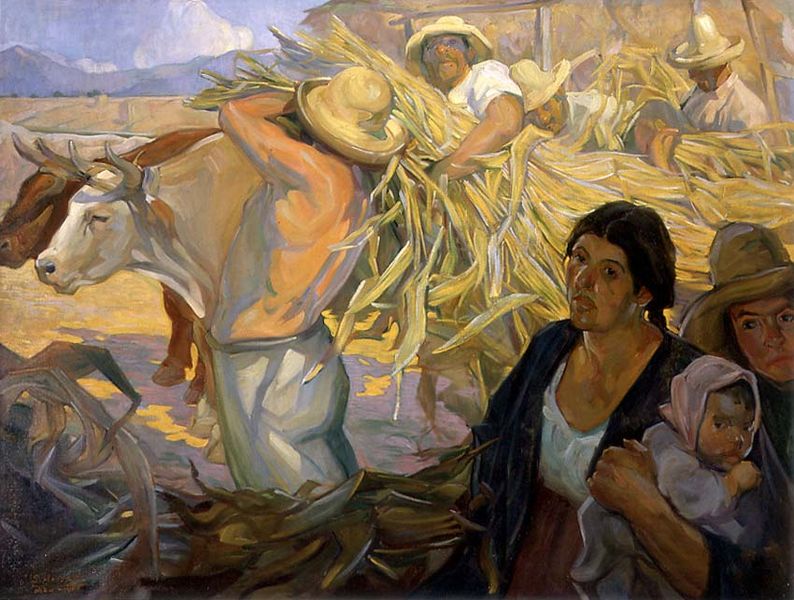
There can be a prayer in the singing fields when the harvesters are in full swing.
There can be a prayer in the cant and call of the construction site.
There can be a prayer in the focused stillness of desk work.
There can be a prayer in the ringing tiredness of our bodies and minds at rest after a good day’s work with something good to show for it.
That is enough.
Any attachment to riches only leads to unending anxiety, and strife, and violence. When we work for the sake of status, for the sake of wealth, for the sake of power, for the sake of some kind of enduring accomplishment, only suffering results.
But before I get too carried away here, C’mon, work itself can be suffering.
Yes, at its best, and if we keep God in mind, work can be fulfilling.
But when it’s bad, it’s a grind.
And at its worst – it can kill us, or it can kill someone else, or entire ecosystems, while someone else gets rich.
That brings us to the next theme when it comes to our biblical survey of labor by the lights of God’s realm:
Justice.
Hear these words from the Letter of James in the New Testament (5:1-8)
“Come now, you rich people, weep and wail for the miseries that are coming to you. Your riches have rotted, and your clothes are moth-eaten. Your gold and silver have rusted, and their rust will be evidence against you, and it will eat your flesh like fire. You have laid up treasure for the last days. [Imperminence, right?]
“Listen! The wages of the laborers who mowed your fields, which you kept back by fraud, cry out, and the cries of the harvesters have reached the ears of the Lord of hosts. You have lived on the earth in luxury and in pleasure; you have fattened your hearts in a day of slaughter. You have condemned and murdered the righteous one, who does not resist you.
Be patient, therefore, beloved, until the coming of the Lord. The farmer waits for the precious crop from the earth, being patient with it until it receives the early and the late rains. You also must be patient. Strengthen your hearts, for the coming of the Lord is near.”
If we approach labor by the lights of the Realm of God, we must care for a just treatment of workers and work, and we must do work that is honest and upbuilding, not driven by greed.
This is a huge theme in the bible: in the laws of Moses, in the great Hebrew Prophets, and with Jesus and the early Christians.
Our God is a God who hears the cries of those who have been enslaved or indentured, exploited or abused for profit.
And time and time again, in biblical times and in our present time and society, these cries are so often the cries of folks who are poor, folks who have less power due to prejudice, folks who are immigrants – those who are uniquely vulnerable to the predatory forces of greed. This is why Jesus and the Prophets are always lifting up how we treat people who are poor and people who are “the foreigner” as the litmus test of how we will fare before God’s judgment.
We could probably all do some commiserating around terrible bosses we’ve had. The tendency to petty tyranny can really become a matter of life or death in the exploitation of people who are in a very vulnerable situation. At its worse this is about using power to take for oneself more than one needs while leaving workers destitute and desperate.
This does not live out a faith in God, who does indeed provide enough for everyone. And calls on us to do the same.
This brings us finally to Jesus’ parable about the day laborers who work the harvest. The Realm of God, Jesus says, is like everyone receiving a full day’s wage simply for their willingness to help with the harvest when invited. This is, as the parable claims, “what is just.” “I will pay you what is just.” What “is just” is what is enough.
That’s scandalous to our usual ways of measuring value.
The economy of Grace cuts through our entitlement – that we ought to get more than others. Grace cuts through our resentment of others who get more or get the same or get anything at all, when we have deemed that they don’t deserve to share in the bounty.
Oh, there are all sorts of subtle ways we compare our value and worth against others and think that this is true in God’s eyes. A lot of it is in how we judge the value of our work against others, whether it’s our paid work or our moral work, works that show off our goodness or our wretchedness, displays what we deserve or don’t deserve.
So much time and energy and strife is wasted over this obsessing and fretting and fighting out of pride, or insecurity, or resentment.
We all leave this world empty handed.
And it is empty handed that we arrive at the gates of the next.
If it is God’s welcome that we meet there, that welcome comes to us by grace, not by whatever merit or esteem we think we earn through our work or our status.
It is only by mercy we are worthy, so it is with mercy that we should treat each other. This is humbling for all of us, no matter our class position.
But by the light of God’s Realm, this is all mere vapor, fleeting breath.
In the view of eternity, by the light of God’s realm, the value of our human lives and souls, is simply a gift, by God’s grace. It simply does not have anything to do with any of the ways we humans try to place value on each other and on ourselves, and our work.
God loves you. God loves us, each of us, all of you.
So let’s just relax.
Take a deep breath.
There’s a big harvest to take in. It’s huge, more than what everyone needs. God needs all hands on deck.
So let’s go out and get to work, whatever is your work to do – you do you, and we’ll all do it together.
And, for the love of God, let’s enjoy ourselves while we’re at it.
Thanks be to God
Image: Saturnino Hernán
 The Dandelion Way