When I was a kid, we’d always hear the Christmas story from the Gospels at least twice: at the Christmas Eve service at church, and then at home before we opened presents.
At home, with my extended family, when the call went out that we were going to open presents and everyone finally got corralled in the living room around the Christmas tree, one of the adults would find a bible and recruit a kid to read the Christmas story from Luke or Matthew.
So, when I hear the opening lines of this story about Caesar Augustus and his registration of the Roman world while Quirinius was governor of Syria,
I have a strong childhood memory of feeling, “Ugh, this is taking forever!”
When they started in on those long old bible words at church, that’s the point in the Christmas Eve service when the wooden pew would really start to feel hard underneath my bottom; or when back at home some poor cousin would be stumbling through that thicket of foreign syllables, that’s when my gaze would drift desperately at those presents under the tree. So close, yet so far away.
Now, the story always managed to pull me in. The Christmas story is a great story, after all, and it would lull me into at least a moment of timelessness. But those opening lines are quite a hurdle to get over for a squirmy kid – or a squirmy adult for that matter.
It takes some effort to try to recover some of the impact that the opening of this story would have had on Luke’s original audience. Because it would have had quite an impact. And I’m talking the opening lines.
When he opens the story by setting the stage with all this business about Caesar Augustus, and a registration, a census, and Quirinius, the governor of Syria, this would not have been some distant ancient history to the folks for whom Luke was telling the tale. In fact, it would have have seized the audience’s attention. This would have gotten them on the edge of their seats.
Because what Luke is making clear to his original audience is that the story he’s about to relate takes place in a fateful time of repression and revolt, a time of fear and danger and uncertainty.
You see, Jesus just so happened to have come along when the first waves of revolts against Roman occupation flared up in Galilee and Judea.
The Roman empire had conquered the area several decades earlier and set up Herod as their client king. But it wasn’t until around the time of Jesus’ birth and early childhood that Rome took the next big step and brought Judea and Galilee under its direct control as an official province.
And the census was key to Caesar’s assertion of his imperial authority. Its purpose was to set up direct taxation. This is definitely taxation without representation, but rather with a whole lot of repression – violent repression.
These new Roman taxes would have been on top of the taxes that the Jewish people paid to the Temple, which by and large they didn’t have a problem with. But the double taxation by a foreign power imposed a terrible burden, and it impose it at the point of the sword. This on top of other problems of exploitation at the time drove a lot of peasants into debt and desperation.
The census administered by Quirinius in particular is documented as the spark for a major violent uprising among the occupied Jews. The leader of this uprising called himself the “Messiah”: Judas of Galilee (no relation – it was a common name).
And this Judas of Galilee wasn’t the first so-called “Messiah.” Just a few years before this, there were at least two or three other “Messiahs” whose followers believed had been anointed by God to deliver their people from foreign oppression and become King of the Jews.
Each of these “Messiahs” took up arms and led war parties. Each claimed a divine mandate to drive out the Roman pigs that had trampled all over their homeland and were feasting on the spoils, befouling the holy temple in Jerusalem and beguiling and buying off the priests and political leaders, and driving the peasants to starvation.
These “Messiahs” sought salvation through the sword.
But instead of salvation, these “Messiahs” and their followers ran up against Roman legions well prepared to meet their attempts at insurrection with overwhelming force.
They all met the same fate that Jesus would years later.
Jeez, Reverend, merry Christmas to you too.
No, but really, considering all of this: Merry Christmas. I offer this context because it’s important to understanding the meaning of Christmas.
Because what was the end of the story for Judas of Galilee and the other self-appointed saviors, was just the beginning for Jesus of Nazareth and the Holy Spirit unleashed through him.
The contrast is clear from the start, from the story of Jesus’ birth. It’s no mistake, so make no mistake: through Jesus, God is doing a new thing.
The kind of salvation, the kind of liberation that is revealed through Jesus is of a different order and magnitude than the kind of salvation one seeks through the sword, through violent force, or through power or through wealth or status or through any other human force. These just bring another turn in the wheel of suffering. Rather, Jesus offers the kind of liberation for which we most deeply and truly yearn.
In the season of Advent leading up to Christmas, we prepare ourselves to receive the gift that comes through Christ’s birth. To help us with this preparation, our practice is to light a series of candles on each of the four Sundays in Advent. Each candle represents a dimension of the gifts we find through Jesus: Hope, Peace, Joy, & Love.
Especially this year, with war raging in the land that is so holy for so many, as I have been lighting our Advent candles in anticipation of Christmas, I have been doing so with sorrow on my heart. It has been impossible not to light these candles amidst the shadows and not feel sorrow for the fear and desperation and confusion and rage and grief many are suffering through.
Hope, Peace, Joy, & Love: these are such lovely and holy gifts. Deep in our hearts, I believe, everyone wishes for them, and my prayer is for everyone to enjoy them.
What Jesus does, and what his story does, is give us the opportunity to recognize not only these holy lights, in ourselves and in others, but also the shadows that seek to oppress them: the forces in ourselves and in our world that would deny and oppress Hope, Peace, Joy, & Love in ourselves and in others.
What are these forces? How would you name them? Forces within oneself, forces within society that oppose and oppress Hope, Peace, Joy, and Love? And in what way are we perhaps confused in looking to these forces for our salvation, rather than to God? And how does this bring suffering, for us, for others, for humanity?
What is war but the most horrific expression of the forces that would deny the gifts of Hope, of Peace, of Joy, of Love?
And yet, they live on, these gifts, these holy gifts of humanity, defiantly if they must, they live on. These flames shine amidst the shadows. This is what the stories of our faith keep reminding us.
For according to our faith, the very incarnation of God in human form, the very embodiment of God’s Love Supreme arrives where we least expect it, where it is most neded. The Holy Creator, in all Their majesty and mystery meets humanity in the most tender and vulnerable parts of the human condition. The Infinite is made intimate, revealing the saving power of Divine Love.
The story of Jesus challenges us to look for God’s human embodiment in a backwater town of a backwater province, suffering under the harsh conditions of foreign occupation, compromised and struggling to survive. We are challenged to look for God’s incarnation with a poor young couple traveling alone, with no one to give them refuge … soon to flee for their very lives and become refugees in a foreign land, as generations of their people have too often had to do.
At Jesus’ birth, the people who recognize the holiness of what is happening are not priests, nor preachers, nor politicians, nor merchants, nor generals, nor soldiers, nor rebels – they are all caught up chasing their own saviors. Rather it’s a bunch of shepherds – poor, dirty shepherds –who are pure of heart enough to hear and to heed the message to come and see the holiness of the Christ Child.
Throughout Jesus’ life – from birth to death, through his teaching and his living, through his resurrected life – Jesus is relentless in directing us to the least and the last and the lost as the location for the liberating power of God’s love. The least and last and lost among others, and among ourselves, and within.
As the embodiment of God’s holiness, Jesus invites us, challenges us to see how the love and mercy of the Divine embraces each of us, all of us, ourselves and our enemies, as we are – in all our beauty, in all our brokenness, in all our shadows, in all our light.
This is the Good News, my friends, that can help us to be free to grow in love and courage and purpose and peace, as we were created to be, one as beloved children of the living God.
Thanks be to God.
Delivered Sunday, December 24, 2023, by Rev. Nathaniel Mahlberg, at the United Church of Christ at Valley Forge
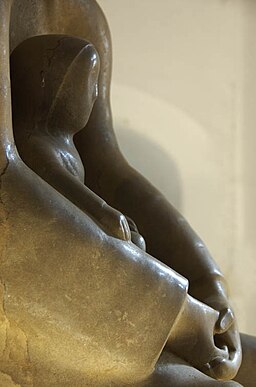
Image: Madonna and Child, Henry Moore, commissioned for a memorial for children who died in World War II, mira66, CC BY 2.0 https://creativecommons.org/licenses/by/2.0, via Wikimedia Commons
 The Dandelion Way