For these 40 days and 40 nights leading up to Easter this Lent we have been reflecting on and practicing what we need for renewal, for spiritual renewal – as individuals, as a faith community, as a society, as a world. A big theme that’s emerged these weeks has been Mercy. Just how important Mercy is to what our souls and our societies need for renewal. We need God’s Mercy – to allow ourselves to receive and to share God’s Mercy.
Now that we are singing the Hosannas of Palm Sunday – “God Save us!” – and poised on the brink of Holy Week, when we witness the confrontation between Jesus’ embodiment of God’s Love Supreme, on the one hand, and, on the other hand, the powers that seek to deny and dominate and destroy that Love, this is a good time to reflect on the ways that we human beings can be inclined to seek our salvation in all the wrong places.
When we hear the Palm Sunday story, keep in mind that at the same time as Jesus was entering Jerusalem from the east, Pontius Pilate, the Roman Governor and representative of Caesar, would have been making his triumphal entry from the west.
The Festival of Passover was a time when the Jewish people at the time often would get rebellious, so the occupying Romans were always sure to make a big show of power. The governor would arrive to assert authority for a few weeks before moving on to other regions of his territory.
Knowing all this, what does it mean about Jesus as a Savior that he doesn’t ride a mighty steed, but a donkey? What does it mean that he isn’t greeted with heralds and brass and show of arms, but with common folk crying out and celebrating with the simple things that are at hand? Remember, it was Caesar who was known as the “son of god,” and “savior.”
Then what does it mean that the first thing Jesus does in Jerusalem is march into the Temple and mess up the economy of sacrifices by which the temple priests mediate the people’s forgiveness from God? What does it mean that the Savior arrives as an anti-emperor and an anti-priest?
It is so common throughout history for people to seek their salvation through political power or through religious power, through the force of arms or through the confabulations of ritual, through the technology of violence or through the technology of divinity.
What is at stake in where we seek salvation, and through what means? Through Mercy or through what I want to call an economy of sacrifice that is based on insecurity.
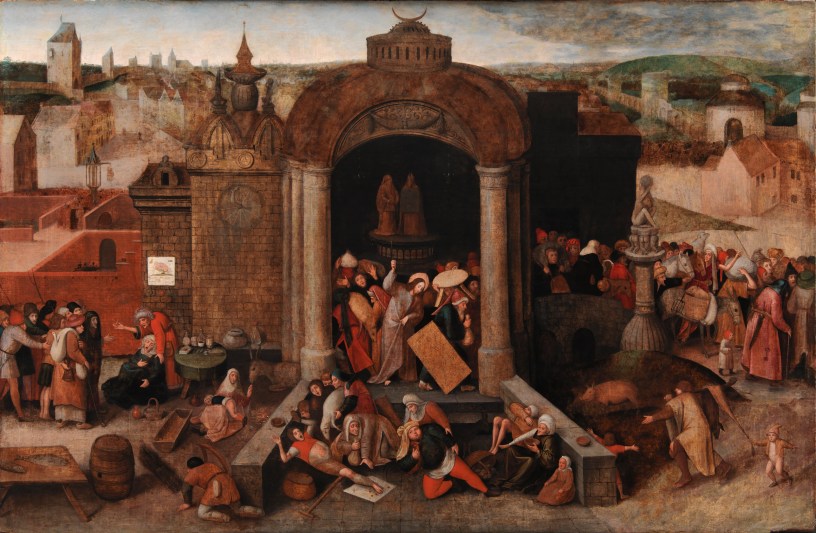
When Jesus overturned the tables of the moneychangers in the Temple, he was confronting a profitable system of religious violence.
God demands blood, the belief goes – a very common belief, to this day. To purge our sins or to punish others for their sins, we need to give God blood, through the sacrifice of a scapegoat. So, at the temple in Jerusalem pilgrims need to buy a dove or some other innocent substitute to present to the altar to die for their sins, to appease God’s wrath.
This kind of economy of sacrifice is almost always paired with a ruthless relationship with one’s enemies. With our enemies, we feel we get to embody God’s wrath against their sins, as their judge, jury, and executioner. Through this we can be granted a safety a security, this is the kind of salvation a king or warlord promises.
Whether we seek salvation through political power or religious power, it’s seeking a security that never really escapes from guilt or insecurity, because it requires cycles of violence. And it always results in exclusive and exclusionary sense of self-righteousness – with its anxiety that at any time anyone can find themselves on the outside of the in-group.
In the face of all this, Jesus weep and cries for Mercy.
“As Jesus came near and saw the city of Jerusalem, he wept over it, saying, ‘If you, even you, had only recognized on this day the things that make for peace! But now they are hidden from your eyes.”
Jesus taught the Way of Peace as being the Way of Mercy, that liberates us from the cycles of sacrificing others for the sake of our sins.
When Jesus turns over the tables in the temple, he is showing that liberation does not come through violent sacrifice but rather through the sacrifice of violence itself. There are echoes here of the great Hebrew Prophets that came before Jesus:
The Prophet Micah:
“With what shall I come before the Lord, and bow myself before God on high? Shall I come with burnt offerings, with calves a year old? Will the Lord be pleased with thousands of rams, with ten thousands of river of oil? Shall I give my first born for my transgression, the fruit of my body for the sin of my soul? God has told you, O mortal, what is good; and what does the Lord require of you but to do justice, and to love kindness, and to walk humbly with your God?” – Micah 6:6-8
Or Isaiah:
“What to me is the multitude of your sacrifices? Says the Lord. I have had enough of burnt offerings of ram and the fat of fed beasts … When you stretch out your hands, I will hide my eyes from you; even though you make prayers, I will not listen; your hands are full of blood. Wash yourselves; make yourselves clean; remove the eveil of your doings from before my eyes; cease to do evil, learn to do good; seek justice, rescue the oppressed, defend the orphan, plead for the widow.” – Isaiah 1:11-17
It’s an internal sacrifice rather than external, where we become free from forces within ourselves that keep us from living lives of mercy and peace and prayer, in alignment with the Ways of God.
Now, I don’t know if all this feel abstract or distant from our lives. This isn’t about some ancient and foreign religious or political practice, but a very common dynamic in any society where we seek salvation through “Caesers” or through “priests.”
What I invite us to reflect on, honestly, maturely, is if the ways we seek salvation, deliverance, security, liberation, spiritual renewal, are truly ways of Mercy, of the universal Mercy of God that Christ embodies? Or if there are still residues of expectation that there needs to be merciless sacrifice, either of ourselves or others.? Do we still subconsciously demand suffering – that we suffer for our sins, or that someone else suffers for our sins, or that our enemies suffer for their sins?
We can reflect on this question with Mercy, of course, rather than judgment. Our growth and spiritual renewal is an ongoing process, by the light of the Mercy of Christ. Especially in this world that can be so merciless, our deliverance is never a one-and-done experience.
So we continue to return to these blessed stories of Jesus, and ancient sacred cycles of our faith, trusting that through them we can learn and grow in God’s Mercy. For it is God’s Mercy that can set us free.
Delivered Sunday, March 24, 2024, by Rev. Nathaniel Mahlberg at the United Church of Christ at Valley Forge
Image: “Kristus uddriver kræmmerne af templet” Pieter Brueghel the Elder, 1570, Public Domain
 The Dandelion Way