There’s an old story about a man who had a dream one night in which he took a shovel and took his donkey and took a trip to a neighboring town. He made his way through the town as if he knew where he was going, until he arrived at a particular home, a modest house of some stranger. He went into the back yard and put his shovel in the dirt and started digging. Soon he uncovered a bag that had been buried. He opened the bag and found it was filled with glittering jewels – a priceless treasure!
The man woke up, and praised God for sending him such a good omen. He immediately picked up his shovel and hopped on his donkey and headed over to the next town. Now, the thing was, the neighboring town was Jewish, whereas the man was Christian, like the rest of his town. And sometimes there could be tension and mistrust between the two communities, as well as trade and so on. When the man arrived at the gate of the neighboring town, there was a guard who demanded to know why he was there. The man was so sure that God had blessed him with this dream, that he didn’t even think about lying to gain entry. He simply told the guard the truth about the dream he had, didn’t leave out any details.
The guard was astonished.
“The house you’re describing is my house!” the Jewish man told the Christian man.
“And last night I had the same dream, except I journeyed to your town and found a treasure buried in the yard of a home there.”
When he described that house in his dream, it was the Christian man’s turn to be astonished. That sounded like his home!
The both looked at each other, and laughed with delight and thanked God for such a blessing.
They each ran back to their own homes and each dug in their own yards and each uncovered bags filled with jewels.
I came across this story when I was a young man traveling through India, trying to get as far away as I could from the religion of my upbringing. I was led by dreams of spiritual treasure in foreign lands … but I was also motivated by a rejection of what I had inherited.
I had concluded that Christianity was morally bankrupt, spiritually dead, and intellectually superficial. By the way, I was 20 years old – and obviously pretty confident in my own moral, spiritual, and intellectual powers. (All later to be humbled).
But more than that, I was genuinely yearning – yearning for something I couldn’t quite name, that I deeply needed, that I hadn’t found in my Lutheran upbringing.
I was also genuinely hurting – hurting because of the judgmentalism and self-righteousness and aggression of so many American Christians, and the guilt and inadequacy that clung to me because of it.
I was genuinely seeking, and genuinely following inner guidance to search for spiritual sustenance embedded in ancient wisdom traditions from civilizations outside that of my ancestors.
I was seeking spiritual treasures in someone else’s back yard. And what I discovered – and am still discovering and rediscovering to this day – is the truth of this story about someone who set out following dreams of uncovering treasures in someone else’s land, only to realize that what they truly seek is to be found back at their own homes. But would that realization had come if they hadn’t first gone looking elsewhere?
In studying and practicing Buddhism in India, in particular, I was gifted with beautiful, sacred, astonishing, and strange experiences. I got to learn from certifiably enlightened teachers, who were at the same time very human. I was challenged by wisdom that I probably could have avoided if I had stayed at home. The teachings and practices of Buddhism are gifts to which I continue to return and from which I continue to learn.
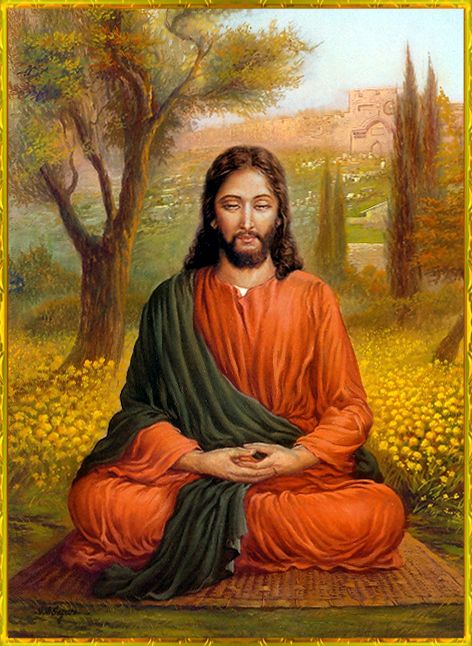
But what kept happening in my youthful trek through this far-off land was that Jesus kept showing up for me. I kept thinking about the Sermon on the Mount. Parables would pop into my mind like koans that held keys to startling new insights. I would remember the stories of Jesus’ mercy and compassion and healing and moral challenge in the face of suffering, and feel a tenderness in my heart.
Through what I was starting to learn and to practice from the way of the Buddha, I started to see Jesus fresh, on his own terms, free from the ways that some people have used his name to justify their own bad behavior, free from the chauvinistic things some people demand I believe about Jesus and the church or suffer eternal hellfire at the hands of an angry God.
I started to feel tenderly toward this Jesus, the Jesus I met on the sermon on the mount, the Jesus who would have embraced the Buddha as a soul brother. I also started to appreciate the ways they were different, the ways they were each working within very different cultures. I began to feel curious in a new way about this One God with whom Jesus was intimate. I began to feel curious about this Kingdom of God in Jesus taught about, in a such a riddling way, which was more mustard seed than monarch. I began to feel callings toward the Universal Christ.
At the same time, the experience of visiting India and studying the history and philosophy and diversity of Buddhism throughout Asia, I was deeply humbled by just how rich and complex and foreign the tradition. I soon had a deep respect for how encountering someone else’s religion was not just a matter of picking out a few souvenirs to show off back home.
Maybe the tradition in which I was raised also had a richness and complexity and diversity that I had yet to explore.
I also soon realized the grass is not greener on the other side of the fence. Religious corruption is a global phenomenon, I’m sorry to say. Other western seekers shared with me stories of abuse at the hands of Gurus and Rinpoches. I learned about mob violence of Hindu nationalists in India, and Muslim retributions. India has given birth to probably the richest inter-religious encounters on the face of the earth, but also some of the bitterest divides.
I learned that Tibetan Buddhists have not always been the most peaceful and compassionate people on the face of the earth. I learned about how Zen Buddhist institutions greased the wheels of Japanese imperialism in the first half of the 20th century and trained kamikaze pilots. I learned about the situation that unfortunately has only gotten worse in Myanmar where Buddhism is the national religion, and, as we speak, there are militias of ultranationalist monks helping to repress religious and ethnic minorities.
Does this mean religion is indeed the source of all evil?
No, my experience of becoming a little less ignorant of the Asian continent also helped me to learn that it doesn’t work to reject religion altogether. The “new atheists,” for all their flawless intelligence, haven’t learned the lessons of Stalinism and Maoism. Purifying your people of the ignorant superstitions of religion does not in fact bring about a world free of evil.
Apparently, religion is not the root of all things that are wrong with humanity. Yes, religion has too often been put into the service of racism, nationalism, militarism, sexism, chauvinism of all kinds – you name it. But so has science. So has every single political ideology people have cooked up.
One of the many teachings that are strikingly similar between Christ and Buddha, is that our harshest judgments of others should be a wake-up call to take an honest look at ourselves. They both teach that we can’t get free from the central crisis of the human condition – whether you understand it as “suffering” like the Buddha does, or as “sin” as Jesus does – by running away from it. Both Buddha and Jesus teach that the liberation we may try to find “out there” is in fact to be found very close to home – perhaps even, “closer to us than we are to ourselves”, to paraphrase some beautiful words from Augustine.
I realized there was nowhere I could go that was free and pure of the issues that troubled me. It wouldn’t help to run away from home. In fact, home was where I needed to return.
If I was to dig for buried treasure, I had to dig through my home dirt, dig through my own dirt, dig through the dirt I inherit from my ancestors.
For me that has meant going back into Christianity, with all of its baggage for me, and clearing away the teachings of Jesus, letting the Spirit of Jesus shine, and discovering the tremendous gifts of Grace here.
I’m sharing with you all this about myself because I know I am far, far from alone in being an American of Christian upbringing who has long been fed up with the hypocrisy and bigotry and abuse and power mongering that folks too often perpetrate in the name of “The Lord.” That’s why many of you have sought refuge in our dear church here. It’s also why many people have left and are leaving “the church” altogether.
It’s why I left. And it took a higher power to compel me to return. And I’m deeply grateful I have. Not because I particularly care about the institution of the church, to be honest. But because I care about Jesus, and I care about what I know the reality of God’s Unconditional Love can do to heal our hearts in this broken and beautiful world. It is because I returned to Jesus that I have been able to receive the healing Grace that I deeply needed, and continue to need. It is because I returned to Jesus that I have been able to be challenged to grow in Love with living communities of beloved people trying to live together in a good way through the struggles and glories of life.
If you’ve suffered because of toxic religion, I’m sorry. I want you to find the healing and home you need. What I have found is that very often an antidote is to be found near to the poison, like jewelweed growing next to poison ivy. In fact, the standards by which we condemn the hypocrisy and abuse and hatefulness of corrupted religion are in fact the standards Jesus taught and modeled, much like the Hebrew Prophets before him.
Now, Jesus doesn’t have to be for everybody. I don’t believe that. (Maybe that’s “heresy” for me to say.) But I do believe that it is urgently important that those of us who are drawn to the Love of Christ go as deep as we possibly can, and share the gifts we receive as generously as we can. This world needs more people formed by compassion, courage, love, humility, faithfulness, reverence, respect, gratitude.
One of the wonderful things about the story of two people who dream of finding treasure in each other’s backyards, is that they would not have discovered where their treasure was hidden if they had not met each other and shared their dreams with each other.
We live in a tremendously diverse and interconnected and cosmopolitan world thank God. We need to be able to talk with our neighbors of different religions, and learn from each other. We need to be able to be curious about each other, and appreciative of each other. We need to be able to challenge each other, and to encourage each other.
For those of us whose home is within Christianity, we need all the help we can get, from each other and from the wisdom of others, to help each other go deep enough to find and to share the life-giving and soul-saving gift within this Way of Jesus.
I’m grateful to you all for being in this together.
Jesus taught them, saying, “God’s kingdom is like a treasure hidden in a field for years and then accidentally found by a trespasser. The finder is ecstatic—what a find!—and proceeds to sell everything he owns to raise money and buy that field. Or, God’s kingdom is like a jewel merchant on the hunt for exquisite pearls. Finding one that is flawless, he immediately sells everything and buys it.” – Matthew 13:44-46
Once Jesus was asked by the Pharisees when the kingdom of God was coming, and he answered, “The kingdom of God is not coming with things that can be observed, nor will they say, ‘Look, here it is!’ or ‘There it is!’ For, in fact, the kingdom of God is within [or among] you.” – Luke 17:20-21
I laugh when I hear that the fish in the water is thirsty
You don’t grasp the fact that what is most alive of all
is inside your own house.
and so you walk from one holy city to the next with
a confused look!
Kabir will tell you the truth: go wherever you like,
to Calcutta or Tibet;
if you can’t find where your soul is hidden,
for you the world will never be real!
-A Poem by Kabir, a 15th Century poet and saint from Uttar Pradesh in North India. Kabir challenged both the Hindu and Muslim beliefs and practices in his day. His mystical witness influenced the Bhakti movement in Hinduism, the Sufi movement in Islam, and Sikhism.
Thanks be to God.
Amen.
Delivered Sunday, July 28th, 2024, by Rev. Nathaniel Mahlberg, at the United Church of Christ at Valley Forge
You can view video of this sermon here.
 The Dandelion Way