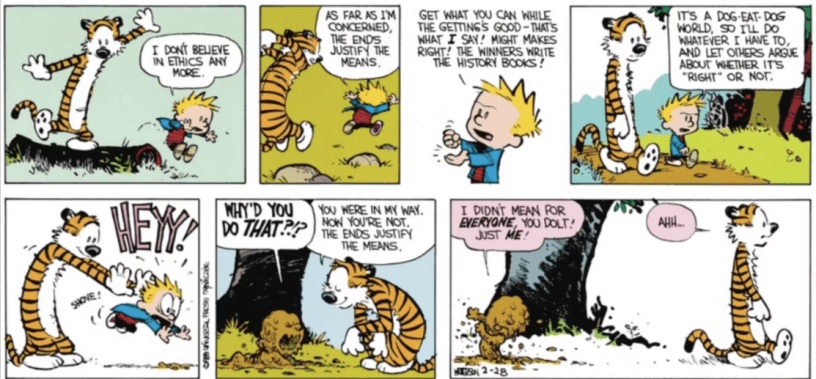
Consider this Calvin & Hobbes cartoon, by Bill Waterson.
Calvin and Hobbes are out on a walk. Calvin starts holding forth, like he does:
“I don’t believe in ethics anymore,” He declares. “As far as I’m concerned, the ends justify the means. Get what you can while the getting’s good – That’s what I say! Might makes right! The winners write the history books! It’s a dog-eat dog world, so I’ll do whatever I have to, and let others argue about whether it’s ‘right’ or not.”
Without missing a beat, Hobbes shoves him.
“Heyy!” Calvin yells as he lands face-first in the mud.
He gets up, caked in mud and furious: “Why’d you do that?!?”
“You were in my way,” Hobbes replies, “Now you’re not. The ends justify the means.”
“I don’t mean for everyone, you dolt,” Calvin yells, “Just me!”
Hobbes just walks away, saying, “Ahhh…”
Now, this is insightful.
Each of us has a strong sense of right and wrong when it comes to how others should treat us and those we care about. The question is whether we’re willing to admit that those same standards of right and wrong, of decency and dignity, should apply to everyone else, and should shape therefore shape how we treat others, including people who are strangers to us, people who we don’t even care about, people we don’t even like.
At a prior church I served, we hosted a winter warming center on cold nights for folks experiencing homelessness.
One of our regular guests got a kick out of proclaiming to anyone who’d listen:
“Remember, kids: You’re special … just like everyone else.”
It’d crack him up. He found it so funny, the seeming contradiction, the apparent tension, the ironic disillusionment perhaps, of realizing that when Mr. Rodgers spoke to him from the television screen, making him feel special just for being who he was, he was in fact telling each and every one else the same thing. If each and every one is special, wouldn’t that mean no one is special?
Yes, and no.
It takes a bit of a glimmer of a God’s eye view of things to see the truth of what’s going on here.
When we look at those throughout history who have been gifted with glimpses of a God’s eye view of things – including, by the way, Saint Fred Rodgers – they have each and all seen the essential worth and dignity at the heart of each person … at the same time as they have seen the radically humbling truth of just how brief and tiny each person is in the cosmic scope of things, and how fragile we all are and in need of each other. Jesus, prophets, saints, sages, bodhisattvas, and so one, have all been hit with this insight, and have gotten the message from it that we therefore have strong ethical obligations to one another, and those ethical obligations don’t privilege one kind of person over another.
When each of us knows in our bones that it is wrong for someone to try to take our lives, for example, or do us harm, or ignore us in our hour of need, we are realizing something that is true for other people just as much as it’s true for us. Each person is just as much an “I” as I am. And if I deny someone else the rights that I want for myself, I am undercutting my own ethical claim to those rights. Because, guess what? I’m not special. And neither are you. Or rather, we are each special, just like everyone else.
The reality is we are each just one of billions of other people, a drop in a wave of just one generation that quickly breaks on the shore of eternity and dissolves to be overtaken by the next wave and the next and the next, we come and go as generations have come and gone for eons.
What can be more absurd and false than to believe that somehow you are the main character in this whole cosmic drama?
We can see the absurdity of it when it’s Calvin in a cartoon. Yet can we see it when it’s we who are acting like that?
This is why we have to keep returning to Jesus’ ethical teachings, because it is in fact very easy to fall into the delusion of own self-importance.
In our time we have some very prominent and powerful people who genuinely believe they are so very, very special that the rules they want others to be judged by don’t apply to them. They even openly flaunt their hypocrisy as an assertion of their power.
There are influential people preaching the virtues of selfishness and will-to-power. Many in our societies are finding this attractive. The idea that we owe anything to anyone outside ourselves or our tribe is mocked or attacked in outrage.
But then catastrophe hits, a flood or a fire tear through from horizon to horizon, or the bombs start dropping overhead.
Suddenly, you are in desperate need of help. Suddenly, you realize just how dependent you are with others.
Who will be kind to me when I am the stranger? Who will be a good neighbor to me when I am alone and in need?
The majority of people are in fact basically decent. Yes, we’re all susceptible to being morally disappointing and to getting caught up in bad influences … but in fact most people want to do good and to be good, and are in fact pretty good.
We are living in a time that calls us to do our best to do good and to be good, for those near, for those far, and for those yet to come.
We are living in a time where catastrophic natural disasters, like the terrible hurricane that just tore through the southeast of our country, are in fact more frequent and more devastating. We are living in a time when political violence and the threat of political violence has increased in our country, and there’s this horrible phenomenon of mass violence. We are living in a time with devastating wars abroad. We are living in a time when the violence of war, and the consequences of economic and environmental devastation have been driving mass migrations of people seeking refuge. We are living in a time where the consequences of callous disregard for other people’s lives are high.
We are also living in a time when, for the majority of basically decent people who do feel some sympathy for some others, it all can feel all the more overwhelming because we can get instant and constant images and information about all the bad things happening around the globe (and the algorithms know our attention is more drawn to the bad than to the good.)
But however much it may feel overwhelming, however easy it can be to get numb, however easy it can be to get hard-hearted and join with those who are cynical and mean, when we genuinely invite God into our experience of it all:
Ah!
We can know we are not alone in this. We can know that the stirrings of our compassion in fact connect us with a wellspring of life and love far greater and more powerful than we can imagine, God who embraces all beings and bears all pain and bolsters all beauty.
We can know we belong to a God who calls us to do our best as we can to be good neighbors and to be good strangers, for those near and those far, and those yet to come. We can know that our God has always been calling people to grow in their humanity, in their times, amidst their crises, to respond with compassion and courage. We can know that while some people have always ignored this call, there have always been people of good will that have responded to it, and have done their part to help the power of love survive and thrive through the generations.
So, I’m going to keep on repeating the refrain: we must not let our hearts get hardened, we must let our hearts stay tender and strong, for the sake of our neighbors and for the sake of strangers, near and far.
We started with Calving & Hobbes. Let’s end with the late great Kris Kristofferson:
“Love is the Way” lyrics – by Kris Kristofferson
Deep in the heart of the infinite darkness
A tiny blue marble is spinning through space
Born in the splendor of God’s holy vision
And sliding away like a tear down [God’s] face
Closer you see the whole wide holy wonder
Of oceans and mountains and rivers and trees
And the strangest creation of many, the human
A creature of laughter and freedom and dreams
Now the warriors are waving their old rusty sabres
The preachers are preaching the gospel of hate
By their behavior determined to teach us
A lesson we’re soon to be learning too late
Look closer my brother, we’re killing each other
And we’d better stop and get started today
Because life is the question and life is the answer
And God is the reason and love is the way
Yes, life is the question and life is the answer
And God is the reason and love is the way
Delivered Sunday, October 6, 2024, by Rev. Nathaniel Mahlberg, at the United Church of Christ at Valley Forge.
You can view video of this sermon here.
 The Dandelion Way