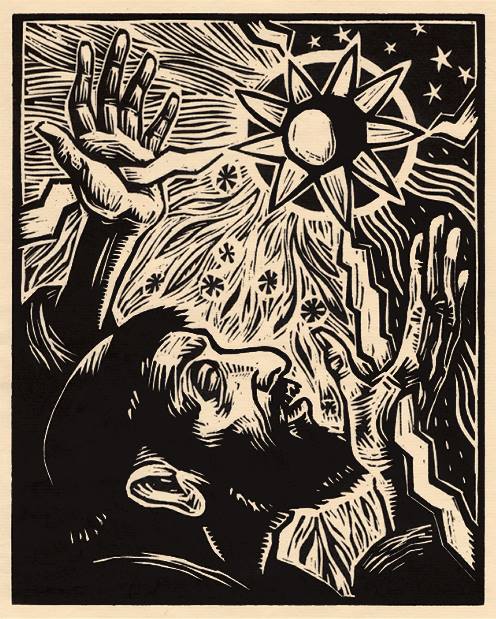
“Help!”
“Thank you!”
“Wow!”
These are the essence of most prayers. This is an insight from the writer Ann Lamott.
Most prayers at their heart are:
“Help!” or “Thank you!” or “Wow!”
That’s probably enough for a lifetime on this earth, with all our fullness of life and sorrows and sufferings and pleasures and joys as embodied souls and ensouled bodies making our way through life together under heaven.
We may have lots of details to add to these fundamental prayers, we may bring all kinds of words or music or movement to express them, but when you get down to the heart of the matter, these are the prayers of the heart.
Help, God! I need help, this feels like too much for me alone.
Thank you, God! Thank you, what a gift this is, beyond my deserving or not deserving, I’m appreciating the grace of the good things in my life, and of my life itself.
Wow, God! Whoa! This beauty, it’s overwhelming, this mystery, I’m astonished, overcome. Holy, holy, holy.
These are ways of expressing something fundamental about who we are in relation to God, God who is the origin and the destination of all being. These prayers express our dependence on that Sacred Source of all, our gratitude for that Sacred Source of all, our awe before that Sacred Source of all.
Yet there is an even more fundamental kind of prayer, at the heart of those prayers, and all our ways of relating with God:
“Here I am.”
“Here I am, O God.”
This expresses a fundamental posture of prayer, you could say. All of me, all of me, here in your Holy Presence, O God, open and trusting. “Here I am, God. Yes.”.
“Here I Am:” simply saying this before something great and mysterious and holy beyond oneself, this creates a posture of being receptive. It’s hard to say it and not stretch your arms out to receive and to behold. From it can come our thanksgiving, our cry for help, our astonishment … and what else?
In the testimonies of scripture, the Hebrew word for this is “hineni.” “Here I am.” Time and again in the stories of the Bible, this “hineni” is how the Prophets and the great ancestors of the faith respond when they hear God calling them. “Here I am, God.”
Then, amazingly, this is also how God responds back to them: “hineni.”
The human being says to their Holy Creator: “hineni.” And God responds, “hineni.” When it is God speaking often this is translated as “Behold,” but it is the same word and the same posture.
These scriptural accounts depict God as saying back to God’s creature: “Here I am, with you, when you are with me, the Great I Am That I Am, here with you in my Holy Presence.”
Then, what happens next?
This is what we will be exploring in some of these weeks of Lent. What we can learn from the testimonies in scripture about what can happen when one genuinely opens oneself to respond to a sense of call from God, a sense of stirring toward relating directly with God, by saying, “Yes, God, here I am”?
Now, first of all, I need to say that “the call” doesn’t always come as clearly as we heard it come to the prophet Samuel, who literally heard a voice calling him by name. There is a lot to learn from that story, because it is about his learning to discern when a call is in fact from God, to his surprise, rather than from a human source. But most of the time the things that lead us to turn toward the Divine and say “Here I am,” aren’t so literally voices. Rather: stirrings, yearnings, heart-tugs, proddings of the conscience, something deep and mysterious beckoning us toward a greater and more holy scope that could make us wonder, could this be from God?
Discernment is key here, with the help of wise mentors and friends.
One helpful question is: if you do turn towards this potential call and say “God? Is that You? Here I am,” what happens next?
The testimonies of scripture give us a picture of some positive signs to look out for when one says “Here I am, God.” An experience of consolation, of comfort. An experience of insight. An experience of healing. An experience of mercy and of grace, gratitude, awe, humility as well as uplift and purpose. These sorts of experiences may come right away when we pray in this earnest way … but they often come a little later, in the Spirits’ time.
There is one kind of experience that is most common in scripture when the ancestors of our faith turned toward God and said, “Here I am.”
That is the experience of conviction. Moral conviction. The experience of being convicted. As in, being seized by a moral claim greater than oneself and of one’s society that is both humbling of oneself and one’s society and uplifting of a greater purpose for oneself and one’s society. Notice how this is not only individual but also collective.
The Hebrew Prophets, when turned toward God and said “hineni,” were each seized by a clarity about something fundamentally wrong about how they and their society were living. They were shown what was out of joint with what is good and true and right and just and beautiful and holy. They realized that God was calling them to do their part to urge the moral arc of the universe to bend toward justice, to humbly serve the higher purpose of trying to bring themselves and their societies to live not for the sake of petty human powers and interests alone, but rather with God at the center of ourselves and all things – the Holy Creator of each and all, God who imbues all people with essential worth and dignity. The God who calls us, in the words of Micah, to “Act justly, love mercy, and walk humbly with our God.”
So, this Lenten season, as we pray and seek to turn and return to God, and say “Here I am, O God,” I encourage us to take seriously the earnest moral convictions that may come from this prayer. In addition to whatever consolations and peace and healing we need to receive for the wellbeing of our souls, one of the ways God works on us is by stirring us up.
Thanks be to God.
Delivered Sunday, March 16, 2025 by Rev. Nathaniel Mahlberg at the United Church of Christ at Valley Forge.
 The Dandelion Way