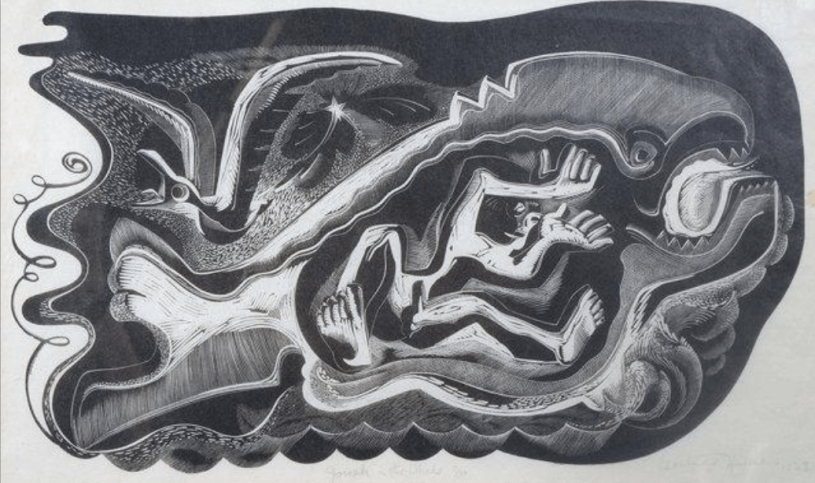
Carl Sandburg, that good old singer of the salt of the earth, once wrote a poem that begins like this:
If I should pass the tomb of Jonah
I would stop there and sit for a while;
Because I was swallowed one time deep in the dark
And came out alive after all.
If I pass the burial spot of Nero
I shall say to the wind, “Well, well!” –
I who have fiddled in a world on fire,
I who have done so many stunts not worth doing.
Sandburg goes on like this with other figures in history who are famous for their tragic flaws or for their spectacular failures.
In the end, Sandburg says,
God, let me remember all good losers.
The poem is called “Losers.”
God, let me remember all good losers.
Jonah has become one of my favorite figures in the Bible, for being a “good loser” – not in the sense of being gracious in defeat (he wasn’t even gracious in victory), but in the sense of being a loser who somehow did good. In the story of Jonah, his flaws get so nakedly exposed … and yet, despite himself, solely by the grace of God, Jonah actually succeeds as a prophet (which rarely actually happens, in the Bible or outside of it).
Jonah is a kind of blessed fool to which, perhaps, some of us, if we’re honest, can relate.
Maybe there’ve been times when we have sensed a higher calling on our lives, or we’ve been seized by a sacred conviction, a moral claim on our lives … and it just scared the bejesus out of us. Maybe we know what it’s like to glimpse a greater moral courage for ourselves, a greater religious clarity, and just turned and ran.
Maybe we pretended we didn’t hear the call and just let it go to voicemail … which we deleted, and hoped we never get the call again. Or, it’s like when we see someone at a gathering who we’d rather not talk to, so we avoid making eye contact, and try to hide in the crowd.
We may have learned, like Jonah, that this kind of strategy of avoidance, I’m sorry to say, doesn’t really work – it ends up causing a lot more problems than it solves for us.
When we are talking about being seized by a sacred conviction, when we’re talking about a possible call from God, we’re talking about nothing less than the true nature of reality bursting in on us, and the true nature of ourselves and the meaning of our lives coming to the surface. If we deny this, you better believe that denial is going to come with a cost.
We may find ourselves “swallowed … deep in the dark,” as Carl Sandburg put it. All we do in avoiding God’s call on our lives, in running or numbing ourselves from a sacred purpose, is make ourselves miserable. Likely we’ll make other people miserable too, until they get fed up and throw us off the boat. Yet the story of Jonah can give us the reassurance that, by the grace of God, we can make it out the other side and let God make some good out of our lives.
This Lent, we’ve been exploring what it can mean when we earnestly turn toward our Holy Creator and say, “Yes, God, here I am,” and then commit to the conviction that can come from this. “Here I am, God:” that’s the refrain throughout the testimonies of the Bible from the prophets and great ancestors of our faith; Hineni is the Hebrew word, “Here I am, God.”
Today, with the help of poor old Jonah, we can be real and honest, with grace and mercy, about the fact that it can be hard to say Hineni, and mean it, to have that kind of posture of openness before the Divine and receive whatever claim or conviction can follow in its wake. It can feel scary, or it can upset our egos, our plans, our very sense of self. We may want to turn and run.
So let’s explore this story of Jonah and see what it may have to teach us.
Jonah is often understood to have had two very human, very relatable, but honestly self-centered motivations that kept him from wanting to say “Yes” to God’s call on his life.
The first is fear.
The story in the Bible doesn’t say exactly what the Ninevites were doing or not doing that was so sinful and unholy and placed them in danger of destruction. But several times the story mentions their violence. This is a big theme throughout the Bible, starting in Genesis: The Holy Creator’s moral distress over the contagion of human violence.
The other very common theme for the Hebrew prophets is summed up by the prophet Ezekiel: “This was the guilt of your sister Sodom: she and her daughters had pride, excess of food, and prosperous ease, but did not aid the poor and needy. They were haughty, and did abominable things before me” (Ezekiel 16:49-50).
In any case, whatever exactly is at stake in the Ninevites’ judgment before God, Jonah has good reason to believe that if he goes through town telling the Ninevites to cut it out and stop being so violent and vicious and negligent toward God and their fellow person, it would be in character if they did not respond well and were perfectly willing to kill the messenger.
That’s a relatable fear, right? Especially when it comes to saying “Yes” to a profound moral and religious conviction that could set you at odds with some very powerful forces in society, we can fear a vicious response.
But, as the story of Jonah turns out, these fears did not come to pass. The people of Nineveh saw the error of their ways and repent and turn toward God. It’s like a miracle. They heard God’s voice through Jonah’s call, and took it to heart. As a consequence of their change of heart, they did not reap what they sowed, the chickens did not come home to roost, they did not get the blowback of an eye for an eye, a tooth for a tooth, a life for a life, oppression for oppression. Rather, they received mercy from their Holy Creator, and blessings for their renewed life in alignment with their sacred purpose.
Is Jonah happy about this? No.
He sulks and pouts.
It then became clear that the true reason for Jonah’s reluctance to receive God’s call is not that he feared the consequences of failure, but that he couldn’t bear the idea of success. Why? Because, success would mean that God is revealed to be a God of mercy and love, rather than of vengeance and punishment. Jonah, however, preferred his dark, apocalyptic revenge fantasy against his enemies. He is shown to be very attached to his own self-righteousness, which causes a hardness of heart that prefers vengeance over mercy.
It becomes clear this is not the true nature of God. It also becomes clear that the only person truly punished by this self-righteous judgmentalism is Jonah himself, who steadfastly refuses to surrender to God’s mercy.
Maybe some of us can relate to that as well, if we’re honest to God? Some of our religious and moral motivation may be in trying to feel better-than others? Or maybe we can relate to the reluctance in saying “Yes” to God’s claim out of a fear that God’s mercy may actually prevail. Maybe part of ourselves does not like the idea that the people we hate for their hardness of heart may in fact have a change in heart?
Yet guess what? Jonah still managed to say “Yes” to God enough to have a profoundly good effect on the world, by the grace of God. The book of Jonah is a kind of comedy, a tragicomic parable. Despite his naked flaws, Jonah is in fact more successful as a prophet than the great and noble and courageous Isaiah or Jeremiah.
What is clear is that it is not Jonah’s success at all. This all just reveals all the more clearly the power of God’s Mercy, and our absolute dependence on God’s grace, despite ourselves.
So, my friends, I hope and I pray we all feel held and guided by God’s Mercy and God’s Grace, above all else, and let that Mercy and Grace ease us out of our fear and our self-righteousness, so we may earnestly respond to God’s call on our lives, saying “Yes” to our deepest purpose, with faith and with courage. Thank you for the ways you have been doing this.
Thanks be to God.
Delivered Sunday, March 30, 2025 by Rev. Nathaniel Mahlberg at the United Church of Christ at Valley Forge.
Image art by Gertrude Hermes
 The Dandelion Way