The “Hallelujah” we sing on Easter Sunday was not in fact the immediate response of those who first encountered the Resurrected Christ, according to the various accounts that have been passed down through the generations. They got to “Hallelujah” eventually, but it wasn’t easy, in ways that maybe are relatable.
As we heard in the Gospel of Mark, the first two people to encounter the empty tomb and the angelic presence informing them about the resurrected Christ were two disciples both named Mary. How did they respond? By running away as fast as they could. They were too bewildered to bear it. And did they go forth and share the good news, like the angel instructed them? No! Mark tells us they didn’t say anything about it to anyone. Then when the resurrected Christ himself later appeared to other groups of disciples, they didn’t believe it, they couldn’t believe their eyes. They did not sing out “Hallelujah.”
In the other various gospel stories about Jesus appearing after his passion and death, the people who knew him best in life didn’t recognize him when they first saw him again. In John’s account, for example, Mary Magdalene thought the risen Christ was a gardener. As the Gospel of Mark put it, the risen Christ appeared in different forms to different people, which they didn’t at first recognize.
This is more than just doing a double-take because you’re surprised to see someone you didn’t expect to see in a new context. This is more than just: “Whoa! Jesus Christ! It’s you! I wasn’t expecting … I mean, um, I thought, you know, you’re dead…”
The resurrection stories are in fact stranger than that. I want to just name this, rather than pretending like it’s otherwise: these can seem like strange stories, especially to modern audiences. A better word than “strange,” perhaps, is “uncanny.” This is important to honor if we are going to take seriously the life-changing power manifest in the mystery of the Resurrected Christ, how it is that we go from fear or doubt or dread, to “Hallelujah!”
There’s this quality of the uncanny when people first encountered the risen Christ.
In some of the stories, when Christ first appeared to people in some form different than how they knew him in life, as soon as something shook the scales off their eyes and people woke up to the fact that – somehow – it’s Jesus as a resurrected being, he disappears. He vanishes. And the disciples are left with their mouths hanging open. “What just happened?”
There’s something dream-like going on – not in the way of un-reality, but rather of hyper-reality. You can tell from these stories that these are heightened experiences that are being described, more real than our usual sleepy awareness allows existence to be, but hard for our awareness to bear.
It may be like: I remember when I saw the Grand Canyon, it was the first time I experienced what it means when people say “I can’t believe my eyes!” There was this bafflement in my brain as it struggled to actually see at what my eyes were taking in. It all blew open the scope of my usual understanding. What was stretched out before me was too tremendous, too beautiful, too vividly real, too totally alive yet dense with countless generations of death and life under vastly powerful elemental forces, too utterly beyond the human realm to totally take in. Reality shimmered before my eyes. I was enraptured, astonished, heart breaking open before the unbearably sublime beauty for which there are no words: Holy, Holy, Holy.
I bet many of you have had experiences like this.
In a different way, I’ve had this kind of experience as well at the bedsides of people in the last moments of their lives. There’s a kind of heightened shimmer in the air, a sense of thinness between realms, an overwhelming presence of a tremendous mystery, as the soul takes leave of the body.
This is the kind of thing people can also often experience around birth.
I know I am far from alone in any of this, in having experiences that leave you with an uncanny sense that, “Oh my God, there is much more going on to reality than meets the eye.”
These gospel accounts of encounters with the risen Christ occur, you could say, in the uncanny valley beyond death and life as we know it.
Yet even more than this: the impact of these encounters with this Resurrected Christ-Being end up moving beyond astonishment and bewilderment and doubt into a soul-shaking revelation that changes people’s hearts and changes people’s lives. Just as it can change ours.
In one resurrection story from the gospels two disciples encounter a stranger on the road to Emmaus and get to talking as they walk the road together. Once they arrive after their journey, they invite this stronger to eat supper with them.
They sit down together and this man takes the bread into his hands and thanks God and blesses it and breaks it and gives it to them. With the breaking of the bread, it suddenly hits the disciples right between the eyes: it’s Jesus.
Once they’ve woken up, Jesus vanishes. The disciples are left remembering that when they first met this stranger on the road, their hearts burned in their chests as he was talking with them, telling them about the sacred story told by the prophet Isaiah about a holy servant of God suffering as a scapegoat because of the sins of humanity, with nothing but redeeming love and mercy in his heart. The broken bread broke open their hearts and their eyes and minds and souls to the reality this Resurrection-Being: “My body given for you.”
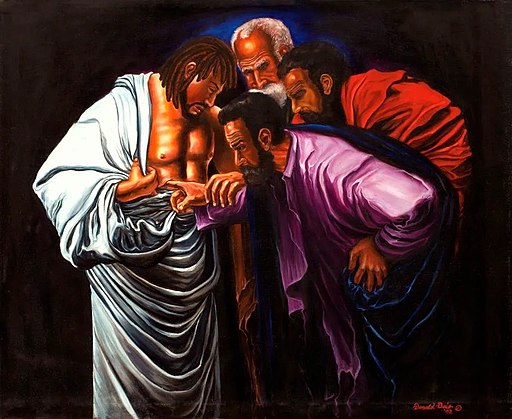
In the story of the disciple Thomas, he doubts the other disciples telling him that they have encountered the Risen Christen. Reasonable doubts, if you ask me – “I’ll believe that when I see it,” he says. And see he does, and touch. The Resurrected Christ appears to Thomas and allows him to touch his wounds, which causes the scales to fall from his eyes: “My Lord, it’s you.” This is a strange story, unsettling maybe, uncanny … and very important.
We cannot forget the trauma of Jesus’ death, not only for him but for his followers, who were not only terrified by the experience, and shattered by grief, but also wracked with the knowledge that they had abandoned Jesus in his hour of need. In life Jesus said, “that which you do to the least of these, you do to me,” and that’s what indeed happened to him. He suffered the worst that humanity dishes out on the “least of these,” the scapegoats that too many human societies find as a way of trying to somehow purify ourselves of our sins – those who are blamed for everything that is wrong, and are expelled or exterminated or disappeared or suppressed as a deluded attempt to purify ourselves. As we know, unbearably, this happens to this very day. But what the followers of Jesus realized, what Jesus showed them, was that the worst the humanity can do to try to destroy others, ourselves, even God … is not the end of the story.
The resurrection experiences of Jesus’ followers broke through to them, even when they didn’t see it at first, with the revelation of Divine Love embodied so fully that it embraced them in their brokenness, it embraced them with a mercy that made them whole and freed them from fear and guilt and hard-heartedness. They discovered that this embodiment of God’s Love goes far beyond one person or one group of people. It is a manifestation of the universal love of God, who loves each of us and all of us no matter what, despite how we may treat each other, despite how we may treat ourselves, despite how we may treat God, Godself.
This Universal Love bears with us, bears for us, all our suffering: all of our own suffering, all the suffering of all those we care about … and all those we don’t care about, even those whose suffering we actually cause or benefit from … the suffering of all humanity, of all this busted and beautiful world.
Jesus bears it all with us, for us, so that we have a holy companion to lead us through the valley of the shadow of death and on into resurrected life. All this reveals that nothing can separate us from the Love of God, ultimately, in the end. Nothing. Not even ourselves. Love wins. Sin does not win. Death does not win. God triumphs over sin and death itself.
When Jesus’ early followers encountered this embodiment of a God-scope of things, beyond life and death, they testified that it moved them into a new way of being, a new way of being centered on this transcendent Love and Mercy that Jesus revealed and embodied.
It moved them out of fear and into lives of moral courage; it moved them out of guilt and into grace; it moved them out of hard-heartedness and mean-spiritedness and prideful pettiness and into open-heartedness, generosity, compassion, humility; it moved them out of the constriction of doubt and into the expansive trust of faith.
So too can we be moved, when we let into our hearts the mystery of the Resurrected Christ.
This is where the “Hallelujah” comes.
Christ is risen! Hallelujah!
Delivered Easter Sunday 2025, by Rev. Nathaniel Mahlberg, at the United Church of Christ at Valley Forge.
 The Dandelion Way