It feels good to do the right thing, right? There’s a rightness to doing right, even if it’s hard. There’s a sense of fulfillment in being our best selves when we genuinely live out our values as children of the living God.
On the other hand, there’s a cost to ourselves when we don’t do the right thing and we aren’t living out our values. There certainly is a cost to others. We cause ourselves suffering when we increase or deny the suffering of others, whether or not we admit it.
I’m willing to bet that all of us have had the experience of having our own moral shortcomings become clear to us. Just like we probably all know what it’s like to do the right thing when it counts. It may be uncomfortable to admit, easy to deny, but if you have any kind of conscience, any kind of moral integrity or sense of values, you have had bad feeling we get when we realize we haven’t done right by those values of our best self, our soul self.
We realize we passed by someone in their need – we could have been the good Samaritan, but we weren’t. Or we realize we got swept up in our anger, or in our lust, and we said something or did something that was wrong, that hurt someone we care about or hurt someone we know we should try care about. Or we realize we got swept up in groupthink, the passions of all those around us, we went along with the crowd, and it led us astray in a bad way. Or we realize that we’ve been just standing safely at the sidelines as someone else gets bullied – we fear becoming bullied ourselves, we’re relieved it’s not us being targeted, so we don’t intervene – but that doesn’t sit well with our consciences, because we know that what’s happening is wrong that we should speak up and act, but we are letting our fear get the best of us.
And so on … This stuff happens. There are countless situations of our moral shortcomings being exposed as our lives play out in this human drama.
Maybe right now, if you’re honest with yourself and honest with God, your conscience is unsettled in this way about something. Maybe not, maybe you’re feeling that rightness about doing right. But maybe there’s something in your personal life that has unsettled your conscience, or maybe something in the larger world, where right now some very powerful people are acting against values a lot of us share in ways that are hurting people.
It’s guaranteed to happen one way or another in our lives. Guaranteed, if we’re honest with ourselves and honest with each other and honest to God. We fall short morally, we have moral blind spots that get exposed.
The problem is that it’s so easy to not be honest about this. We don’t like that feeling of admitting that we’ve done wrong or that we didn’t do right. So, we find ways to avoid feeling that discomfort.
Folks have all kinds of ways of denying, dismissing, deflecting the blame onto someone else. Right? It happens in small ways, it happens in big ways. That’s most of what’s happening in the stories that make the news, from the halls of power to the back allies. That’s most of what’s modeled by the people who capture the most attention and power, especially now in this cynical age. What’s even popular now is denying morality altogether: “how dare you tell me what to do, how I can or can’t treat others, how dare you try to make me feel guilty – I’ll do whatever I want. Never apologize, never back down, never admit mistakes or try to repair harm – it’s all their fault anyway.”
This isn’t the way of Jesus. This must not be our model. There is too much unnecessary suffering in this world and in ourselves for us to deny what is true and good and right and just. The way of Jesus leads us to a better way, the way of the truth that sets us free.
The heart of what can feel unbearable about admitting we’ve done wrong or we haven’t done right, is the feeling of guilt or shame. Guilt and shame come with a message we think it tells us about ourselves: I’m bad, therefore I’m worthless and unlovable. People don’t like feeling this way about themselves, of course, so we have all these strategies to avoid it by denying our moral responsibilities, one way or another. Or if we are willing to admit our sins, we then just feel wretched about it, and wallow in our unworthiness.
It is from this guilt and shame that the Way of Jesus frees us. Jesus reveals the radically unconditional and universal love of God – unconditional, universal love that frees us from guilt and shame; frees us to be who God created us to be, one in our belovedness as children of the living God; frees us to then act from that place of truth and integrity.
Unconditional. Universal. Big words; abstract seeming words. But the reality is very, very real – more real in fact than the deluded stories we tend tell about who we are and who other people are. When we taste this love-nature of our Creator, we realize, even for a moment, that nothing – nothing, nothing – separates us from this love.
To quote Thomas Merton: “In the true Christian vision of God’s love, the idea of worthiness loses its significance. Revelation of the mercy of God makes the whole problem of worthiness something almost laughable: the discovery that worthiness is of no special consequence (since no one could ever, by himself, be strictly worthy to be loved with such a love) is a true liberation of the spirit.” (New Seeds of Contemplation, pg. 75).
The knowledge of this unconditional love, the experience of this almighty mercy beyond the question of worthiness, helps us to be mature in owning up to our moral shortcomings. What’s at stake in admitting our faults is no longer so dramatic for us. When we know we are loved no matter what, it’s a lot easier for us to be honest to God, honest to ourselves, honest to others, when we fail to act with integrity. This all, in turn, helps us to have the courage and clarity needed to act with integrity, as best we can.
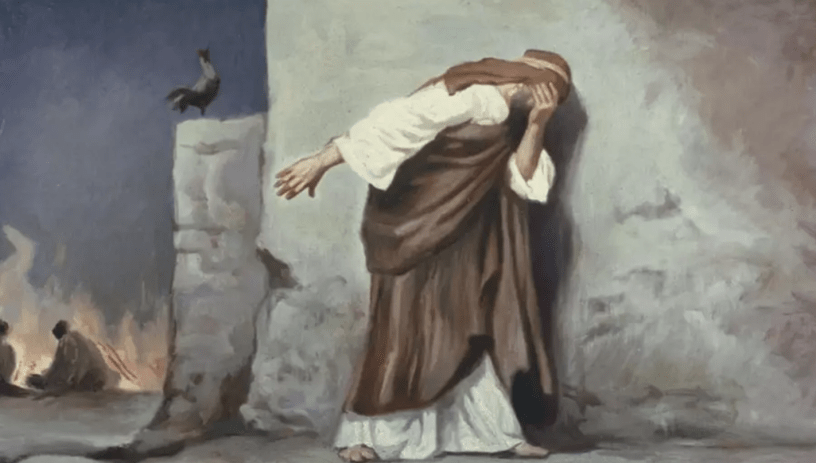
The epic dramatic illustration of the transformative power of this love through Christ is the contrast we see in Jesus’ disciples before and after the passion and resurrection. In the last days and hours of Jesus’ life, his disciples failed him in the most painful way. They had pledged to stick with their beloved teacher, no matter what. But when it came down to it, in his time of need, they were too afraid they would suffer the same fate as Jesus, they were too afraid of the bullies in power and of the angry mob, so they abandoned him. It’s all-too-human, very relatable.
Then fast-forward just a few months, and we see the disciples showing tremendous courage and clarity in the fact of the same fearsome authorities they had earlier cowered before. They were strong in their connections with each other as a community, strong in the values they shared as followers of the Way of Jesus. They boldly did what Jesus had taught them, and the Holy Spirit had empowered them, to do: comfort the afflicted and afflict the comfortable with the life-changing power of the gospel. (Acts 5:12-32)
What happened? Why this dramatic change of heart?
The mystery of the crucifixion and resurrection holds the key.
Through this mystery, Christ showed them the unconditional, universal Love of God, the almighty Mercy of our Holy Creator. He showed them that nothing any one can do to God can take away this love, this mercy. He showed them that death itself is nothing to fear. The truth of all this unlocked the hearts of the disciples. And it unlocked their hearts as a community, connected to the love of God they all share.
So too can this truth unlock our hearts. So too can this truth connected us to ourselves as a community centered around the unconditional universal love of our Holy Creator.
Lord knows we need it. Lord knows our world needs it.
Thanks be to God.
“There is no fear in love, but perfect love casts out fear; for fear has to do with punishment, and whoever fears has not reached perfection in love.” – 1 John 4: 18
Delivered April 27, 2025, by Rev. Nathaniel Mahlberg, at the United Church of Christ at Valley Forge.
 The Dandelion Way