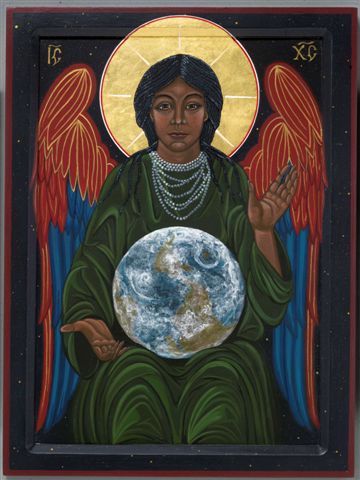
Who are you in God’s view?
At the deepest, truest level of the soul: who are you in God’s view?
This is the kind of question that needs some space. This is the kind of question invites prayerful reflection beyond our immediate reaction. This is the kind of question that challenges us to loosen up our expectations of what the answer may be, opening ourselves to a wider perspective far, far beyond our own, so we can let some Mystery in.
Who are you in the eyes of God, in God’s view?
The truth is guaranteed to be more than whatever story we usually tell ourselves about ourselves, and about others, as we scurry around in all our anxious strife and struggle, triumph and tragedy, frustration and boredom, elation and joy and hate and pride and prejudice, ignorance and love and devotion and courage and desperate need … and all the rest of everything that sweeps us up in this all-too-human drama.
Who are you in God’s view?
And who are you? And you? And you? And you?
Who is he? Who is she? Who are they?
Who are we in God’s eye view?
Who are those we know and who those we don’t know, those who are close to us and those who are far, those who are familiar and those who are strange, those we adore and those we detest?
Who are they in God’s view?
Who are we all – and I mean all – ultimately?
This is a question for prayer. Whatever glimpses we can receive about the answer are beyond words: A tremendous Mystery to any of our usual ways of reckoning. I want to honor this Mystery. I want to honor however it is your souls may be stirred and challenged when praying on these questions.
At the same time, I also want to honor and to share the testimonies of those great souls who have received deep insights about this question, and have tried to put them into words. Especially I need to share what Jesus revealed and embodied about this question of who are in the eyes of God, the nature of human beings and the nature of God in God’s relationship with us.
In God’s view, who you are is beloved.
In God’s view, you are embraced as you are, including your brokenness, which God brings to light, and including your blessedness. In God’s view you are embraced as you are, as beloved, in your brokenness and your blessedness.
In God’s view, who you are belongs, and belongs in a broad and deep belonging that is beyond, far beyond our limited earthly identities. We belong to God, our belonging is within God.
Who we are in a God’s view is both much less than we usually think we are, and much more. Our brokenness becomes impossible to ignore, as does our blessedness.
It is profoundly humbling to get a glimpse of ourselves in God’s view: we are shown to be fragile, fickle, faulty, fraught, confused, and very, very brief. This is why it can be easy to avoid this question and pretend God doesn’t exist, or pretend God just whatever we wish God to be. But sooner or later God is going to humble us.
At the same time, it is also profoundly uplifting to get a glimpse of ourselves in God’s view: our souls are greater than the cages of our earthly identities and identifications.
This is why Mother Mary, when she was astonished by the revelation of who she is in God’s sight, sang out to God: My soul magnifies you, O God; You humble the haughty and you uplift the lowly.
In God’s view, we are beloved, beloved in our brokenness and our blessedness. We are beloved and we belong. We each and all belong, to God, to nothing less than God, and – ultimately – we belong to God alone. In God we ultimately belong. In God we have our ultimate belonging.
All people seek a sense of belonging. All people suffer when they don’t find it. So, there is a lot at stake in how we find belonging. There can be a lot of anxiety and strife about it, as well as satisfaction. The human tendency is for us to find our sense of belonging in groups of other humans, of course. The challenge is that with groups of humans, our belonging is always defined by an “in group” and an “out group.” We often define who “we” are based on who we are not – “we” are we because we are not “them.”
This doesn’t necessarily need to be a problem. There’s nothing inherently wrong about finding belonging in a group of fellow humans; there can a whole lot of good in this, for the sake of love and care and survival. We need it.
But human sin has a way of getting in. Because we do have a tendency toward sin – sorry to break it to you – we often hurt and threaten each other. So, we can get fiercely attached to our “in group” and violently opposed the “out groups” whom we define ourselves against, whom we fear and hate for the threat they pose to us. We can also get anxious, violently anxious, about patrolling the boundaries between “us” and “them.” And we can get violently anxious about keeping our ingroup “in” – keeping our “us” pure of corrupting influences from the outgroups. We punish anyone we worry are imposters, intruders, double-agents, turn-coats, heretics, apostates.
Group identity through an ingroup and an out group often takes on moral dimensions: We are good, they are evil; We are enlightened, they are ignorant; We are just, they are corrupt; We are pure, they are scum; We are lawful, they are criminal; We are holy, they are demonic; We are human, they are monster.
Every group has these tendencies for harsh moral judgments in how they form their sense of identity. Some groups are wiser than others in how they manage these judgments, but we all have this tendency.
Sometimes the judgments are mild, just a roll of the eyes – “Okay, boomer” vs. “Kids these days.”
Too often the judgments are deadly, executed through violent force – just look at any of the many examples of politically motivated violence these days (if you are only thinking about the violence the “other side” has done against “your side,” you’re missing the point.)
Often times the judgments are hypocritical, because that’s how sin works: we detest and condemn in our enemies bad behavior we justify or refuse to admit in ourselves.
All of this is just one of the many expressions of human sin.
So, we shouldn’t be surprised that Jesus burned through it.
Jesus embodied a much deeper and broader belonging, free from the forces of sin, a belonging that came from his full knowledge of who we all truly are in the eyes of nothing less than God Godself.
We are all beloved. We are all broken. We are all blessed. We all belong.
After Jesus came along, we shouldn’t settle for anyone peddling anything less.
This is why Jesus went out to those cast out from his society, and to those born outside who would not be let in. Jesus crossed the boundaries set around every “in group” and “out group” in his time. Jesus reached across every division and embraced those fellow humans he encountered there.
Jesus reached across the ethnic divisions of his time, between Jew and Samaritan and Syrophoenician and Greek and Roman. Jesus reached across the gender divisions between male and female. Jesus reached across the religious divisions between Pharisee and Sadducee and Essene and all those they considered sinful and impure. Jesus reached across the political divisions between those who collaborated with the empire and those who rebelled against it.
As we heard in our scripture reading, the Gospel writers made sure we knew that Jesus’ group of closest disciples included both a tax collector and a Zealot, two people who would have hatedand resented each other before Jesus swept them into a greater belonging. The Gospels contain story after story of Jesus inviting the wrong kind of people into the holy family.
In the process Jesus managed to scandalize pretty much everyone. In the process Jesus managed to challenge pretty much everyone. In the process Jesus managed to call on the best of human nature from everyone who was prepared to respond, from each and every group, across each and every division.
Not everyone responded well to this call on the best of ourselves, as we know. But thank God enough people did.
This best of human nature is our capacity to love.
The best of human belonging, with whatever group, is our ability to love and care for each other, our people. Jesus showed how this love can deepen and broaden when we realize the wider truth about humanity and about our God, that we each and all belong to the same God, are therefore members of the same family.
Jesus challenged his followers to see themselves in the light of the One God of All Creation, whose sun shines and rain falls on the just as well as the unjust, the sinners as well as the saints, on everyone across all divisions.
Jesus challenged his followers to know this, experience this, and to live like this.
What does that mean?
Time and again, when Jesus taught about our greater belonging in the universal embrace of our Holy Creator, Jesus said:
“Therefore, be merciful,” Jesus says, “as your God is merciful.”
When we begin to know something of who we truly are in God’s eye view, the experience of belonging is an experience of mercy, which supports and challenges us to grow in having mercy toward each other.
Mercy has a way of softening all the extreme judgements we make to defend our limited human in-groups and out-groups.
Easier said than done, especially when huge forces in a society are pitting people against each other. Easier said than done, especially when we have good reason to be on guard against those we would be fools to trust, who do not care for our best interest or safety. Jesus did say, “You are sheep among wolves, so be as savvy as serpents and as gentle as doves.”
All of this is why we need our regular and ritual reminders of our wider belonging, so we can repent and return to our belovedness in our brokenness and blessedness. Communities of faith can be our practice, our exercise of this greater belonging and how it supports and challenges us to grow in mercy – despite the differences between us, despite how painful it can be to truly care for others, both within and without our
I have no doubt that Matthew the tax collector and Simon the Zealot managed to irritate and offend each other, even hurt each other, as they tried to be a part of this new community of broader and deeper belonging through what Jesus was showing them about God. This is why Jesus kept teaching his disciples about mercy, mercy, mercy.
The same is going to be true for us, as a community of faith.
Our society is faced with a crisis of belonging.
Who belongs? Who doesn’t belong? To whom do we belong? To whom do we not belong? Do I belong at all? The boundaries between many groups have been very barbed and laden with mines, merciless. Many people on various sides of the various divides are feeling the distress of the harm, even as many people are cheering it.
As follower of Jesus – God help us – we get to have a broader and deeper belonging, in God. Even when that’s painful, because we feel the bitter distance between the way things are and the way things could be. Even when that’s painful, because our hearts are become a little less hardened by callousness and meanness. As a community of faith, we get to be part of a sacred experiment in living according to this broader and deeper belonging, with mercy.
For in God’s view, we each and all belong, beloved in our brokenness and our blessedness. Thanks be to God.
Delivered Sunday, July 27th, 2025, by Rev. Nathaniel Mahlberg, at the United Church of Christ at Valley Forge.
Scripture Readings
Did you know that at least two of Jesus’ twelve closest disciples would have hated each other before they became a part of Jesus’ people? The Gospel writers make a point of telling us that Jesus’ disciple Matthew was a tax collector and the disciple Simon was a Zealot. In the political divisions of the time, these two groups were bitterly opposed. You see, the Roman empire occupied Judea and Galilee, as well as the surrounding nations. The Zealots were Jewish revolutionaries violently opposed to the Romans and to any of their fellow Jews who collaborated with Roman rule. Tax collectors were precisely that: collaborators with Roman occupation, who profited handsomely from it.
What does it mean about Jesus and his Realm of Heaven on earth that a tax collector and Zealot were both earnestly seeking to follow him together?
What does it mean for us now as people who seek to Jesus followers?
Galatians 3:28-29
You are all offspring of God, through your faith in Christ Jesus. For all of you who were baptized into union with Christ clothed yourselves with Christ. All distinctions between Jew and Greek, slave and free, male and female, have vanished; for in union with Christ Jesus you are all one. And, since you belong to Christ, it follows that you are Abraham’s offspring and, under the promise, sharers in the inheritance.
Matthew 10:1-4
Calling his twelve Disciples to him, Jesus gave them authority over foul spirits, so that they could drive them out, as well as the power of curing every kind of disease and every kind of sickness. The names of the twelve apostles are these, First Simon, also known as Peter, and his brother Andrew; James the son of Zebedee, and his brother John; Philip and Bartholomew; Thomas and Matthew the tax-gatherer; James the son of Alphaeus, and Thaddaeus; Simon the Zealot, and Judas Iscariot – the apostle who betrayed him.
 The Dandelion Way