“God is still speaking.” This is one of the core teachings of the United Church of Christ. When we say this, what do we mean?
For the coming weeks I’m going to explore this through the sermons I hope to offer. What can “God is still speaking” mean for us now, how we live our lives in our times and how relate to God and to Jesus? What does it mean for how we understand each other and ourselves and our society, our present and past and future, in the light of the Holy Reality of the Divine? What does it mean for our approach to our faith as followers of Jesus and its practices and traditions and spiritual resources?
“God is still speaking.” Our faith is centered on the Living God, the Ever-living and Ever-loving God.
Today I’ll explore what this can mean about our relationship with scripture.
Last Sunday when we gave study Bibles to our youth group, we offered each of our young folks this blessing, which we put in each of the Bibles. (This is a blessing, by the way, I adapted from one used by Pastor Michael, one of the previous Pastors here):
“May this Bible be a window for you through which you see God’s love for you and for all people. You are beloved. You belong. You have our love and prayers, from your family at the United Church of Christ at Valley Forge.”
Then there was a citation from the book of Romans 8:38-39, which is the passage I paraphrase every Sunday: Nothing separates you from the love of God as made known through Christ Jesus.
May this Bible be a window for you through which you see God’s love for you and for all people … I can testify to this.
There have been times when I have been prayerfully contemplating a passage of scripture, or have been earnestly discussing and even debating a passage of scripture with others, when I have been suddenly overcome with an experience of divine love, that is both personal for me, and universal for all.
And … there have been plenty of times exploring the scriptures when I have not experienced anything like that.
To be honest, if you just pick up the Bible and turn to a random page, you may not immediately get the impression that it is a window for God’s love for you and for all people. The passage may seem strange and confusing – these are ancient foreign texts after all. It could even seem in whatever passage you find that God seems to be the opposite of loving: like it’s saying that God is scary and very exclusive and exclusionary.
If we then just left with that impression, this would be missing the forest for the trees, missing the full scope of the Biblical testimonies, but also missing something important about the nature of scriptures themselves, and the nature of humanity.
If we understand the Bible to be a sacred text, what this means is that it can be a means through which humans experience and learn about the Divine. This does not need to mean that every little word and passage in it is inerrantly true with one fixed interpretation for all time.
It’s very important to a “God is still speaking” faith that we have an intelligent, thoughtful, and faithful approach to the scriptures. The scriptures are a library of various text written and edited and interpreted and reinterpreted through the generations, as part of an evolving revelation of understanding about God’s nature and human nature. The word “Israel,” means “those who wrestle with God.” The scriptures are products of that wrestling over many generations, which means they are shaped by very human forces, and have human fingerprints all over them, while at the same time showing us something of the mysteries of divine revelations with which the prophets wrestled.
The overall outcome of all this wrestling is the successive and ongoing realization of humanity’s belovedness and belonging before God. At the same time, the scriptures also show the tragedies of humans refeusing to accept this as true of ourselves or others, the suffering we cause for ourselves and others due to our attachment to sin. A lot of the Bible are accounts of how folks experience God in ways that help them survive with their humanity and dignity intact in the face of tyrannical and dehumanizing forces. Overall the message is: God wants for you and for all humanity to know our belovedness.
I want to share with you a wonderful way of expressing all this, which is from one of the Bibles for kids we will be using for our Sunday School Program. It is called “The Book of Belonging: Bible Stories for Kind and Contemplative Kids,” by Mariko Clark, and illustrated by Rachel Eleanor.
The introduction by Mariko Clark is a wonderful way of expressing what “God is still speaking” can mean for our approach to scripture:
“This is a book inspired by stories from the Bible,” she writes, “And what is the Bible? The Bible is a very old, very long book [a library, really], made up of many different types of stories. Some of these stories are told through poems and songs, some are more like history lessons, some are official royal records, and some are letters.
“But they all work together to teach us what God is like. What is God like? Well, that is a big question with many lovely, complicated answers – answers that you will likely spend the rest of your life exploring, because most of the time, these stories don’t just come right out and give us the answers … Often they show more than they tell.
“And they present to us who God is through the history of God’s family: people who were learning to trust God in the middle of their messy lives. They learned bits and pieces of who God is and they saved their stories for us to learn from. But God is too big to fit into even our most imaginative human words, so all throughout history, people who have tried to describe God say things like ‘God protects us like a mother bird sitting on her nest.’ Or ‘God is everywhere, like the wind.’ Or “God comforts, like a hug.’ We’ve tried to display that too, in our different illustrations of God.
“We’ve imagined God with a face that frowns and smiles, with arms that help and hold, with a mouth to breathe and speak. In some stories God is shown looking like a hovering bird, a covering cloud, or a brightening fire. But it is important to remember that we don’t know what God looks like. We only know what God is like. So each picture is a beautiful, true idea for our eyes to rest on while our hearts do the important work of learning to trust God’s big, mysterious fullness.
“One of the most special things about learning stories from the Bible is that they teach us about who we are. We get to learn the names that God has for us, the people God has made. The more we read the Bible, the more names we will learn. There are three big names that seem really special to God, three that show us again and again in the stories we’ve shared here:
Belonging
Beloved
Delightful.”
(The Book of Belonging: Bible Stories for Kind and Contemplative Kids, by Mariko Clark, illustrated by Rachel Eleanor, pp. 10-11.)
To this I say Amen! Amen!
This approach to God and to the Bible is doing some very important and faithful things. You’ll notice how it is very different from acting like every word in scripture is the direct and literal and unchanging word of God. It suggests a very different view of God than one that instills fear, judgment, guilt, shame, and damnation. And it creates a very different sense of who we are as people than one that is exclusive and exclusionary and inclined to self-righteousness.
Religious people can make idols of their sacred texts. It happens. Christians are no different, we can fall into biblio-idolatry.
Jesus was vigilant about this and had a clear standard for catching it: The core of the scriptural testimony for Jesus is Love – Love for God, Love for neighbor, receiving and sharing the Love-nature of the Divine. If we are using the scriptures to do something other than this, then we are missing the point. But we can trust we’re on the right path if our engagement with the testimonies of our tradition is helping us to know and share greater belonging; to know and share greater belovedness; to know and share greater delight.
God is bigger than the images we use for God. God is bigger than the words we use and the stories we tell about God. Yet our God is a Living-God, a Still-Speaking God, and has been actively at work through history in ways that people have sought to share through words and images and stories. When we engage with our sacred compendium of these words and images and stories, this can help us grow deeper in our experience and understanding of who God is here and now. The more of ourselves we bring to it, the better. So, we shouldn’t leave our intelligence at the door; nor our creativity and imaginativeness; we shouldn’t leave our messiness at the door, nor our cries and cares and outrageous and joys and desires and delights, and all the everything of our human condition.
The Biblical stories and poems and accounts are full of very raw human experiences, and complicated, fraught, and wonderful characters. They provoke deep and difficult questions. It’s all meant to be engaged with, honestly, and courageously, and faithfully.
We can do this best when we simply trust it is true that God is still speaking, God is still living, here and now, with us, among us, and beyond us, helping us to grow in our belonging and our belovedness.
For this I give thanks to God. Thanks be to God.
Delivered Sunday, September 14, 2025, by Rev. Nathaniel Mahlberg, at the United Church of Christ at Valley Forge
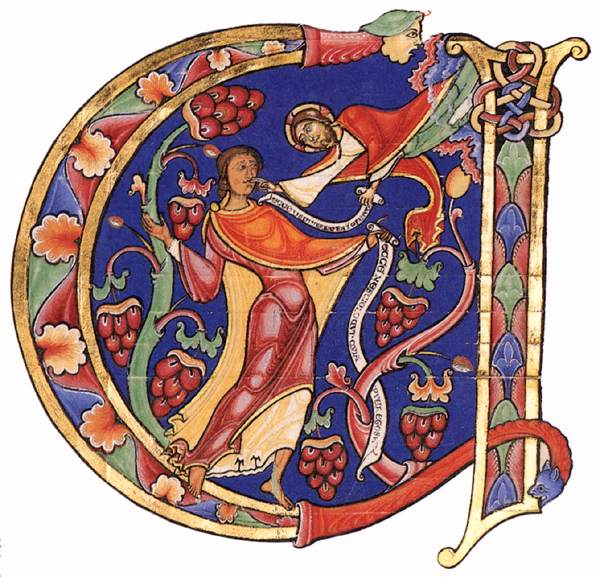
Image: Unknown Miniaturist, English (active 1160-1175 in Winchester), Winchester Bible, Public Domain
 The Dandelion Way