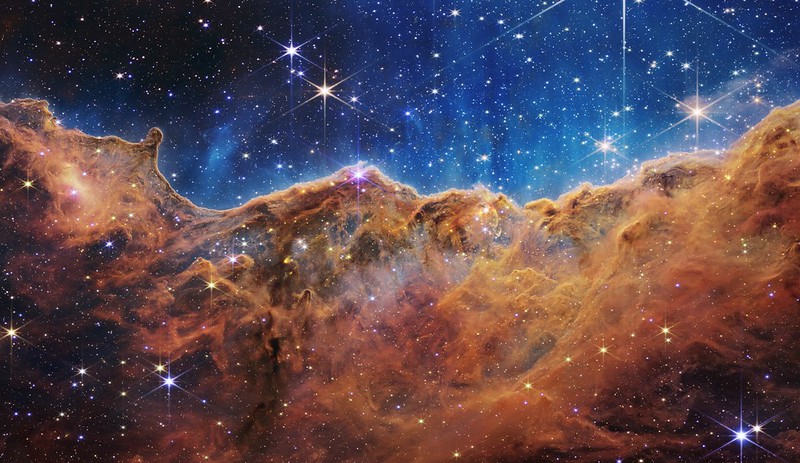
Wise folks through the ages have said that wonder is at the heart of genuine religious faith. “Awe before God is the beginning of wisdom” (Proverbs 9:10) Wonder, awe, reverence before Holy Mystery, before glimpses of divine transcendence, before experiences of sacred presence – these are all fundamental postures of faith.
It has also been said that wonder is the beginning of philosophy (by none other than Plato and Aristotle).
Wonder is also said to be at the root of scientific exploration. Many folks who pursue science will tell you about some formative experience of astonishment in their pursuit of scientific questions – looking through a microscope and seeing a teeming world of life in a single drop of ocean water, or looking through a telescope and witnessing the radiant bodies in the infinite reaches of the universe, or that “aha” moment when the formulas of a theory click into place and new dimension of the universe’s elegance reveals itself.
Wow!
All of this is no coincidence. The experience of wonder – or, as I like to say, the posture of being we call wonder; Wowness of Wow – this is the fertile common ground shared by faith and philosophy and science. Wonder open us to something fundamentally true and good about what it means to be human in this universe of God’s creation.
As many of you here well know, faith and science don’t at all need to be enemies threatening each other with annihilation. We have in our church community here quite a few folks trained in the sciences who work in the fields of science or medicine or technology. You all have very thoughtful and beautiful ways of understanding how scientific investigation in fact supports and deepens your life of faith in God.
We are in good company through the ages, from John Calvin to Pope Francis, from Isaac Newton to Werner Heisenberg, and countless other working scientists who are deeply people of faith and people of faith who are deeply impressed with the work of science.
Now, it’s also true that many religious folks through the ages have seen scientific investigation as a threat to their faith and have tried to suffocate it or burn it at the stake. Copernicus and Galileo were themselves sincere Christians at the same time as they were attacked as heretics by the Catholic church for arguing that the earth orbits the sun, rather than the other way around. (Catholic teaching has since changed to fit the science, by the way.)
For their part, many scientists have gone to battle against any and all religious thought as being fundamentally stupid and dangerous.
At the same time, both religion and science have been used to advance and to justify the most horrific actions through the ages – violence, racism, exploitation, you name it – injustices of every kind done under the cover of religion or of science. Tyrants have come in all flavors, from devoutly religious to resolutely atheist. So have your garden variety know-it-alls, with their sneering sense of superiority (which for the record I have never been, in either my atheist or my religious phases of life).
We’re not going to cure human sin by rejecting science, on the one hand, or by rejecting God, on the other.
Rather, if we truly care about what is good and what is true, as people of faith, if we truly seek to know and to follow our ever-living God, our still-speaking God, we should embrace ways that reconcile religious faith and the scientific pursuit of knowledge.
Wonder can be our guide.
Francis Collins is a biochemist whose life-work has been focused on exploring how genes work, for the sake of developing medical treatments for diseases. He was the director of the groundbreaking human genome mapping project at the National Institute of Health, and also led that federal agency’s efforts to develop a Covid vaccine in record time. Collins has written and spoken extensively about how his personal beliefs evolved from atheism to committed and thoughtful Christian convictions.
This is what Collins writes about what happened when his scientific pursuits deepened his understanding of the way the universe works:
“I found [the] elegant evidence of the relatedness of all living things an occasion of awe, and came to see this as the master plan of the same Almighty who caused the universe to come into being and set its physical parameters just precisely right to allow the creation of stars, planets, heavy metals, and life itself” (“The Language of God: A Scientists Presents Evidence for Belief,” by Francis Collins, pg. 199).
Notice the awe here, the wonder.
Collins is far from alone in this view, both among scientists and people of faith, through the ages.
There is a long and rich tradition of Christian thought that appreciates that our ability to reason and observe is a gift from God. As John Calvin put it, there is “implanted in the human mind a certain desire for investigating the truth.” When we rigorously use this gift for figuring things out about the world, we are using one of the gifts that God gave us. Our ability to reason and observe is one of the gifts we have that helps us survive and can help us thrive, and to create and invent and discover and delight. That’s what human being throughout all cultures and times have been doing, thank God.
The scientific method is a particularly rigorous and organized application of these gifts for reason and observation.
At its best, the methods of science are a humble and careful approach to finding out what is true. It’s about experimenting and exploring and gathering data to test if our idea is right. We have to show our reasoning and have that reasoning be tested in dialogue and debate with others. We have to be willing to be proven wrong, as well as willing to be proven right, or shone to be partly right and partly wrong, and to change our view of things to better fit what we find to be the facts, even if the picture proves to be surprising.
(This is of course at its best. Science is a human pursuit like anything else, subject to the flaws and limitations and pettiness of human beings)
None of this needs to be a threat to faith. None of this requires a materialist worldview, according to which the physical world is all there is. In fact, logical reasoning about the discoveries of science has led countless people through the ages to believe there needs to be a Divine source of all being, the primordial origin, the ultimate and transcendent reason why there is something rather than nothing, who creates this all-and-everything out of nothing, Who sets the exquisitely balanced physical laws and properties needed to keep this whole thing from collapsing in on itself, a God Who sustains the very being-ness of every being, so that this all-and-everything can flourish into this dazzling complexity of forms. (For example, see “The Experience of God: Being, Consciousness, Bliss” by David Bentley Hart).
But what about the Bible?
There are deep rooted teachings in both Christianity and Judaism that the biblical accounts are not to be taken as objective history, let alone scientific theory, as we understand that all now. The books of the Bible are not going to give us all the answers to every question everyone has about everything ever. It’s just not the kind of writings they are. Rather, the scriptures are meant to led us to explore deep questions of meaning and value and morality and spiritual insight. They help us to learn about God and God’s relationship with humanity, and to learn awe and reverence before the glories of God and of God’s ongoing self-revelation. These are all vital parts of reality and human life that science is not going to teach us.
There is likewise an ancient, enduring understanding within Christianity and Judaism that the natural world is one of the revelations of God’s glories and creative power. We should honor and study nature along with the testimonies in the Bible. Augustine wrote that, in addition to the Bible, there is the “the great book” of “the very appearance of created things.” An influential 3rd century Christian monk named Anthony of Egypt wrote, “My book is the nature of created things, and as often as I have a mind to read the words of God, they are at my hand.”
It is such a gift that we are able to investigate and learn about all this in our pursuit of what is true … scientific investigation is one of the ways we can listen for how God is still speaking, and wonder at what we may discover.
As Pope Francis has said: “science and faith are grounded alike in the absolute truth of God;” and “Faith and science can be united in charity, provided that science is put at the service of the men and women of our time and not misused to harm or even destroy them.” And, I’ll add, provided that religion is also put to this service, and not misused to harm people and creation, nor the scientific exploration of truth.
It is a big problem when it is not.
As I said last week, one of the many crises of our times is a crisis of knowing. Some have called this a “post-truth” era, with too many people acting like we can just ignore any and every piece of evidence and perspective that is inconvenient to what we wish to believe. There have been cynical and sustained attacks on any independent standard for adjudicating what is true and what is false. This has included attacks on science and scientists.
As people of faith who are called to care for what is good and what is true, we have a lot at stake here. We have a responsibility to be advocates for the free investigation of what is true, through the means of science, and through the other means we have, the reasoning, dialogue, debate, the free exercise of the gifts that God has given us to try to figure out what is true. To figure out what is true, and what is good. For that we need both what faith offers us, as well as science. As Pope Francis put it, what is most important is that we do this for the sake of living out the charity to which our faith calls us, honoring the inherent worth and dignity of every child of God.
So, it is important we share the ways that we know our faith is not threatened but in fact deepened by scientific investigation.
Now, I started this message with a word about wonder. Science, like faith, is one of the ways we have to deepen our appreciation for the glory of the Creator as manifest through Creation. It’s one of the ways, like scripture, we can get a glimpse a bit of a God’s eye view of things. It’s so important for us to return to awe and wonder, especially in times of anxiety and strife, that we allow ourselves a more expansive view to keep us rooted on our faith in God.
So, let me end, as we began, with a word about wonder.
This is a poem called “In Praise of Mystery,” by the former Poet Laureate of the United States, Ada Limón. NASA scientists engraved this poem on a spacecraft that, as we speak, is traveling through the solar system on a 1.8 billion mile journey to one of moons of Jupiter, called Europa. Europa is an important place to study because there likely is a huge ocean of water under the ice of its surface. Water is the extraordinary substance perfectly tuned to make possible life as we know it on earth. It could be that in the water of this other moon of another planet there are also living beings, or evidence of the pregnant possibilities of life.
In Praise of Mystery: A Poem for Europa
By Ada Limón
Arching under the night sky inky
with black expansiveness, we point
to the planets we know, we
pin quick wishes on stars. From earth,
we read the sky as if it is an unerring book
of the universe, expert and evident.
Still, there are mysteries below our sky:
the whale song, the songbird singing
its call in the bough of a wind-shaken tree.
We are creatures of constant awe,
curious at beauty, at leaf and blossom,
at grief and pleasure, sun and shadow.
And it is not darkness that unites us,
not the cold distance of space, but
the offering of water, each drop of rain,
each rivulet, each pulse, each vein.
O second moon, we, too, are made
of water, of vast and beckoning seas.
We, too, are made of wonders, of great
and ordinary loves, of small invisible worlds,
of a need to call out through the dark.
For all this, my friends, I give thanks to God.
Thanks be to God.
Delivered Sunday, September 28, 2025, by Rev. Nathaniel Mahlberg, at the United Church of Christ at Valley Forge
Image: Carina Nebula, James Webb Telescope, Credits: NASA, ESA, CSA, and STScI
 The Dandelion Way