How do we tell the stories of our ancestors? What are the stories we tell about our ancestral roots? And how does that inform how we understand ourselves and how we relate to other people, here and now, especially people of different ancestries?
By “ancestors” and “ancestries” here I mean of both family and of faith – our literal genetic ancestry, as well as about our ancestors in the Christian faith.
Whether we are aware of it or not, we all have some kind of narrative about our ancestors – of family and of faith – that says something deep about how we understand ourselves and how we understand other people.
Here are some examples:
Some of us, in one way or another, may have the belief that our ancestors were ordained by God, because of the righteousness of their faith or the supremacy of their ways, to conquer lands and dispossess peoples with different ancestries. That’s one kind of story.
In other ways, for other reasons, we may put our ancestors on pedestals – sometimes literally.
On the other hand, others of us may have some kind of shame or guilt about our ancestors that we feel like we need to atone for. Consciously or subconsciously, that may be how we think about the past of our people. That’s telling a different kind of story than the triumphal story.
But those aren’t the only options. The stories we tell about our ancestors may be stories of tremendous resilience, thanks be to God, that can inspire us. They may include painful stories, tragic stories, that can lead us to work for healing or to struggle for justice … or that may lead us to desire vengeance or to be very much on guard against ancestral enemies or rivals.
The way we talk about our ancestors may include stories of virtues that we want to aspire to, or vices we want to distance ourselves from.
We may not think about our ancestors or history at all – they’re dead and gone, after all. Life keeps progressing, focus on the now and the new and the future. That in itself is a kind of story about the past that shapes the present – that the past doesn’t really matter.
And so on.
Whatever the kinds of stories we tell about our ancestors – of family or of faith – the truth is probably, if we’re honest, a little complicated.
In this room, we have a whole range of different ancestries, both of families and of faith. We weren’t all formed in the same religious environment. We don’t all have the same ethnic heritage, even those of us who are called white.
On a Sunday morning 100, 150 years ago it would have been a different picture. For example, my grandmother, bless her memory, grew up attending a Swedish speaking Lutheran church in Minnesota that was not the Norwegian speaking Lutheran church across the river, and definitely not the Polish Catholic church that her future husband grew up attending.
Some of us have more or less the same Christian faith as our forebears; for others of us the faith family we find here at our church is a chosen or adopted family.
To make matters even more interesting: Christians of every stripe have adopted as our sacred texts the ancestral stories of the Jewish people and how they experienced God to be at work through their generations of struggle and survival. For those of us who are not ethnically Jewish, this is a wild twist of history – part of our religious self-understanding is deeply shaped by the religious self-understanding of people quite different from ourselves in ethnicity, culture, time … and even, you can say, religion.
So there is a lot going on when we think about what are the ancestral stories in this sanctuary right now.
All of this is to say that through our faith in the God of all creation, we are drawn into community and into communion with folks very different from ourselves, with very different ancestral stories. In Christ, as the Apostle Paul taught, the ancestral stories that once divided us are ultimately powerless before the university unity of the universal Christ.
How are we to live like that?
In the United Church of Christ (UCC), we call ourselves a “united and uniting church.” What this means is that we tend to embrace the messiness of having a very big tent, and trust that God is still speaking to and through the diversity and hybridity of our sprawling family of faith. The United Church of Christ is pretty unique among Christian denominations in that we formed through acts of uniting rather than acts of dividing. We didn’t form as a split from another church. We formed in 1957 as an ecumenical union of several different Protestant denominations and fellowships with a range of ethnic and theological roots, that chose to focus on our essential unity under God in Christ, while aspiring to be gracious about all the other differences and disagreements between us.
This week we celebrate the 300th anniversary of the establishment in America of one of our ancestor denominations in the UCC, the German Reformed Church. This is particularly meaningful in Southeast Pennsylvania, where many UCC churches have those roots. Our local church itself doesn’t have those roots, but several of you all here do, and it is part of the DNA of our denomination. This is an opportunity to reflect on how we tell the story of our ancestors in the faith, and how that narrative shapes the way we try to live out our faith in the present.
It has been remarkable to me to see that the ways folks in our regional UCC Conferences in Pennsylvania have been telling the story of the establishment of the German Reformed Church in America has not been as a story of triumphalism, or of supremacy. Rather, it has been a story of profound gratitude. Gratitude to God, for the faith and the provision that their ancestors found with God. Gratitude to God for the opportunity to settle into life and the practice of faith in Pennsylvania (relatively) free of persecution – persecution due to ethnicity or to religion.
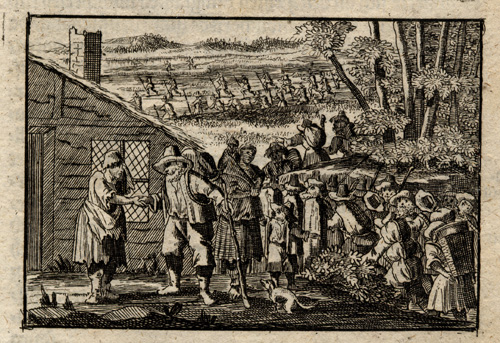
The Reformed German immigrants who settled in Pennsylvania in early 1700s came here to find refuge in what was the most religiously tolerant place they could find. They were refugees from horrific, bitter wars in continental Europe, as the old Catholic powers fought to try to tame the rising Protestant powers. They were refugees that had a hard time finding welcome elsewhere.
These refugees from the Palatine region along the Rhine River were followers of the Protestant Reformation. Particularly they were influenced by the Swiss Reformer Ulrich Zwingli, who led one of the many movements cropping up Europe that defied the authority of the Catholic church to dictate and monopolize the means of salvation through the institution and offices of the Catholic Church. These reformers – including, in addition to Zwingli, leaders like Martin Luther and John Calvin – declared that what was most important for believers was to keep our focus on Christ, scripture, and faith, not the outward displays of ritual and church authority. For hundreds of years the Catholic church had been able to censure and snuff out views like this, any teachings it didn’t approve of, any religious movement that did not go through Church hierarchy and kiss the ring of the pope. But the Protestant Reformation came at a time when that authoritarian reach was fraying, and the reform movements could gain some purchase and political protection. But it was very dangerous for them.
In the case of the communities of folks along the Rhine river who were worshipping God and following Christ according to the Reformed understanding, they enjoyed some breathing room for a time, but soon were facing invading French Catholic armies who were happy to commit atrocities to assert both political and religious domination.
Some communities of these German Reformed folks managed to flee to England, with the help of William Penn. In England, there at first were some charitable efforts to help them out. But mostly the English politicians and public treated these poor bedraggled refugees with scorn. They despised them as “encroaching foreign elves.” “Elves” here does mean not cute little sparkling pixies. It means disgusting goblins, subhuman creatures. You could insert whatever vile word you hear these days spit out by those who hate immigrants.
So, our German Reformed refugees were then expelled from England. They eventually got dumped in the colonies on the other side of the Atlantic, where, long story short, they finally found refuge in William Penn’s “holy experiment” of religious toleration here in Pennsylvania.
Thank God. And they did thank God.
So, what do we do with this story?
As I have been listening to folks in our conference tell this history and what this anniversary means to them it’s been very heartening for me to witness folks doing the deeply faithful and humble thing, which is relating the stories to those of countless other peoples who become dispossessed due to violence and intolerance, and must become immigrants in a foreign land.
One’s gratitude to God for the provision of safety and opportunity in a time of need can lead the faithful soul to wish and to work that others may also find that refuge today.
This is a deeply Biblical ethic.
Moses taught his people in the book of Exodus: “You shall not wrong or oppress a resident alien, for you were aliens in the land of Egypt” (Exodus 22:21)
This is the same as Jesus’ love ethic: “Do to others as you would have them do to you.” (Matthew 7:24). Remember how you were treated and how you would have liked to be treated, and use that to guide how you treat others.
This isn’t just about being nice. This is about matters of life and death, of physical survival and soul survival.
This is how scriptures say we will be judged – according to how we have judged others, as being worthy or unworthy of the good things we wish for ourselves.
“For I was a stranger, and you did not welcome me. That which you did not do to the least of these you did not do unto me.” (Matthew 25:31-46)
We know that sin easily gets in. Fear and hatred of the foreigner has a kind of primal traction, which we see yet again asserting great power. It’s easy to believe we are exceptionally deserving of good things at the expense of others.
We also know that none of us can fully live up to the love ethic of Jesus – we so often fall short. But when we truly let God’s grace into our hearts, when we truly feel the unearned gratitude for our salvation through Christ, when we recognize all the ways we and those we love have been delivered in our need, whether we deserve it or not, this frees us from the power of sin in our lives. God’s grace opens space in our hearts to extend that grace to others in their need.
The good news is there is great joy in living out this grace. For this is living according to the truth and goodness and beauty of the God of all people and all creation.
I’ll end with part of a prayer that will be offered at the 300 Anniversary worship service at Falkner Swamp United Church of Christ:
“We give you thanks, O God.
For the tenacity, resilience, and faith of all the congregations of our past, who weathered wars here and abroad; stood firm in the face of disasters both natural and human-caused; preached grace and gratitude in the darkest times and continuously celebrated thegoodness of our Great God,
We give you thanks, O God.
For the tenacity, resilience, and faith of all the congregations of our present day, who, building on the witness of previous generations, continue to feed the hungry; practice mercy and love of neighbor; walk and talk as advocates for justice, reconciliation, and peace; and follow Jesus who leads us to truth,
We give you thanks, O God.
Now draw your people into the future you have called us to, O God.
Inspire us with vision and perseverance, O Holy Spirit.
Lead us on your path of humility and compassion, O Jesus.”
For all this I give thanks to God.
Thanks be to God.
 The Dandelion Way