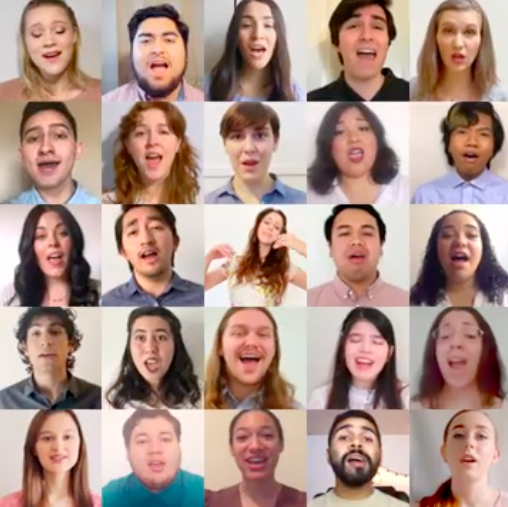
Hope – Inspired by Mark Miller’ “I Believe” by Nick Vlaisavljevic
There are moments in life when hope feels fragile—when uncertainty seems to drown out the light. In such moments, it is tempting to assume that darkness tells the whole story. And yet, again and again, human beings have insisted on a different truth: that even in the deepest night, something within us still reaches for the dawn.
The choral piece “I Believe” captures this truth with a haunting simplicity of hope. Its text has traveled the world with a kind of quiet dignity. Many people have heard the words associated with an anonymous inscription found on a concentration-camp wall. Others tie it to the Warsaw Ghetto, a hidden cellar in Cologne, Germany, or a cave where refugees once hid. The exact origins have become part of the mystery.
But one story, unearthed by Unitarian Universalist minister Everett Howe, leads us to a powerful and historically grounded source. After World War II, Catholic Scouts discovered underground rooms in Cologne that had sheltered nine Jewish fugitives for four months—passageways once forgotten, transformed into secret spaces of survival. These rooms, hidden beneath old buildings, had been made livable through the generosity of friends who shared precious food rations. Meals were cooked only at night to avoid smoke that might alert the Gestapo. In these cramped, lamp- lit quarters—the following inscription was discovered on the wall:
“I believe in the sun, though it be dark.
I believe in God, though He be silent.
I believe in neighborly love, though it be unable to reveal itself.”
Those words were written not in comfort, but in hiding. Not in security, but under threat. And still—still—someone wrote them. That alone is remarkable. Whether or not we know the exact
hand that formed the letters may not matter as much as what the words do: they testify to a hope that refuses to be extinguished.
I find these words deeply relevant today. We live in a time of rising political vitriol, when public discourse often seems fueled by suspicion rather than understanding. We face uncertainty around humanity’s most basic needs—food, heat, shelter—and we see the strain these pressures place on our communities and on our spirits.
In such a moment, the temptation is to look away, to grow numb. But the inscription, and the music built upon it, call us to something more HOPEFUL and courageous (with three verses).
“I believe in the sun … even when it’s not shining.” “I believe in love … even when I don’t feel it.” “I believe in God … even when God is silent.”
The people who sheltered beneath Cologne wrote these words not as poetry, but as survival. Their faith—whether in God, in one another, or in the faint promise of liberation—became a quiet lantern of hope in the dark.
Today, we too can carry such lanterns.
As we listen to “I Believe,” may we HEAR not only the beauty of the music, but also the quiet courage of the words that inspired it. May we honor the resilience of those who wrote them. And may we, in our own time of uncertainty, refuse to surrender the hope that sustained them.
“I Believe” by Mark Miller – University of La Verne Chamber Singers, conducted by Dr. Irene Messoloras
Delivered Thursday, December 4th, 2025, by Nick Vlaisavljevic, at the United Church of Christ at Valley Forge
 The Dandelion Way