Here’s the story about how my father’s-father’s side of the family came to this country.
After the Civil War, the U.S. government turned its attention to putting an end to the stubborn resistance of the people of the plains and deserts and mountains out West: The Apache people, the Comanche, the Ute, the Diné, the Sioux, the Yakima, the Nez Perce, and so on.
My family’s story involves the homeland of the Dakota Sioux. In the early 1860s, the U.S. Army managed to conquer them in brutal fashion in what’s now called the Dakota War.
Not long after that in a poor rural part of Sweden, my great-great-grandfather, a young man at the time, encountered a representative from an American railroad company. The company was recruiting workers to come over to America and build the railroad across what we now call Minnesota and North and South Dakota. In return the workers got some pay, and they got a plot of good farmland that was theirs to settle on ad build a livelihood with.
My great-great-grandfather was not going to pass that up. He signed on. Before he went he proposed marriage to my great-great-grandmother and said what many immigrants have said before and since, “I’ll send word and some money once I’m established in America and you can come over and we’ll start a life together.”
And that’s what happened.
The way the story’s been passed down in my family, as the railroad workers made their way laying track across the plains, their boss would divvy up plots of land the men along the way. After they were done, the workers were able to come back and settle on those plots.
When I looked into the history of this I found that the railroad company and the U.S. government were very clear about their intentions. They wanted to bring Nordic blood to populate this area they had just conquered from the Dakota Sioux people. They believed that northern Europeans were racially superior and wanted to grow their numbers as the country expanded. That’s why my great-great-grandparents got such a good deal as immigrants.
This is not just my interpretation of history. This is the stated intent, clear in the words and the actions of the people with this power at the time.
The Chinese railroad workers didn’t get a plot of land after they were done laying track on the transcontinental railway. The Irish railroad workers didn’t get a plot of land. The freed African-American workers, the Mexican workers, they didn’t get land. Instead they got trapped in indentured servitude or worse. My great-great-grandfather happened to be a poor young man from Sweden, so he got a plot of land and an easy road to citizenship.
Now, my great-great-grandfather and great-great-grandmother were honest, faithful people who worked hard and worked smart. I owe everything to them, and to my grandparents, and parents, who are modest, honest, faithful people who have worked hard and smart. But for all the virtues I can claim for my family (and that may not be the full honest-to-God truth, right? Families have a way of brushing over certain uncomfortable details in order to tell a triumphant story, right?), this isn’t the point. Nothing can take away the fact that we were offered an advantage from the start that we didn’t do anything to earn. It wasn’t fair. Racism cut our way.
Sure, some folks were given bigger advantages than we were. But most folks have been given more of a disadvantage to start out with.
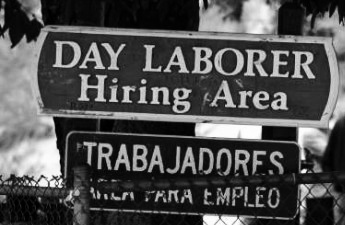
So, in the present day, when I have seen day-laborers lined up early in the morning waiting for a contractor or a farmer or rancher to come hire them for a few hours, I see mostly recent immigrants, often from Mexico or Central America, and I think, “My great-great-grandfather was in that line, you could say. But he was picked out early – generations ago – and he was given a job that meant that he didn’t have to come back to that line the next day and be unsure about whether he’ll be able to earn again the daily bread for his family.”
Now, when I have seen day-laborers lined up early in the morning, the other thing I have to think about is what Jesus said about the Realm of Heaven. Jesus said that if you want to understand the Realm of Heaven, think of a gathering of day-laborers out early in the morning needing to get work to earn bread to fill the empty bellies of their families. (Matthew 20:1-16)
Jesus tells the story of a farm boss coming by first thing in the morning and hiring a good crew of day-laborers to work the vineyard he owns. He hires them for the regular days wage, which is enough for daily bread and basic needs – enough but not more than enough.
Now, any halfway competent farm manager knows the budget they have for labor per day, and they know the work that needs to be done and the number of people it takes to do it, so they go out early in the morning and hire that number of workers they know they need for the day. Furthermore, they’re going to size up the line of workers and pick out the people who look strongest and healthiest and the best able to put the most labor into each hour. The older workers and the injured and infirm, those who are out there just because they are desperate for work, they aren’t going to make the cut.
So, our first sign that something is amiss here with this landowner in Jesus’ story is that he comes back to the market-place to hire more workers. The Kingdom of Heaven is starting to look different from business as usual.
As the day goes by he keeps coming back to hire more and more workers. What’s going on with this landowner? Either he isn’t very good at planning, or his priorities are upside-down. It’s starting to seem he is just eager to hire anybody and everybody he can find.
This become very clear when at very end of the work day this landowner comes back one last time to see who’s still waiting for work.
“Why are you standing here idle all day?” He asks them.
The answer from the workers, is simple and honest: “We are here because no one has hired us.”
It’s not because they’re lazy, as the accusation often is. They are ready and willing to work, but no one has hired them.
Now, why hasn’t anyone hired them?
The folks left without work at the end of the day are the least desirable candidates who have been beaten out round after round. The bosses coming by through the day picking and choosing have been discriminating, it’s like picking teams in the school yard. They’ve been picking out folks who look like they can work the best … or picking out folks who they prefer for some other reason – “I like where you come from, I don’t like where you come from, I want Nordic blood, I don’t want Samaritans and Mexicans,” and so on. Meanwhile the folks who lose are left still needing work, wanting to work, and are worrying all day about the hungry bellies at home.
But the landowner in Jesus’ parable about the Kin-dom of Heaven, the caretaker of the Kin-dom of Heaven doesn’t care about the reasons someone else had found these workers to be undesirable, he doesn’t about a sense of scarcity restricting how many people he “should” invite in. He just cares that they are ready and willing. That’s enough. That’s what the Realm of Heaven is like.
It doesn’t end there: When the day is done, the caretaker of the Kin-dom of Heaven lines up everyone according to when he hired them. And he pays them each a full day’s wage. Each of them gets enough for daily bread, enough to fill the empty stomachs of their families and provide for their other needs for another day. Enough, but not more than enough.
The workers who were hired first thing in the morning – our first-round draft picks – are furious. They won the first-round pick, and they’ve been working hard all day, only to get just as much as the last-round picks who only worked an hour, if that.
The caretaker of the Kin-dom of Heaven replies: “You’ve received what I said you would at the start of the day. You agreed to it, and we both fulfilled our agreement. It’s a fair wage, enough for your families’ daily bread. It should be no concern of yours if I’m generous with others who are also willing to work and who also need their daily bread. Are you envious because I am generous?
Such is the Realm of Heaven. This is the “economics” of Grace. Everyone can get enough for they need, what they truly need, as long as they – as we – are willing to just say “yes” to the invitation to join in the work.
The Realm of Heaven operates by Grace, which scandalizes our earthly value systems. Jesus’ parables about the Kin-dom of heaven short circuit our sense of “deserving” and “un-deserving,” “worthy” and “unworthy.” He means to bring to the surface our feelings of outrage the underpin entitlement or resentment in order to free us of them.
Grace is a scandal to our sense of entitlement – that we ought to get more than others because we are more deserving. Grace is a scandal to our resentment of others who get more or get the same or get anything at all, when we have deemed that they don’t deserve to share in the bounty.
Grace is a scandal in how it cuts us all down to size and then lifts us all up together. When we sincerely dedicate our lives and our work to God, all of a sudden the playing field is level, it’s a circle, it doesn’t matter when we’ve come to dedicate our lives and our work to God, it doesn’t matter if we’ve been working this land for generations, or if we’ve just arrived and have been hired to work for a season or today, we all belong in the realm of God’s grace, and God deems that we all should receive what we most truly need.
It’s just up to us to be willing to say “Yes.”
Now, the way this parable is usually preached makes it out to be just about heavenly things, about what happens to us after we die. But Jesus has always had this way of marrying heaven and earth. His teachings about the Realm of Heaven is always textured with the grit of earth. Jesus prays and instructs us to pray “Thy Kingdom come, thy will be done, on earth as it is in heaven.” Jesus shows us that we are to try to live out this prayer through our actions and intentions, through the values that guide us, through the ways we treat others. “Be merciful as your Creator is merciful.” Be generous as your Creator is generous.
Grace is the gift from God of our eternal souls – that’s true – and, at the same time, Grace is also the gift from God of our daily bread. How else can we respond but with utter gratitude?
The more we are able to enjoy the scandal of how generous God is with these gifts, the more we are able to commit that scandal ourselves in sharing that generosity of this good land and good work with any who arrive ready and eager.
Delivered Sunday, March 15, 2026 by Rev. Nathaniel Mahlberg, at the United Church of Christ at Valley Forge.
 The Dandelion Way
Awesome story and sermon!
LikeLike
Thank you!
LikeLike