This holy night in this holy week as we remember and bear witness to the final teachings and actions of Jesus’ life. We bear witness to just how totally he embodied God’s Love Supreme, even when it means confrontation with the powers of this world that have fallen from the true and good purpose for which God created them, and have become tools of death.
Tonight, we are invited to bear witness: to bear witness to Jesus’ love, and to bear witness to his suffering on behalf of that love. This is not easy, but it is very important, in whatever degree is healthy for you. The sacred stories of our faith, the sacred cycles of our yearly practice are wise in how they challenge us and invite us and support us to bear witness in love to very hard realities: to the pain and atrocity and grief caused by sin, which the story of Jesus so nakedly lays bare.
This is important because it gives us a space to honor this pain and to grieve the losses we suffer and others suffer due to sin, supported by the faith that, which Christ, there is resurrection. This is not “only” about Jesus’ suffering, but, because Christ is of all and for all, this is also about our own suffering … and the suffering of all those we care about, both near and far … as well all those we don’t care about … all those who suffer due to other people’s actions or inactions, and due to our actions or inactions … the suffering of all humanity, the suffering of our whole broken and beautiful world that struggles as we do with the costs that come from how humanity can be so severely out of joint with our true nature and purpose as children of the living God.
Because of the nature of how Jesus died, because of his clear identification and solidarity with “the least of these” – “that which you do to the least of these, you do to me” – the story of Jesus’ death gives us an opportunity in particular to feel the grief of all those who suffer innocently due to violence, greed, lust, pride, vindictiveness, neglect and so on, which is particularly important in times of war, such as the time we are now living through.
Here is Richard Rohr writes about this: “Creating scapegoats is the capital sin of capital sins, so much so that it required Jesus to become the cosmic scapegoat, exposing and resolving this dangerous and universal human illusion. The death of Jesus, the crucified perfect person, stands as the Christian symbol of the scapegoat, which has always dominated human history. By placing this tragedy at the center of faith, we can join Jesus in saying, “Father, forgive them; they do not know what they are doing.” We will surely start with anger and disgust as we wake up to the universality of fear and moral duplicity, [including our own], but then we must let ourselves be moved toward a sadness and solidarity out of love with the victims, if we can. Anger hardens, while sadness saves.” (The Tears of Things, pg. 147)
In this ritual space, we can know that we are not alone in all this. We are here together with each other in this beloved community, we are joined by all sincerely faithful people on earth, and through the generations. And most powerfully, we are joined by Jesus and the undying power of Divine love he embodied and shares with us all through the spirit of the resurrection.
Jesus bears it all with us, Jesus bears it all for us, so that we have a companion to lead us through the valley of the shadow of death and on into resurrected life. All this reveals that nothing can separate us from the Love of God as manifested through Christ Jesus.
May the sure knowledge of this unconditional love of God and its resurrection power help us to grow in courage and compassion and commitment to what is true and good and just and right and holy.
Delivered Maundy Thursday, 2026, by Rev. Nathaniel Mahlberg at the United Church of Christ at Valley Forge.
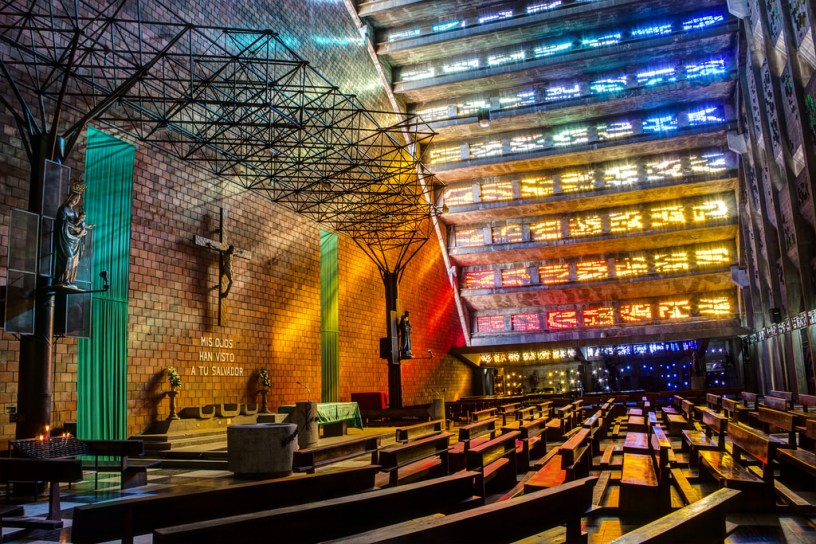
Image: Iglesia El Rosario, San Salvador, Ruben Martinez
 The Dandelion Way