I never met my paternal grandmother, Margaret, God rest her soul. She died when my dad was twelve, of a brain aneurysm while she was leading a prayer at the women’s group at their Lutheran church. Although I never met her, there are several stories from her side of the family that have been passed down to me.
Her father, my great-grandfather Erik, as a young man in the mountains of Sweden, was going to go out with his cousin to check their trap-lines. The night before he had a troubling dream and woke up and told his cousin, “I don’t think we should go out today.” The cousin said, “What are you talking about!? It’s a clear day, we gotta get this done, it’s just a dream, don’t be silly, let’s go.” So they went out into the mountains to check their traps. And they got hit by an avalanche. My great-grandfather managed to dig himself out. But the cousin was never found.
Erik ended up settling in the United States with his wife Joanna as immigrant farmers in a tiny town in North Dakota, mercifully free of mountains. (When discussing my nordic ancestors, I always need to add that they were undocumented immigrants who settled on land from which the native Dakota and Nakota Sioux had been recently dispossessed.)
Many years later, after their kids had grown up, as the story goes, my great-grandmother Joanna had a health issue that required an operation. For that she had to go to the big city, Bismark. The doctor said it wasn’t going to be a big deal, and my grandmother Margaret at that point was working as a nurse at the hospital. So my great-grandfather, Erik, stayed on the farm to keep working, and my grandmother would look after her mother in the hospital as she recovered.
But after the surgery, it quickly became clear to the doctors and the nurses that it was not going according to plan. My grandmother called her father and said, “I think you better come to the city to be with mom.”
He got into the car with his son, who worked on the farm, and his brother and they drove off across the plains, with his brother driving.
Half way there, Erik suddenly got quiet.
He said, “Mom’s left us.”
He took out his pocket watch and marked the time. And when they arrived at the hospital time they found that his beloved had indeed passed from this mortal realm, with my grandmother by her side. And she had died, to the minute at the time her husband had felt it, had known it, as he tried to race to her side many miles away over those great plains.
These are special stories in my family, and were told not only as stories about our predecessors but also as lessons about how there’s more to reality than meets the eye, and the importance of honoring that and being attentive to it.
What’s most amazing to me is how common these kinds of stories are, just many people have had experiences like this.
Someone is asleep and in their dream their grandpa appears and says “goodbye.” They wake up, and the phone rings, and they get the news that their grandpa is dead. Or a mother gets a jolt, “Oh no, my daughter is in trouble,” and soon she learns that her daughter has been in a fatal accident. There are so many precious stories like this, from folks from all walks of life. You may have had experiences like this yourselves.
The time around someone’s passing from this mortal realm can be a time when the veil is thin, so to say. We can have a heightened sensitivity to the spiritual dimensions of things.
If you’ve ever had the privilege of being by the bedside of someone as they pass on, you may have noticed a shimmer in the air. The experience could be calm and peaceful or terrifying and horrific. But there’s always, if you settle down in a prayerful way, there’s always something astonishing for us to notice, a way in which the soul rises up like incense.
The ways that we are connected and interconnected with the ones we love and with the great Mystery Who is the Source and the Destination for all life, these deep connections can come to the surface around the experience of death. And it’s all so sad and beautiful and full and empty and simply beyond words.
Our usual horizons blur …
Jesus’ followers said to him, “Tell us how our end will be.”
Jesus said, “Have you discovered the beginning that you ask about the end? For, in the place where the beginning is, there the end will be. Blessed is the one who takes a stand in the beginning. That one will know the end, and will not experience death.”
The Realm that is beyond death, which we can only know through death, is a realm where the horizons of time blur. The more we go to the beginning the more we know the end. The beginning and the end circle back on themselves.
Who were we at birth? Who were we before, before we were here on earth?
What was God before Creation … when there is no when, where there is no there?
Jesus’ followers said to him, “When will the repose of the dead take place? When will the new world come?”
He said to them, “That which you look for has come, but you did not recognize it.”
There is eternity in the timeless moment. There is a connection, interconnection – mysterious – between the spiritual realm and the physical realm, the realm beyond death and the realm where all is mortal. And it is here, and now, for us to recognize.
Jesus, as the Christ, embodies this connection between heaven and earth. His being is in the blurring of the boundaries. This is part, I think, of the mystery of Christ’s resurrection, it’s part of the power of the image of Christ’s open grave and of the resurrected self … these mysterious images help us to recognize the way we all belong to the eternal.
This is a mystery, that’s hard to talk about, but it doesn’t mean that it’s only abstract riddles we have to work with. We have very real touchstones. Experiences like I described at the beginning, this profound connection to a loved one, beyond space and time, around the time of their dying, or after they’ve passed on, these are like comfort stones we can keep in our pocket, concrete reminders that we belong to a greater realm.
Images like Christ’s open grave at Easter or Christ’s resurrected self are touch stones that carry this insight.
In our culture we don’t usually talk openly about death. Even in the midst of a global pandemic that’s claimed more than a million lives in our country, and six-and-a-half million lives around the world; even with escalating loss of life due to natural disaster, and acts of mass violence, our society is strangely silent about the reality of death, and loss, and heartbreak and grief.
This is unhealthy in its denial of the heart; it’s insane in its denial of reality; and it’s unjust in its denial of the urgent moral demands that come from the cries of those who suffer.
The wisdom of our Christian tradition, and our inheritance from the wisdom of the Jewish tradition, teaches just the opposite. Jesus takes us right into the heart of heart-break, Jesus gives us courage to cry and to hear the cries of our neighbors, Jesus teaches us to live fully in view of mortality, with the assurance that death does not have the last word.
Now, I want to honor all the feelings that may be coming to the surface in all of us right now. The more comfortable we can be with the feelings we have around death and loss, the more comfortable we can be with death itself, and mortality, the more we can be aware of the broader reality that’s at play here, the realms of the Eternal Spirit through earth, so we may live as fully as we can for whatever measure of life is given to us.
For many throughout history this time of year – autumn – is a time to reflect on these matters of death and loss and renewed life.
This is the time of the year when tremendous abundance of the earth that has been sown has grown to fruition and, now, through sweat and labor, is being harvested.
The first frosts are near. The trees are letting go of their leaves and sending their final burst of seeds into the wind. They are beginning to retreat into themselves. The days are getting shorter and colder, the seasons of growth and flourishing are beginning to come to a close, for now.
Yet the sun warms. And there is still so much life at this time, such a wondrous ember glow of life-force smoldering. This is a time for creativity and clarity and change.
For many, this is a time when the realm beyond this earthly realm feels near – a time when the “veil is thin.” Many traditions have festivals of the dead at this time of this year. In the Christian world there is All Souls Day, All Hallow’s Eve, All Saints Day, Dia de los Muertos.
This is a good time to pray and settle and to be still,
To feel the subtle presence as well as the absence of those we love who are no longer with us in this earthly realm.
This is good time to reflect honestly on death and our own mortality within the larger scope of life and death and life anew.
It’s a good time to reflect deeply on our own purpose for whatever measure of life and vitality God sees fit to entrust to us.
Holy God,
Your ways are not our own,
Your very being, the source of all being, is beyond our knowing,
And yet we know that you are with us
Pulsing through the cycles of life and death and life anew.
Stir us awake to your Holy Spirit, O God
So that Spirit may embrace the hearts of those who gather here.
May we trust that embrace, as we honor the loss of those who are beloved to us,
And honor our ancestors, of blood or of spirit,
Help us to treasure and share the gifts we have received from them,
If we are unsettled in our relationship with them, or unsettled with their loss,
Help us to do what we need to do to be more at peace.
Assure us, O God, that all is well with their souls,
And all can be well with ours.
Assure us, O God, that no ear can hear, no eye can see,
no imagination can even conceive
The peace that you have prepared for those who say Yes to your Love.
Amen
Introduction to the Scripture Readings
Our scripture readings for this Sunday are teachings about mortality. As you may expect, they are not easy. They each in their own ways challenge us to a much bigger perspective than may at first be comfortable for us.
The first reading is from the Book of Psalms. The second is from Paul’s letter to the community of Jesus followers in the Greek city of Corinth. And the last two readings are from Jesus’ teachings in the Gospel of Thomas.
May God bless us with wisdom and understanding as we hear the words of scripture.
Scripture Readings
Psalm 90: 1-6, 12
Sovereign of the Universe,
you have been our dwelling place
throughout all generations.
Before the mountains were born
or you brought forth the whole world,
from everlasting to everlasting you are God.
You turn people back to dust,
saying, “Return to dust, you mortals.”
A thousand years in your sight
are like a day that has just gone by,
or like a watch in the night.
Yet you sweep people away; they are like a dream—
they are like the new grass of the morning:
In the morning it springs up new,
but by evening it is dry and withered.
Teach us to number our days,
that we may gain a heart of wisdom.
1 Corinthians 15:35-36,42-44
But someone will ask “How are the dead raised? With what kind of body do they come back?” Ridiculous man, what you sow does not come to life unless it dies. And what you sow is not the body which it will become; what you sow is a bare seed – it could be of wheat or one of the other grains.
And so the dead will come to life like that: sown in corruption, raised incorruptible; sown in a condition of humiliation, raised in a state of splendor; sown in weakness, raised in power. Sown with a body fit for earthly life, they are raised with a body fit for life in God’s new world.
Gospel of Thomas 51
Jesus’ disciples said to him, “When will the dead have rest, and when will the new world come?”
He said to them, “What you’re looking for has already come, but you don’t know it.”
Gospel of Thomas 18
The disciples said to Jesus, “Tell us, how will our end come?”
Jesus said, “Have you found the beginning, then, that you are looking for the end? You see, the end will be where the beginning is.
Blessed is the one who stands at the beginning: that one will know the end and will not taste death.”
(Delivered Sunday, October 30, 2022, by Rev. Nathaniel Mahlberg at the United Church of Christ at Valley Forge.)
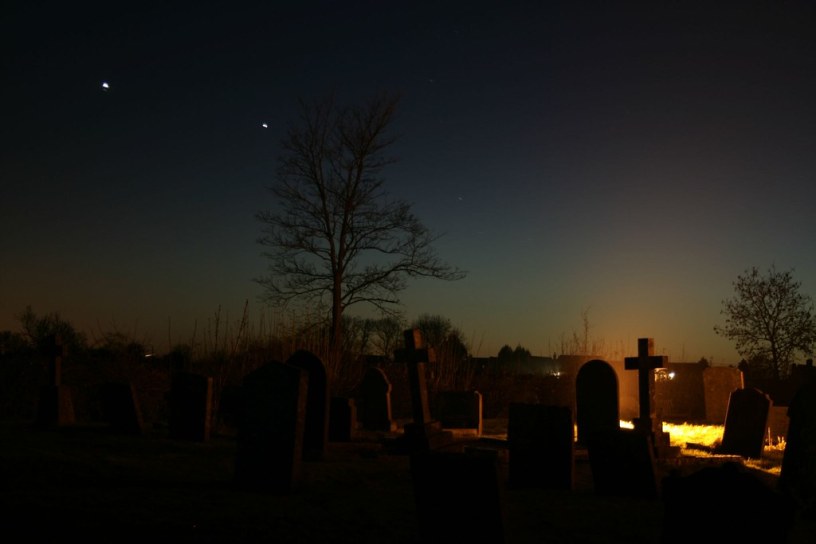
Image: “On a cold December evening” by Lplatebigcheese is licensed under CC BY 2.0.
 The Dandelion Way
Thank you for sharing these resources. I came across When the Veil is Thin after leading music in a funeral and being emotionally overcome afterwards. Reading your sermon helped me find my footing again for the remainder of the work day and also a sense of peace. In gratitude, Jennifer
LikeLike
Jennifer, thank you for sharing this. I’m so glad these reflections have been helpful to you. Thank you for contributing your musical gifts in a way that I’m sure brought comfort and beauty amid grief. Peace, Nathaniel
LikeLike