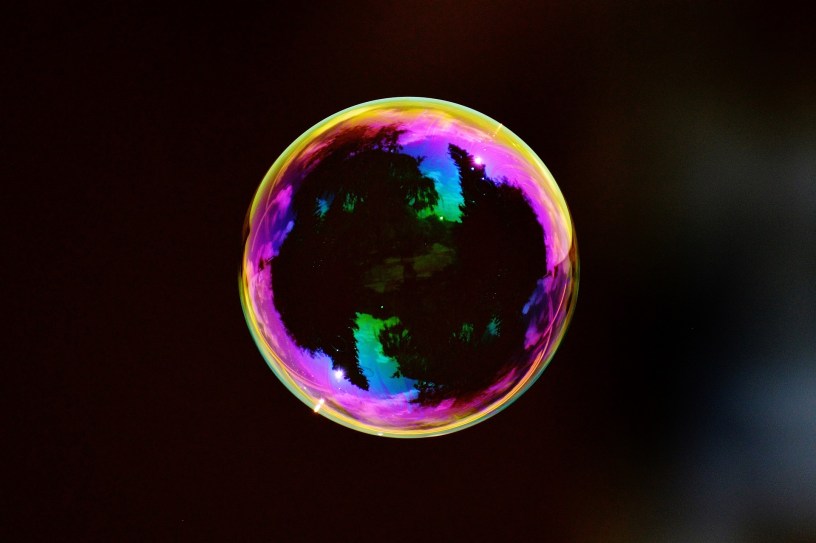
One of the gifts of hanging out with children is the opportunity to spend a lot of time with bubbles. Bubbles in the bathtub, bubbles in the backyard. If we’ve been deprived of children, we can forget about bubbles. But we easily remember.
Blowing bubbles is amazing. And it’s hard not to get stirred back into amazement, especially if you let the amazement of a kid rub off on you.
Consider the bubble:
We breathe into being a billowing liquid orb, that unfurls and lifts and floats, translucent in the sun, a lens aloft, revealing the landscape in miniature, a world within a world, whirling with shimmering eddies of rainbows …
We scarcely breath as space transfigures and time suspends…
Then … Pop!
It’s so amazing, these wondrous bubble-beings, that a kid can’t contain themselves. They just have to chase ‘em and grab ‘em.
And really, we adults aren’t all that different than kids. We may be less open to wonder in general, I’m sorry to say (and it doesn’t need to be that way). But whenever wonder does happen we’re just as prone to popping it.
With wonder, with any kind of beautiful, impossibly beautiful, sublime experience, the impulse is to grab it and pop it.
Have you ever been in some glorious place, perhaps up in the mountains in the clear air and clean light and you gaze up up at a mountain summit vaulting into the sky and …
Time suspends …
Space transfigures …
Then someone you’re with, or maybe you, has to open their mouth and say something. And it always is something kind of stupid.
“Well, this sure beats Nebraska.”
Pop goes the bubble.
We’re having this holy moment and someone’s gotta pop it.
But of course, what is there to say that doesn’t sound stupid in the face of the glory of God’s creation?
There isn’t anything to say really, beyond the breathless silence of awe …
But sometimes we just can’t contain the impulse to jab out our finger and pop the moment.
This, I think, is because the Sacred, when it overcomes over us, can be overwhelm our small sense of self. This feel awesome and awful at the same time. The true meaning of “sublime” has more than a hint of terror.
And part of ourselves, as puny little humans, just can’t handle it.
The reaction is to pop the bubble and go back to something being safe and comfortable. Because we know at some level that when we allow the Holy One to reveal even a glimmer of the glory of the Lord, we will have to die and be reborn.
But it isn’t always fear that can pop the bubble. It’s often a kind of genuine desire, like the kid who is just so excited about a bubble that they have to grab it. This desire to grab and hold and have what is Holy.
“Jesus took Peter, James and John and led them up a high mountain. His appearance changed from the inside out, right before their eyes. His clothes shimmered, glistening white, whiter than any bleach could make them. Elijah, along with Moses, came into view, in deep conversation with Jesus.”
…
Time suspends …
Space transfigures …
And then Peter, oh Peter, he’s the guy that’s gotta open his mouth:
“Hot dog! This sure is something, huh? Here, let’s all snap a selfie. Jesus, Elijah, and Moses!? My Instagram followers are going to freak out!”
In first century terms it’s “Let’s build three memorials – one for Jesus, one for Moses, one for Elijah.”
It may be the same impulse that leads people to graffiti their names on rocks overlooking the Tetons or the Grand Canyon: “Peter wuz here.”
But let’s not be too harsh on dear Peter.
The Gospel tells us that Peter “blurted this out without thinking, stunned as they all were by what they were seeing.” He was stunned. Maybe it’s just that he couldn’t stand to be stunned, to be breathless and silent before this in-breaking glory. But it’s more than that. We see here in Peter his desire, this desire to hold on to this holy moment. To make it linger. To build a memorial for this astonishing moment of mystery when these great, ancient, holy souls all abide together on the mountain top, overflowing with the light of Heaven. We can all relate to that.
But when Peter reaches to grab the light, the cloud descends.
And, you know what? That’s fine.
It’s fine, this human desire to grab and have and hold what is Holy. To memorialize it. It’s fine. But the fact is we can indeed simply witness and abide the holy in silent awe. We can forget ourselves in it and not even think to grab and hold and pop. We can.
But the real hard thing about being human is that even if we simply allow a holy moment to be as it is, it does come to an end. We must come down from the mountaintop. When we do we may want to have and hold that holy moment with us.
We’ve all had holy moments. I’m convinced of it – everyone. You don’t have to be some kind of spiritual athlete. We may not always remember them or recognize them for what they are, it may have been years ago, it may have popped pretty quickly, but we all have experienced some little or big holy moment.
The challenge about being human is that we don’t live on the mountaintops. After the mountaintop, we go back into the valleys where people live. Valleys are muddy and fertile. We plant seeds there. But valleys are can be dark and prone to flooding. The valley of the shadow of pain and death.
“Coming down the mountain,” the Gospel tells us, “Jesus swore them to secrecy.” “Don’t tell a soul what you saw,” he told them.
He’s asking them to honor that mountaintop moment as a holy moment that they don’t know the full meaning of. It’s best to just ponder these things in the heart.
But then Jesus tells them:
“After the Child of Humanity rises from the dead, you’re free to talk.” They puzzled over that, wondering what on earth “rising from the dead” meant.
Meanwhile they were asking, “Why do the religious scholars say that Elijah has to come first?”
Jesus replied, “Elijah does come first and get everything ready for the coming of the Child of Humanity. They treated this Elijah like dirt, much like they will treat the Child of Humanity, who will, according to scripture, suffer terribly and be kicked around contemptibly.”
Jesus is telling his disciples that he is going to suffer, now that they’re coming down from the mountain.
After the mountaintop, the valley and the muddy gorge. Christ’s journey is about bringing the light of the mountaintop down into all the furrows and folds of real human life here-below.
Discipleship means letting Christ lead us up to the mountaintop, bearing witness to the glory there, glory, glory, glory, of a glimpse of the overflowing light of God, before the moment pops.
And then discipleship means letting Christ lead us back down the mountain, as we seek to live by the light we have found.
The ancient cycles of the church calendar give us this mountaintop moment, this transfiguration Sunday, before Ash Wednesday and the journey through the lowlands of Lent. As we begin the journey of Lent with a reminder of our mortality, I invite you to pause and remember those holy moments in your life, moments of awe, of the sublime, and to honor those experiences – fleeting and precious as they are – and what they reveal.
Thanks be to God.
 The Dandelion Way
This makes me think of Brian Doyle’s essay “In Otter Words,” from the book “Children and Other Wild Animals.”
It’s a great big concatenation of sentences sent spooling off by a marvelous typo made by a little child. From the essay:
”
A child has scrawled this in the brightest green ink you ever saw: in otter words, the holy parts are circled, she writes.
”
And isn’t that so! The holy parts *are* circled, and calls our attention to them in the most marvelous fashion. And sometimes our joyous surprise involves dancing off amidst the floating bubbles, popping some and watching others.
That of course is a thing to be celebrated! And at the same time, there are other times when we “pop bubbles,” which has less beauty.
The draw to such extraordinary beauty – because God has circled them in the extraordinary language of otters and other wonderful creatures – is perhaps another reason why we sometimes accidentally destroy it.
When we have followed His calling to the beauty before our eyes, we must remember to keep on listening to him. Lest we let the voice of the beauty overwhelm the voice of the One who brought us there, and our folly overcomes His wisdom.
Even though this is a risk of seeing beauty – that we might destroy it – I am perpetually so, so grateful that he keeps calling us to see it. Truly, our Father’s generosity never ends.
You can read the essay here as well, if you so desire. (But only if you so desire!) Published by Mr. Doyle himself. (-:
https://www.eurekastreet.com.au/article/kids-circle-the-holy-parts
LikeLike
Robin, How wonderful for you to quote Brain Doyle. I’ve read a different collection of his essays, “One Long River of Song.” It’s astonishing the way his words convey holy wonder. Thank you for this.
LikeLike
Yes! I’m glad you know Brian Doyle. I agree. (-:
LikeLike