Whose life example from the past can help you find the encouragement, the challenge, and the faith you need to receive right now?
When I posed this question last week, I appreciate that some of you shared with me the person, the people, who came to your heart – whether it’s someone you knew personally, or someone who was more widely well known, someone more contemporary, someone from the distant past. I genuinely want to know:
Who are the saints and great ancestors you look to for guidance right now? Whose life example from the past can help you find the encouragement you need, the challenge you need, the faith you need to receive right now?
Last week I shared with you about Harriet Tubman, as one such person, a person of great moral courage, who lived with integrity on behalf of love and justice and compassion, in the face of great challenges, guided by deep faith in the Living God.
I shared how Tubman’s tremendous moral and physical courage in defying the practice of slavery was guided by her tremendous faith in the Living God. “’The good Lord,” she said, “has come down to deliver my people, and I must go and help Him.’” (210) In the words of the scholar Tiya Miles: “Harriet Tubman fought for the ability of all God’s creatures to share this earth in freedom and dignity.” (234) “Every person had innate value and deserved care in the eyes of Harriet, who attempted to view the world through the lens of her God, an ‘almighty helper.’” (224)
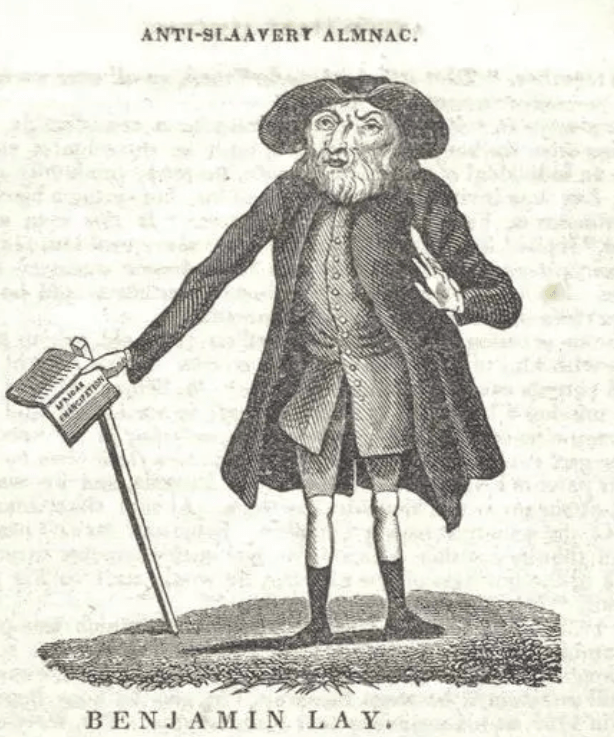
The same God and the same cause and the same urgency of injustice animated the people I want to share with you today: Benjamin ad Sarah Lay. In Tubman’s lifetime, she saw the end of the practice of enslavement in this country she fought against. But Benjamin and Sarah Lay, who lived more than one hundred years prior, were part of the very beginning of the abolitionist movement.
The holy efforts involved in bending the moral arc of the universe are the work of generations, which morally responsible people inherit and contribute to and pass on, knowing it takes lifetimes of faithful struggle against great odds. In doing so, we join God’s long work of overcoming human evil.
One snowy Sunday morning in the early 1730s, when the faithful were arriving for worship at a Quaker Friends Meeting in Philadelphia, they were greeted by a small, stooped, bearded man at the gate. His entire right leg and foot were uncovered as he stood in a foot of snow.
“Benjamin!” people said to him, “you’re going to freeze out here without proper boots and socks! Come inside! We have to find you something to cover you from the cold.”
But the man refused to move.
“You pretend compassion for me,” he told them, “while as we speak the people you enslave are forced to work outside half clad.”
On any given Sunday at any given church in Philadelphia and the surrounding towns the preacher in the midst of his sanctified sermonizing may find himself interrupted by shouts, as this little stooped bearded man leaped out into the aisle, booming about how the so-called reverend blasphemes against the name of Jesus for daring to mouth the Savior’s words while himself committing the satanic sin of owning and abusing human beings.
Then when the faithful congregation rose up against this disruptive lunatic and threw him out of the sanctuary, he would just lay there, at the steps of the church, until the end of the service, forcing the good Christian citizens to step over his body in the mud.
Meet Benjamin Lay.
Benjamin and Sarah, his wife, were recent arrivals to the American colonies. Upon arriving in Philadelphia, they lost no time in continuing their track record of stirring up trouble with their uncompromising conviction that the widespread practice of slavery was a sin against God and a crime against humanity. Prior to this they lived in Barbados, with a colony of English Quakers, where they became pariahs for their practice of treating the African inhabitants enslaved by European colonists as fellow human beings. They opened their home to their African neighbors, and threw great feasts and became friends with them. That was not only improper, but dangerous. From these friends they learned about the intimate atrocities their white neighbors were committing against the people they enslaved. Some of these the Lays witnessed themselves. The Lays soon came to share with their new friends the conviction that such practices of owning human beings was morally repugnant and against any faithful understanding of the teachings of Jesus.
Their abolitionist beliefs arose from humble, humane friendships across the color line. They listened, learned, and believed.
Then the Lays began openly encouraging the rebellions that were stirring in the Caribbean among the people who had been forced there in chains. The slave-owning class did not let the Lays stay very long.
Years before this, Benjamin worked as a sailor. Working on the ships, Benjamin became part multiethnic crews that worked their way through the trade routes of the known world. He got to know fellow sailors who had formerly been enslaved, as well as those who had worked on slaving ships. He got to visit foreign lands. These experiences gave Lay, what the historian Marcus Rediker calls “a hard-earned, hard-edged cosmopolitanism” (Marcus Rediker, “The Fearless Benjamin Lay,” pg. 24). Lay later wrote that because of these experiences as a Christian and a “common sailor,” he came to “truly and sincerely desires the present and eternal Welfare and Happiness of all Mankind, all the World over, of all Colours, and Nations, as [my] own Soul” (Rediker, 25).
Very few people shared this sentiment at that time.
Both Benjamin and Sarah Lay had the condition known as dwarfism. They also had conditions that led to pronounced curvatures in their spines. From a young age they both knew what it was like to have people ridicule them and try to push them around.
They both were also from modest peasant backgrounds in England. They both were part of the Society of Friends, or Quakers. Quakers are a movement within Protestant Christianity that emphasizes how Jesus’ teachings should compel us to resist as sinful the forces of human violence. Quakerism teaches that there is an “inner light” within everyone that is able to connect with God without the mediation of religious authorities and religious institutions.
All of this was a recipe for both Benjamin and Sarah to be inclined to be compassionate toward others who are the victims of violence, against the callous and cruel conventions of their day. It also inclined them to trust the authority of their conscience above the authority of religious and political powers. (Rediker, 143)
This put them in quite the minority in their society, on both sides of the Atlantic.
Quakers at this time were no different than Europeans of other creeds in being okay with the practice of slavery. Some of original generation of Quakers in the 1600s opposed slavery and indentured servitude (before it was largely racialized), but many subsequent Quakers became part of the merchant class and were content to make their money the same ways as everyone else.
The Lays aimed to change that.
Sadly, Sarah Lay died only a few years after they emigrated to Philadelphia. After his beloved wife’s death, Benjamin only became more radical in his efforts to compel people to stop the practice of slavery. He interrupted worship services to denounce ministers who owned people who were enslaved. He staged the kind of holy fool performances like the story I shared about him standing in the snow without a shoe, in order to try to shake people out of their moral complacency and into compassion for the suffering they were inflicting on people who they enslave. He refused to buy anything produced by slave labor, so he spun his own fabric and grew his own food and refused sugar and tea. His practice of nonviolence expanded to animals – he stopped eating meat. He preached gender equality. He was quite ahead of his times, which tends to happen with those who listen closely to God and to their fellow creators.
Benjamin made people uncomfortable. He embodied the tradition of the Hebrew Prophets and of Jesus, whose experience of God compelled them to confront the moral complacency of their times. Good thing we don’t have any moral complacency to be worried about these days!
Benjamin Lay wrote one of the very first tracts to call for the unconditional abolition of slavery. The established Quaker presses refused to publish it. Lay found a willing printer by the name Benjamin Franklin. Franklin published the book in 1738, but he was not quite bold enough to include his imprint.
The book bursts with prophetic fury, and it bristles with verses from the Bible that make it very clear that God calls those who profit from slavery to repent and atone for the sin before our God of justice and mercy.
Like many of the abolitionists of his day and in the generations to come, Lay’s argument hammered away with Jesus’ Golden Rule. Don’t treat anyone in ways you wouldn’t tolerate yourself being treated. Rather, treat others with the same respect and compassion you wish for yourself and those you hold dear. Good thing we don’t have problems living like that anymore, right?
In Benjamin Lay’s hands, the Golden Rule was honed into a fierce edge. Do unto others as you’d have them do unto you … and if you don’t, then prepare for the ways you are doing onto others to be done unto you. In other words, beware that we don’t reap what we sow. This is the radical prophet at work. If his slave owning society did not change, he said, they would suffer the same atrocities they were inflicting on others. Lay, I think, would have agreed with Abraham Lincoln more than a century later who believed that the Civil War was God’s punishment against the U.S. for the sin of slavery.
The book did not make Benjamin Lay many friends. It made a big stir. It was widely read and widely denounced. But there were enough others who consciences were stirred that it contributed to a slowly growing movement.
Lay’s strategy was to focus on his fellow Quakers. He wished to encourage those who were already speaking out, to embolden those who opposed slavery but were silent about their convictions, to convert those Quakers who supported slavery, and to condemn those who refused to see the horrible error of their ways (Rediker, 79).
The amazing thing is, it worked. At least among the Quakers. In the early 1730s, Benjamin Lay was getting thrown out of Quaker meetings. But a movement coalesced. A younger generation of Quakers took up the cause. Their methods were a little more politic than the furious firebrand Lay: “The thundering prophet and the gentle saints worked hand in dedicated hand,” as the historian Marcus Rediker put it (Rediker, 138).
By 1758 the Philadelphia Quaker meeting formally denounced the practice of slavery. According to the historian Jill Lapore, “When Lay heard the news he said, ‘I can now die in peace,’ closed his eyes, and expired.” (Jill Lapore, “These Truths: A History of the United States,” p. 76).
Now, as we know, the abolitionists did not succeed in preventing the practice of slavery from being encoded into the U.S. Constitution, and worsening. It would take another century of suffering and resistance among the enslaved and free African Americans, it would take sustained efforts of abolitionist white folks, it would take a bitter and brutal civil war, for the practice to end. Yet the sin of racism and racial inequality endures to this day.
But as the abolitionist and signer of the Declaration of Independence Benjamin Rush wrote, “The success of Mr. Lay, in sowing the seeds of … a revolution in morals, commerce, and government … should teach the benefactors of mankind not to despair, if they do not see the fruits of their benevolent propositions, or undertakings, in during their lives” (Lapore, 75).
If we want to join the company of fellow workers in God’s garden, we must take heart in the wider view of God’s time.
So, I thank God for the great souls whose sacred labors we can inherit and be challenged by and contribute to and pass on.
Thanks be to God.
Delivered Sunday, February 23, 2025, by Rev. Nathaniel Mahlberg, at the United Church of Christ at Valley Forge
 The Dandelion Way