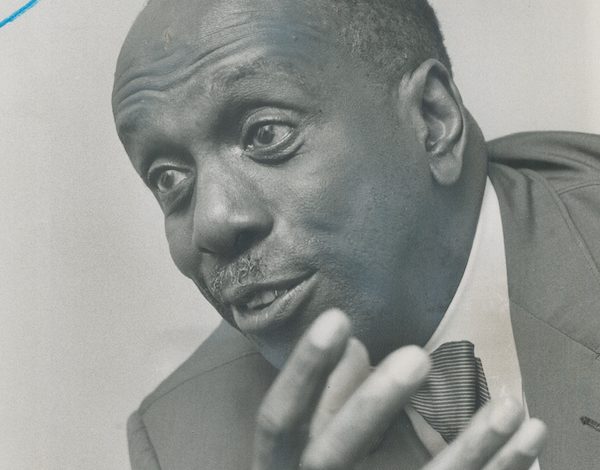
“What the world needs are people who have come alive.” – Howard Thurman
One sign we have that God is on the move is that people are coming alive, and are coming alive not just for their own sakes but for the sake of helping others to come alive. On the other hand, one of the signs of oppression or, we can say, sin, is that the opposite is happening, people are suppressed from coming alive, stifling their essence, desperate, deadened.
“What the world needs are people who have come alive.” This is one of the many insights taught by Howard Thurman, a pastor, theologian, and professor who, along with his wife Sue Bailey Thurman, played a very important role in the civil rights movement that sought to confront and transform forces of inhumanity in our country.
The past few weeks, I’ve been doing a series of sermons where the question is: What saints, what great ancestors of the faith do you and do we need to be remembering right now, to receive the wisdom, to receive the courage, to receive the moral fortitude, to receive the sense of legacy, to receive the faith that we need right now?
Two weeks ago, I shared about the life and faith of Harriet Tubman. Last week I shared about the lives and faith of Benjamin and Sarah Lay.
This week, let’s meet Howard Thurman.
Howard Thurman was a key spiritual advisor and wise elder for many civil rights leaders: Dr. Martin Luther King Jr., Bayard Rustin, James Lawson, Pauli Murray, James Farmer, Jesse Jackson, Marian Wright Edelman, Vernon Jordan, Vincent Harding …
So, if we take a moment and pay our respects and sit at the feet of Professor Thurman for a spell, we are going to learn about the kind of faith perspective that that animated and sustained some great souls through some great struggles for the sake of a more just and peaceable world.
Howard Thurman was born in 1899 in Daytona, Florida. He was a very bright and eager student, but the racist policies at the time barred Black kids from the public high schools. Thurman fortunately had a cousin who was able to pay for him to attend a private religious high school for African American students. He received a scholarship to Morehouse College in Atlanta, where he was a classmate of the Soon-to-be-Rev. Martin Luther King, Sr. At Morehouse, Howard Thurman was reported to have read every book in the college library.
He went on to seminary and other higher education, which included time at Haverford near here, studying with the Quaker scholar Rufus Jones. Thurman was ordained as a Baptist minister, served congregations, and taught Philosophy and Religion at Morehouse and Howard University.
Howard and Sue Bailey Thurman were the first Americans to meet with Mohandas Gandhi in India to discuss how Gandhi’s strategy of nonviolent mass “soul force” could be applied in the struggle against institutionalized racism in the United States. This was in 1935, when the idea would have been unthinkable to most Americans.
In 1944, the Thurmans started an intentionally inter-racial and inter-cultural church in San Francisco, the Church for the Fellowship of All People, called the Fellowship Church, which included people of European, African, and Asian descent. This inspired other intentionally multi-racial Christian fellowships around the country.
In 1953, he accepted a position at Boston University that included serving as the dean of the university chapel. Thurman used this as an opportunity to replicate the inter-racial faith community model that had grown out of the Fellowship Church. It was at these church services at Boston University that Thurman met a young theology student who turned out to be the son of his Morehouse classmate, the Soon-to-be-Dr. Martin Luther King, Jr.
Dr. King later said that he would sit in the pews during Professor Thurman’s sermons and take copious notes. He also said that throughout all of his travels in his work for the civil rights movement and it’s struggle for the love ethic, to overthrow hate through nonviolent force, Dr. King always kept with him a copy of Howard Thurman’s book, “Jesus and the Disinherited.”
So, let’s talk about what Howard Thurman taught that was so influential. Now, we’re talking about a very deep and original and wide-ranging thinker who published more than a dozen books – I’m not going to pretend I can do justice to his thought. To give you a sense of his range, here are some of the titles of his books: “Jesus and the Disinherited,” “Mysticism and the Experience of Love,” “The Luminous Darkness,” “Deep is the Hunger,” “Disciplines of the Spirit.”
Thurman’s central question in that book Dr. King always kept with him is, “What do the teachings and the life of Jesus offer to those who stand, at a moment in history, with their back against the wall?” (Jesus and the Disinherited, by Howard Thurman, pg. 11). In answering that question, Thurman said, “I learned more… about the genius of the religion of Jesus from my grandmother [who had been born into slavery] than from all the men who taught me all the Greek and all the rest of it. Because she moved inside the experience of the religion of Jesus and lived out of that kind of center” (Howard Thurman: Essential Writings, ed. Luther E. Smith, pg. 15).
“The basic fact is that Christianity as it was born in the mind of this Jewish teacher and thinker appears as a technique of survival for the oppressed. That it became, through the intervening years, a religion of the powerful and the dominant, used sometimes as an instrument of oppression, must not tempt us into believing that it was thus in the mind and life of Jesus. ‘In him was life; and the life was the light of men.’ Wherever his spirit appears, the oppressed gather fresh courage; for he announced the good news that fear, hypocrisy, and hatred, the three hounds of hell that track the trail of the disinherited, need have no dominion over them” (Jesus and the Disinherited, pg. 29).
It’s the experience of religious life in the spirit of Jesus among those who that Thurman takes very seriously, in teaching about how God helps real people be whole human beings in the face of oppressive circumstances. In doing this, Thurman explores the spiritual psychology of oppression as well as of liberative religious encounters with God.
Thurman explored deeply what it is like to be a person who has experienced oppression who, you could say, goes with Jesus up to the mountaintop to experience the Transfiguration, and then come down with Jesus back into a fallen and hurting world, to share that healing knowledge of one’s belovedness as child of God.
To convey this, what I’m going to do is give you a little immersion in Thurman’s consciousness and just share with you some passages from his writing:
“There are few things more devastating than to have it burned into you that you do not count and that no provisions are made for the literal protection of your person. The threat of violence is ever present, and there is no way to determine precisely when it may come crashing down upon you. …The underprivileged in any society are the victims of a perpetual war of nerves… [which]] work[s] its perfect havoc in the souls of the poor.” (Jesus and the Disinherited, pg. 39)
However:
“To the child of God, a scale of values becomes available by which people are measured and their true significance is determined. Even the threat of violence, with the possibility of death that it carries is recognized for what it is — merely the threat of violence with a death potential. Such a person recognizes that death cannot possibly be the worst thing in the world. There are some things that are worse than death. To deny one’s integrity of personality in the presence of the human challenge is one of those things.” (Jesus and the Disinherited, pg. 51)
“The religious experience as I have known it seems to swing wide the door, not merely into Life but into lives … my religious experience makes it possible for me to experience myself as a human being and thus keep a very real psychological distance between myself and the hostilities of my environment. Through the years it has driven me more and more to seek to make as a normal part of my relations with people the experiencing of them as human beings. When this happens love is the essential material with which to work. And contrary to the general religious teaching, people would not need to stretch themselves out of shape in order to love. On the contrary, a person comes into possession of themselves more completely when one is free to love another.” (Howard Thurman: Essential Writings, pg. 50-51)
“The ultimate meaning of [religious] experience is felt in such a way that all of oneself is included. It is total, it is unified and unifying. It is not the experience of oneself as male or female, as black or white, as American or European. It is rather the experience of oneself as being. It is at such a time that one can hear the sound of the genuine in other human beings. This is to be able to identify with them. One person’s response to the sound of the genuine in another person is to ascribe to the other person the same sense of infinite worth that one holds for oneself. When this happens, people are free to relate to each other as human beings – good, bad, mean, friendly, prejudiced, altruistic, but human beings.” (Howard Thurman: Essential Writings, pg. 159-160)
“Behold the miracle! Love has no awareness of merit or demerit; it has no scale by which its portion may be weighted or measured. It does not seek to balance giving and receiving. Love loves; that is its nature … Whence comes this power which seems to be the point of referral for all experience and the essence of all meaning? No created thing, no single unit of life, can be the source of such fullness and completeness … there is but one word by which its meaning can be encompassed – God.” (Howard Thurman: Essential Writings, pg. 123-124)
“There is no need to fear evil. There is every need to understand what it does, how it operates in the world, what it draws upon to sustain itself. We must not shrink from the knowledge of the evilness of evil. Over and over we must know that the real target of evil is not destruction of the body, the reduction to rubble of cities; the real target of evil is to corrupt the spirit of man and to give to his soul the contagion of inner disintegration… Therefor the evil in this world around us must not be allowed to move from without to within … To drink in the beauty that is within reach, to clothe one’s life with simple deeds of kindness, to keep alive the sensitiveness to the movement of the spirit of God in the quietness of the human heart and in the workings of the human mind – this is always the ultimate answer to the great deception.” (Howard Thurman: Essential Writings, pg.171-172)
“As a human being, then, one belongs to life and the whole kingdom of life that includes all other lives and perhaps, also, all that has ever lived. In other words, one sees oneself as part of a continuing, breathing, living existence. To be a human being, then, is to be essentially alive in a living world” (Howard Thurman: Essential Writings, pg.109)
In short: “What the world needs are people who have come alive.”
So, I invite us all to respond to the call to come alive. Despite all the forces that may be seeking to deaden you, and to deaden you to the essential worth of others, despite fear or uncertainty: come alive, with God’s help, and with God’s help, help others come alive as well.
Thanks be to God.
Delivered Sunday, March 2, 2025, by Rev. Nathaniel Mahlberg, at the United Church of Christ at Valley Forge

