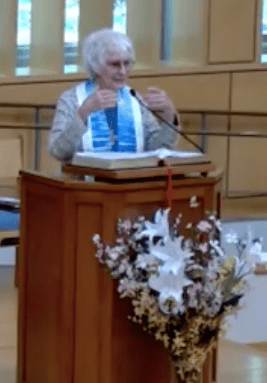
We were blessed to have Rev. Susan Scott as a guest preacher last Sunday at the United Church of Christ at Valley Forge. Her husband, Ray Gray, shared a story from his childhood about his mother for the children’s message.
There are a few things I really like about the story Ray told us about he and his brother eating most of the strawberries while their Mom is off buying jelly jars.
First, I like how the presence of the mother is still real for those kids,
even when she’s physically absent. They’ve clearly developed a sense of what developmental theorists call “object constancy.” What that means is: Though she’s temporarily “gone from their sight,” they trust she’s still “somewhere out there” and she’ll be coming back — and in their guilty imaginations — when she does return . . . there’s gonna be hell-to-pay for scarfing down those juicy, red strawberries.
Secondly, I like the way Ray’s mother, Ruby, doesn’t forget her children’s humanity, and her own! She remembers what it’s like to be a kid left alone with a big bowl of strawberries to tempt you. So when she discovers what they’ve done, she doesn’t stoke their guilty fears with harsh judgement — she doesn’t treat them like strawberry criminals! You gotta love this Mom for her gracious perspective on their strawberry skirmish —for how she comes alongside them in her own humanity as a fellow lover of strawberries!
In the Scripture narrative prior to the one read to us this morning, John 13:36-38, Jesus hints to his disciples that physically, he’s not long for this world. Peter protests! In today’s Scripture passage, John 14:15-21, Jesus is responding to the anxiety this unwelcome piece of news has aroused in his disciples. Jesus exhibits a sensitivity to & an acceptance of his disciples humanity. He understands the sort of reassurance his disciples humanly need to help them “go on” after he’s physically absent. And isn’t it true that when a loved one — someone we’ve trusted our lives with, is about to physically leave us temporarily or perhaps permanently —that we, too, can feel some anxiety and a need for reassurance. For as the little song that I sang, suggests, perhaps the most primal of our fears is the fear of being forgotten, and the fear of being forsaken.
Jesus gets the humanity of his disciples, because, Jesus himself is not some dis-embodied spiritual entity. He’s lived 33 years in a human body, and in human community he’s acquainted with broken-ness . . . with grief and loss. So Jesus’ reassuring promise to his disciples and to us . . . is framed in human terms with which we all can empathize — that of being a child without parents to support them or protect them.“ I will not leave you orphaned.”
Jesus says, and that promise is not empty — in so many words he’s saying to his disciples and tous: “I may not be present with you in the flesh but you will continue to have divine companionship through the gift of a Friend, an Advocate — the Holy Spirit that will abide with you forever.”
So, where do we sense the activity . . . the abiding of the Holy Spirit in our lives?
Christian contemplatives down through the ages have Identified one way — it’s what they call “consolations.” In the context of Ray’s story, we might suggest that those strawberries were a kind of consolation for those kids— a way to pleasurably soothe themselves in the absence of their mother. So do we, in our own experience, come to appreciate a multitude of blessed forms, blessed events and blessed experiences that are for us, not the entirety of God’s presence, but consoling whispers of the wind of the Spirit blowing thru our lives & our world.
In our backyard in D-town there is a venerable magnolia tree. It sits so close to our living room’s picture window that it seems like a family member — through the seasons of the year, Ray and I gaze at it every evening as we listen to music and enjoy what we like to call “our secular sacrament of ice cream”. For us, the tree is a little splinter of God’s Presence expressing itself as “tree-ness.”
We don’t worship that tree as an idol, but are drawn to it as an icon — a form of creation through which we get a little glimpse of God-with-us. This magnolia will not live forever, nor will we . . . but at this time in our lives, we are nourished and reassured by its nearby presence, in the same way a child is soothed by having its Linus blanket in its hand when Mom Is away. That magnolia tree is for us, a consolation.
This is one example of how we might perceive the presence of what we’d call the Holy Spirit through our sensate experiences in the world. if we open-mic-ed this congregation right now, we’d likely hear from you about a multitude of blessed experiences we’ve had in the living of our lives that we’d call “the activity of the Holy Spirit,” or “a glimpse of God’s abiding presence.” As you sit out there in the pews perhaps you can recall in your own life story —
▪ a providential, gracious happenstance
▪ an unanticipated consolation that arrived at your moment of need
▪ a serendipitous sustenance that helped you get through a difficult
▪ set of circumstances
▪ a numinous nudge that got you on the path to healing or to finding your vocational bliss.
How grateful we are for all these types of provision!!
But friends . . . aren’t there also times, when for reasons beyond our understanding and control, these sorts of consolations seem to dry up, and like a child being weaned from its mother’s breast, or from bottle-feeding, or its favorite pacifier . . . we feel bewildered and
bereft —forgotten and forsaken.
Now, I don’t picture God as one who zaps us with these dry spells for the purpose of fostering our spiritual growth . . . rather, I’d say that: “ . . . since dry spells have a way of happening in our lives, we can allow them, we can let them contribute to our spiritual growth.
An omni-present parent who never leaves their child’s side, hinders that youngster from developing its own inner resources — resources that in time, help them weather separation from the parent and gain a sense of their own autonomy. Similarly, the temporary absence of external spiritual consolations creates conditions in which we’re more apt to discover our own inner divine flame. Quakers refer to that flame “that of God” in us — it’s a flame whose source in the fire of the Holy Spirit, energetically burning in all that is. We are meant to recognize that fire, flickering not only in the many consolations that come to us as unbidden gifts, but also within ourselves.
St. John of the Cross, the Spanish mystic who wrote eloquently of the mystery of the dark night of the soul, put it this way . . .
In the lucky dark
no light to guide except for my heart
this fire inside.
Here’s a “fire inside” story . . .
Though having been blind from birth, a Jewish rabbi from NYC managed to
make it through the rigors of rabbinical school. As an aged rabbi, still blind
as he was when he was a boy, was asked what had helped him persevere in
completing his rabbinical education.
“It was due to my Mother,” he said. “One day my older sister and I were walking in Central Park. For a while she had her hand in mine, but then we got separated. I panicked, and went first in one direction, and then another. I called her name, but she didn’t answer . . . I was hopelessly lost . . . or so it seemed. I crossed 5th Avenue and I could hear the traffic come to a screeching halt around me. I was terrified, but once across the street, I reached out to my side, and my fingers touched what felt like a familiar iron fence. I groped my way along that fence and then began to feel the stone face of some buildings I knew were on my street.
Finally, I found my family’s apartment house, climbed the steps, opened the door and walked in. Then, surprisingly, my mother walked in the door behind me, spoke my name, and gave me a big hug.
Apparently, when my older sister lost track of me, she’d run back home to alert Mom. Mom took off to try and locate me. She’d had me in her sights when I was three blocks away from home. How did she manage to hold herself back from just rushing in to rescue me?! I’ll never know. But she chose not to intervene, but instead to patiently watch, in confident trust that I would find my way . . . and I did.
Had that mother swept in to spare her son this challenging experience, he would not have discovered the resource within himself — “the fire Inside” to help himself find his way home.
And so my friends, we are invited first to grow in trust that God’s Holy Spirit is present and active in so many forms that come to us as unbidden gifts and consolations . . . but to then take that further step of maturity in Christ — to grow in trust in “divine constancy” – so that even when outward consolations have seemingly disappeared, and we are left groping in “the lucky dark” and doubting that the dark could possibly be lucky —feeling forgotten and forsaken . . . that even then our heart’s flicker, however faint . . . our heart’s song . . . however quavering . . . our heart’s longing for the fullness of God, are themselves signs of what Jesus promised when he left us . . . “I will not leave you orphaned.”
So now sing with me again this little song, imagining it as seems most meaningful to you
— you might hear it as if it was being sung to you by your own burning heart
— you might hear it as if God’s Holy Spirit was singing it to reassure you.
— you might sing it to someone whose consoling presence you deeply miss
— you might sing it to someone you love whose consoling presence is still
physically with you.
— you might sing it to God’s heart.
Listen, listen, listen to my heart song. (Repeat)
I will never forget you, I will never forsake you. (Repeat)
Delivered Sunday, May 10, 2026, by Rev. Susan Scott, at the United Church of Christ at Valley Forge.
 The Dandelion Way