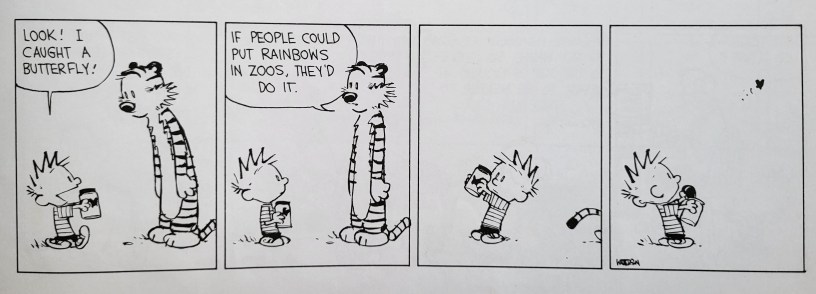
Consider the lesson in this little story about Calvin and his tiger buddy Hobbes (from “Calvin and Hobbes: It’s a Magical World” by Bill Watterson, pg. 51)
Can we allow wild things to stay wild?
Can we allow rainbows to remain uncontained?
To survive as human beings there are some things we need to tame. That’s part of survival strategies. But to stay truly human – and to not become monsters – we best not attempt to domesticate each and every part of the vast and flourishing more-than-human world around us.
How much is this all the more true when it comes to the greatest Beauty and Power and Mystery of all, the Great & Sacred Source of existence itself, the Holy One Beyond Name, the One Whom we call “God.”
Imagine someone trying to catch the stars in a butterfly net. They have more of a chance of succeeding than someone trying to capture “God” and bring “God” into some kind of domesticated display. It’s like trying to catch stars in a butterfly net, yet infinitely more impossible – and I do mean infinitely.
How much is this “G” word a butterfly net? I shouldn’t even be using this “G” word, because it can lead us to think that we know what we’re talking about. We religious folks like to bandy around this “G” word – “God” this, “God” that … – but, really, the reality we are presuming to evoke with this round little word should leave our mouths open and empty, agape, utterly awestruck.
Unutterably holy, holy, holy …
Any words we dare use, if they are going to be any use at all in moving us into contemplation and worship of the Divine must be words that press language to its limits and past the breaking point.
Theologians has come up with some words like this:
The Transcendent – beyond any created thing, beyond all of Creation – the uncreated Creator, Being beyond being, Ground of all Being, sacred Source of existence, self-existing, self-sustaining Sustainer of all …
The Sublime
Holy Mystery
The Eternal – infinite, unending …
Omni-present: “God is too simple to be absent” (Martin Laird); “God is closer to us that we are to ourselves” (Augustine); “God is a circle whose center is everywhere, and whose circumference is nowhere” (St. Bonaventure)
Omni-potent – a power beyond all power, without which all existence would collapse
Omniscient – all-knowing, all-conscious, total awareness …
“Immortal, invisible, God only wise,
In light inaccessible hid from our eyes,
Most blessèd, most glorious, the Ancient of Days,
Almighty, victorious, thy great Name we praise.
Unresting, unhasting, and silent as light,
Nor wanting, nor wasting, thou rulest in might;
Thy justice like mountains high soaring above
Thy clouds which are fountains of goodness and love.
To all life thou givest—to both great and small;
In all life thou livest, the true life of all;
We blossom and flourish as leaves on the tree,
And wither and perish—but nought changeth thee.” – Walter Chambers Smith, hymn lyrics “Immortal, Invisible, God Only Wise”
These are challenging philosophical notions, and important for us to try to contemplate, but they are themselves limited. Thomas Aquinas himself, a great mind in philosophical theology, toward the end of his life had a full-blown mystical experience, where the veil tore open for him to the overwhelming Presence of the Holy. Before the great flaming power and light and love of this experience Aquinas said that all the words he had ever written seemed like straw.
“God” is wider and wilder than our words can contain.
What I think is most wild of all is that, apparently, despite G*d’s transcendence, G*d is not at all absent. The testimonies of our faith are teeming with experiences like Aquinas’. The Hebrew and Christian Scriptures contain accounts of these kinds of experiences, that disclose something of the living Presence of the Divine … along with the ways human beings have tried to wrestle with what they mean about G*d and about us, as they wrestle with the troubles and triumphs of the human condition. These reveal a transcendent G*d who is very much in relationship with humanity and the rest of Creation, a relationship which is a relationship of Love. Many of us here have known this personally in one way or another, or we have heard about it and yearn for it.
Today traditionally is Trinity Sunday, the Sunday after Pentecost when we celebrated the outpouring of the Holy Spirit on the followers of Jesus. I’m apparently using this as an opportunity to subject you all to a crash course in Christian theology, (with Calvin and Hobbes as our starting point).
The Christian concept of the Trinity is a way to try to express the Mystery of how Christian folks have witnessed to the ways G*d has been in relationship with us.
It’s important to remember that idea of the Trinity is trying to do the impossible, use human words and concepts to contain the uncontainable. Yet at its best the Trinity is inspired, the best kinds of words that try to talk about G*d, words that point beyond themselves and can inspire in us awed contemplation of Holy Mystery, can open our hearts, as well as our minds, in our relationships with the Divine and with each other, our growth in a Holy Love Supreme. It’s a shame the Trinity too often has become a rote dogmatic formula.
For example, Augustine said: “You see the Trinity when you see love … for the lover, the beloved and the love are three” (quoted in Möltmann, pg. 58). That’s not a rote formula, but an active and dynamic sacred experience.
The Christian theologians who developed the concept of the Trinity, starting in the 4th century, were all folks with living mystical experience of the living God, people whose hearts and minds clearly had been transformed by Christ into being servants of the love of God, folks who dedicated their lives to caring for the least and the last and the lost. They were the real deal. (Gregory of Nyssa, Gregory of Nazanasius, Basil of Caeasria, Macrina the Younger, John of Damasacus.)
So here it is:
G*d in G*d’s essence is One, utterly simple, complete, whole, without bounds our boundaries.
Creation and all the things that make it up are not-G*d, are other-than-G*d, and yet G*d is in a profound relationship with Creation. In our Christian experience there are three modes, you could say, of this relationship. These modes are the ways that we can come to know something of G*d, by G*d’s grace. They are three, yet G*d is still one.
One aspect of the Trinity is what is traditionally called “the Father.” This means G*d as Creator, as Ground of Being, as the source of all that is, and of the fundamental framework by which the cosmos exist. We can come to know this aspect of the Trinity by observing Creation; physicists and mathematicians can come to glimpse some of the astonishing order of Creation, and so forth.
God as “the Father” or we could also say “the Mother,” is God as the One who gives us life, and also the God who guides us through life. G*d “the Father” also is related to the moral order, which prophets can come to know something about. So, we’re talking about the abstract ideals like the Good, the True, the Just, the Beautiful, which can guide us and hold us accountable, as individuals and as societies.
Another aspect of the Trinity is “Christ.” This aspect of G*d shows how G*d is profoundly and poignantly present with us in the human condition. God who is in flesh, who has revealed Godself through Jesus, and has revealed Godself as Love, a Love that redeems and forgives, a Love that challenges us to grow into more loving, humble, and courageous people.
God comes as Christ to help us with the struggle to be well, to be whole, to be faithful in all that our human lives can bring. In Christ we can see the sacrifices God makes to love us despite the brutality with which humans seek to sever themselves from God. Christ is the way God comes to redeem humanity.
We see this reality of God embodied in Christ through the very particular historic experience of Jesus of Nazareth … and then after his death and resurrection and the re-embodiment in community, we can see Christhood as a universal principle. Some Christians through the years have talked about the Cosmic Christ or the Universal Christ who is present to us through the Holy Spirit.
Which brings us to the third aspect of the Trinity: The Holy Spirit.
People have experienced the Holy Spirit as wind, as breath, as fire, as water, as a bird, as a yearning, as an elemental, animal force, that blurs the boundaries between the physical realm and the spiritual, stirs us awake to how, as the Apostle Paul said, In the Eternal Spirit we all live and move and have our being.
The Holy Spirit gives us inspiration, insight. It’s the aspect of God that connects people into community. Through the Holy Spirit Christian Community is unified as the body of Christ. It flows through people in acts of creation and acts of healing.
We can already see a blurring of the boundaries between the Holy Spirit and Christ and ourselves. The Holy Spirit has this ecstatic quality to it. It moves us past the bounds of our limited selves, there’s a mystery at work here.
That’s what each facet of the Trinity does, it draws us out and into a deeper relationship with the Mystery of God, and with each other.
The early Christian thinkers who developed this idea of the trinity said that these three are essentially one. These are not three distinct deities. But rather ways of approaching the Mystery of the God-beyond-“God”.
The three of the Trinity are inter-related so intimately that it is an inter-being, three dynamic facets of the One.
There are two important images the early Church thinkers used to describe the inter-relationship.
One image for the inter-relation of the One-in-Three, the Three-in-One, from John of Damascus, is a dance, a circle dance. The Greek word is beautiful, in my opinion: perichoresis. Each three of the Trinity embraces in a circle and wheels round and round in a beatific blur.
The other image is “self-emptying” – the Greek word is kenosis. Each member of the Trinity empties itself into the other – each gives its very being to the others and receives its very being from the others. We could see it perhaps as like an M.C. Escher-like image of three vessels pouring out water into one another in an infinite loop. The nature of the Divine is not static, it’s ecstatic. It’s not solitary, but relational.
What this means is that in the core of who and what God is with respect to the Cosmos, is relationship, and relationship characterized by Love. Love is not a solitary force. As the theologian Jurgan Möltmann wrote: “If God is love, [God] is at once the lover, the beloved and the love itself,” (Möltmann, “The Trinity and The Kingdom,” pg. 57). This is in fact a way of approaching the mystery of the Trinity, God’s three-part nature in the Christian experience. Augustine said: “You see the Trinity when you see love … for the lover, the beloved and the love are three” (quoted in Möltmann, pg. 58).
Let’s leave it with that. Let’s leave it with Love.
With that, you have hereby survived my crash course in Christian theology.
If nothing else let’s leave it with Love, with the wild mystery of God’s love – untamable, undomesticated, astonishing, and beautiful.
Thanks be to God.
Delivered Sunday, May 31, 2026, by Rev. Nathaniel Mahlberg, at the United Church of Christ at Valley Forge.
 The Dandelion Way