“What is your favorite color?”
With kids that’s a regular get-to-know-you question. “What is your favorite color?”
I much prefer this question to the usual get-to-know-you question between adults in our culture: “What do you do?” Meaning not, “What do you do that brings life? What do you do what do that brings awe? What do you do that shares meaning?” But rather, “What do you do to make money?”
“Greetings fellow producer-consumer, how do you produce profit within our economic system?”
Now, that can lead to meaningful conversation. I’m very fortunate that I happen to love my job and to have a vocation I find meaningful, and in years past I have been comfortable answering the question when the answer was I was making money washing dishes or working a cash register; and I’m in general curious about the working lives of others and how they find meaning and dignity and solidarity at their workplace, as well as boredom and irritation and all the rest.
But still I’d much rather have a conversation about our favorite colors than about how we pull a paycheck (or not). Why? Because it’s another way of asking, “What brings you delight?”
So, even though none of you asked, but I’m going to tell you about my favorite color.
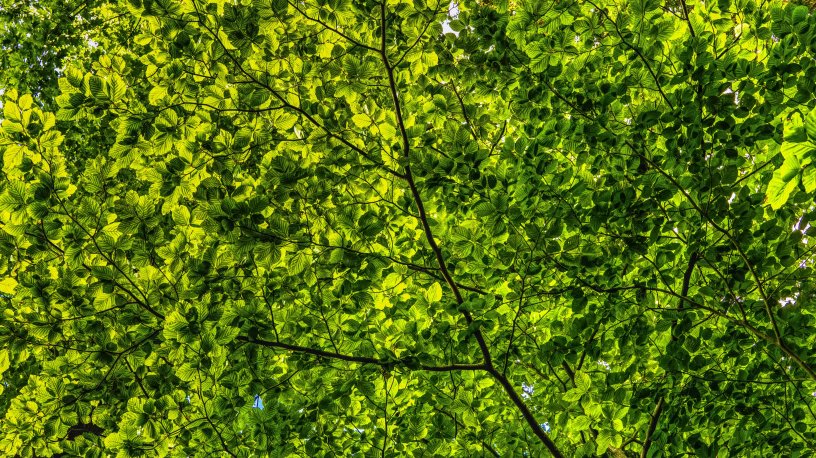
My favorite color is the color of the underside of leaves when you look up in a forest and see the sunlight shining down through the overstory: that luminous green, glowing bright and clear and strong in the light, with a pearlescence as it shimmers in the breeze.
When I’m out among trees and I take a moment when to look up and out into that lofty field of light-green – literally light-green – I can’t help but smile. Even if I’m feeling down, it is a little winking reminder that there is more beauty in the world than I be letting in that moment. It is a moment of delight, a moment of quiet awe before the glowing life-force that transforms light and air into fibrous being.
I’ve loved that living-light green for a long time before I learned that Hildegard of Bingen, the great 12th Century Christian spiritual genius, wrote very powerfully about it. Hildegard called it “veriditas,” the “greening” glow of the life-force all being draws from the creative well-spring of the Divine.
“Without the Word of God no creature has being,” She wrote, “God’s Word is in all creation, visible and invisible. The Word is living, being, spirit, all verdant greening, all creativity. All creation is awakened, called, by the resounding melody, God’s invocation of the Word:
‘I, the fiery life of divine essence, all aflame beyond the beauty of the meadows, I gleam in the waters, and I burn in the sun, moon, and stars … I awaken everything to life.’”
We can glimpse that life-force as veriditas, as a greening glow.
That’s my favorite color, if I have to pick one. What’s yours?
That’s where I can find delight, even when I’m feeling down. How about you?
In our exploration of Awe this autumn, of the life-giving faith-fulfilling practices of Awe, we are making a little detour into Delight. Why is this? Isn’t delight a little too dainty for serious religion during serious times?
Awe should be to be big and profound, right? Awe before the great heights and plunging depths and infinite reaches of this universe; Awe before the Tremendous Holy Mystery – the mysterium tremendum – of the Divine Being Beyond Name; Awe before symphonic triumphs of creative genius; Awe before heart-opening acts of human moral beauty; Awe before insights into life, the universe, and everything; Awe before the gaze of our beloved, Awe before the eyes of a perfect stranger looking out from a revelation of our shared humanity … Yes to all of this!
Yes to Big Awes!
But also, Yes to Little Awes!
Yes to the flash of delight we get when we hear the giggles of a toddler playing peek-a-boo; or of enjoying a clever little joke with a friend, or with a stranger bantering in the grocery store; or of knitting a scarf of the favorite color of the person you want to give it to…
Where are your moments of delight?
Where you do find Little Awes?
It’d be good for us to hear how folks respond to this. We can share them during prayer time. Anytime during the rest of my sermon when you think of a delight of yours or a little awe, you can write than down on the slips of paper we have in the pews. During the prayer time when I gather prayer requests, if you want to also hand me your delights and little awes, I can lift them up as prayers, as well as our cares and concerns and cries.
The scripture reading we heard for today, from the Book of Proverbs, is, I find, astonishing. We hear this powerful voice of Wisdom personified. She makes it very clear how heeding or ignoring the voice of wisdom is a matter of life or death, flourishing or floundering, meaningful fulfillment or spiritual destitution. Wisdom is more important than worldly riches. Wisdom is not to be trifled with – if we live unwisely, prepared to get schooled by some nasty consequences. Wisdom is woven through creation, at the foundation of all that is, so we best align with her:
I, Wisdom, live with prudence,
and I attain knowledge and discretion.
Awe for the Holy One is hatred of evil.
Pride and arrogance and the way of evil
and twisted speech I hate.
I have good advice and sound wisdom;
I have insight; I have strength.
…
The Holy One created me at the beginning of God ’s work,
the first of God ’s acts of long ago.
Ages ago I was set up,
at the first, before the beginning of the earth…
Wow … and … don’t for a moment think that Wisdom in all her power and majesty doesn’t also know how to let her hair down and dance. It is by and through Wisdom that God created all that is, and that very act of creation through Wisdom was and is an experience of delight. Through the holy acts of creation, Wisdom says,
I was beside God, like a master worker,
and I was daily God’s delight,
playing before God always,
playing in God’s inhabited world
and delighting in the human race.
Delight and the creative power of the Divine are closely interwoven, and all of this is interwoven with Wisdom.
Therefore, it is wise, deeply wise, for us to seek and find delight and to return to the delights of our lives. This in no way takes away from our other responsibilities as folks striving for sincere lives of faith and service, in the midst of deep and urgent needs.
Delight is good in and of itself.
Allowing ourselves to delight in daily delights also has a way of giving us a little more buoyancy for the larger struggles of our lives and times. The practice of appreciating daily delights also has a way of softening us up so we are ready for the more momentous moments of thunderstruck revelation, whenever they may come.
The poet Ross Gay developed the practice of every day writing down where he found delight that day. It became a book, then another. What he discovers is that the practice of recording his delights brings more depth to his life, and real joy, joy which is not the opposite of sadness. Through his practice of writing about his delight Ross Gay manages to teach us about growing in one’s humanity through encountering the fullness of one’s humanity, the sorrow and the horrors of what life and society can bring. He exercises a joy that does not deny sorrow or suffering, but embraces it. Especially writing as a Black man in America, his practice of delight is in fact an act of spiritual resistance.
Lord knows we all could use a little more delight in our lives. Am I right?
One way to help ourselves have a little more delight in our lives is through the practice of “Awe Walks.” This is from Dacher Keltner’s book on Awe. Go out on walks outside – or move or sit outside however works best for your body – with the intention of “being amazed at something outside yourself,” in the words of Jane Goodall (Dacher Keltner, Awe: The New Science of Everyday Wonder and How It Can Transform Your Life, pg. xxv).
Keltner offers two instructions for these “Awe Walks:”
“1. Tap into your childlike sense of wonder. Young children are in an almost constant state of awe since everything is so new to them. During your walk, try to approach what you see with fresh eyes, imagining that you are seeing it for the first time. Take a moment in each walk to take in the vastness of things, for example in looking at a panoramic view or up close at the detail of a leaf or flower.
“2. Go somewhere new. Each week, try to choose a new location. You’re more likely to feel awe in a novel environment where the sights and sounds are unexpected and unfamiliar to you. That said, some places never seem to get old, so there’s nothing wrong with revisiting your favorite spots if you find that they consistently fill you with awe. The key is to recognize new features of the same place.” (Keltner, Awe, p.105)
Remember that Jesus taught that we must become like children to receive the Realm of Heaven on Earth.
So however serious and savvy we must become in this world, however calloused and tough, however well-acquainted with the ways of strife and struggle in this fallen world, let us always stay open to awe before the freshly greening life-force of our Holy Creator, as it arises and falls in this kaleidoscopic play of forms through us and out and beyond, according to the astonishing ways of Holy Wisdom. Let us allow ourselves to delight that we are here, now, alive together, to witness to this beauty and to contribute to it, throwing ourselves into playing our part in it, with open hearts on behalf of holy Love.
Thanks be to God.
Delivered Sunday, October 18, 2026, by Rev. Nathaniel Mahlberg, at the United Church of Christ at Valley Forge.
Image by Felix Mittermeier from Pixabay

