Through my years of religious practice and exploration and experience I’ve come to understand that prayer at its heart is not about what words we use or what thoughts we have. Prayer engages much deeper parts of ourselves, at the core of who we are, at the center of our being itself as human beings in relationship with the Sacred Source of All Being.
I’ve come to understand payer in terms of postures of being. Prayer is about moving into certain postures of being which help us to be in relation with the Divine through the depths of our whole selves.
What are some of these postures of being that help to place us into relation with the Divine? They are the shapes our very beings take when we are absorbed in experiences of gratitude, or experiences of awe, or of reverence, or loving embrace, or trusting surrender, or deep yearning, or ultimate dependence, or dawning insight, and so on … these kinds of experiences that lead us beyond the specific object of our gratitude or awe or trust to a wider horizon of Holy Mystery.
Words certainly can express those deeper soul movements in our relationship with God. But if we just focus on words, this can get us stuck, because prayer is about the parts of ourselves that are deeper than words and thoughts. Some people don’t pray because they feel they kind find the right words
Human beings have found many powerful methods of prayer that can bring us into postures of being deeper than words, that can express our utter gratitude, or awe, or reverence, or rejoicing, or trust, or need, or yearning with God. Music, singing, chanting, rhythm, breathwork, and so on.
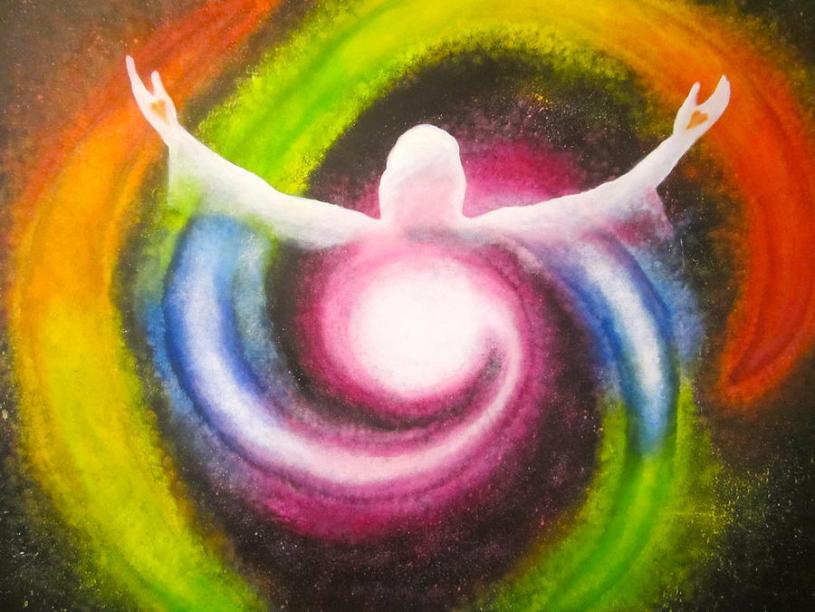
Today I want to honor our bodies themselves as instruments of prayers. The postures and movements of our bodies themselves can help bring us into those deeper postures of being that open the way for prayerful experiences.
The day after my daughter was born I had to run home from the clinic to pick up something we needed that of course I had forgotten in our rush out the door the night before when it was clear this baby was ready to get born. It was the first moment I had to reflect on what on earth had just happened. I experienced something like a magnetic force that pulled me to my little prayer altar – I fell to my knees and bent down to the ground and just wept with gratitude and love. “Thank You, Thank You, Thank You, Thank You …” With my entire being I was in a posture of utmost gratitude before a capital-Y-“You.” This You of my Thank You encompassed my gratitude for all the lower-case-y-“yous”, like my awesome spouse who had just been a force of nature, and this amazing new life who had just joined us, and all the people at the clinic who had cared for us, and our families and ancestors, and so on – My utter gratitude encompassed all of these “yous” and put me into open relationship with an utterly unutterably holy “You” beyond scale and scope.
I felt the embrace of a Divine Presence. This is one of my treasured prayer experiences. These are the kinds of experiences in my life that have led me to believe that this word “God” can mean something very, very real, both infinite and intimate.
Do you see how important it was for me to allow my body to move as it wanted to move? I did use words, right?, but they were simple and direct and from the heart, and they repeated into a kind of chant. In fact, my sobbing “Thank you, Thank you, Thank you…” trailed away into a humming stillness as I rested, surrendered on the earth.
Now, to this day, all I have to do is let my body fall back into that posture and I more easily fall back into that state of being of gratitude and awe and surrender and embrace with God. That posture is now in fact part of my prayer life.
For those of us from Euro-American Protestant backgrounds it may be kind of new to focus on our bodies in prayer, maybe outside of our comfort zone. Our tradition has focused a lot on the intellectual and the ethical realms, the realms of words and virtues – which are important, but they are not the full scope of the human experience or the full reality of how we can relate to the Divine.
I have come to know that it is very important that we honor our bodies in our religious and spiritual lives and practices.
We are embodied beings, after all. As human beings, we are embodied souls & ensouled bodies. This phrase, that “we are embodied souls and ensouled bodies” is from the theologian Karl Barth who reflected very deeply on the meaning of the Incarnation, the in-the-flesh-ment of God through Christ as a revelation of something essentially true about holy reality, showing us something about the union between heaven and earth and what that means about being human in this life.
It’s not accurate or healthy to act like the spiritual realm is something entirely different and separate and better than the physical realm, that the soul is good while the body is bad, and therefore the goal of prayer and religious or spiritual practice should be to somehow kick off these dirty skin bags and evaporate into the pure celestial realms. The Jewish roots of Jesus were not dualistic in this way. The early Christian Church repudiated beliefs that longed for etheric spiritual realms while condemning the embodied realms as irredeemably corrupt. Yet this kind of harsh, judgmental dualism between body and soul, the spiritual and the material, has made its way into a lot of Christian understanding for centuries, especially in Euro-American world-views from the Greco-Roman times to the time of European Enlightenment thought.
Especially for those of us who have been shaped by this dualism between the spiritual and the physical, it can be very powerful, very healing, to learn to pray as embodied souls, as ensouled bodies, to honor our bodies and our embodiment, to let our bodies be sanctified, to be sacred instruments for prayer.
For me personally, learning to pray with my body has helped me to get out of my head and into my heart and into the depths of my being in ways that sometimes have unlocked cleansing tears, sometimes inspiration or insight, sometimes peace and serenity, sometimes an astonishing sense of the nearness of God, sometimes a glimpse into the grandeur of God, both infinite and intimate. My personal prayer practice in an embodied prayer practice.
I want to share this with you, and give you permission to explore how postures and movements can deepen your prayer lives.
What is it like for you to pray simply by placing your hands over your hearts? What is it like for you to pray with your hands open and outstretched? What is it like to pray with your head and chest up, like basking in warm sun? What is it like to pray with your head lowered? What is it like to pray on bended knees? Or prostrate on the ground or on a bed?
Our bodies are gifts, to the glory of our Holy Creator. Let’s pray like it.
I will leave you with a poem by Symeon the New Theologian, a 11th Century Eastern Orthodox monk from Macedonia.
This English version, translated from the Greek, is by Stephen Mitchell
We awaken in Christ’s body
as Christ awakens our bodies,
and my poor hand is Christ, He enters
my foot, and is infinitely me.
I move my hand, and wonderfully
my hand becomes Christ, becomes all of Him
(for God is indivisibly
whole, seamless in His Godhood).
I move my foot, and at once
He appears like a flash of lightning.
Do my words seem blasphemous? — Then
open your heart to Him
and let yourself receive the one
who is opening to you so deeply.
For if we genuinely love Him,
we wake up inside Christ’s body
where all our body, all over,
every most hidden part of it,
is realized in joy as Him,
and He makes us, utterly, real,
and everything that is hurt, everything
that seemed to us dark, harsh, shameful,
maimed, ugly, irreparably
damaged, is in Him transformed
and recognized as whole, as lovely,
and radiant in His light
he awakens as the Beloved
in every last part of our body.

