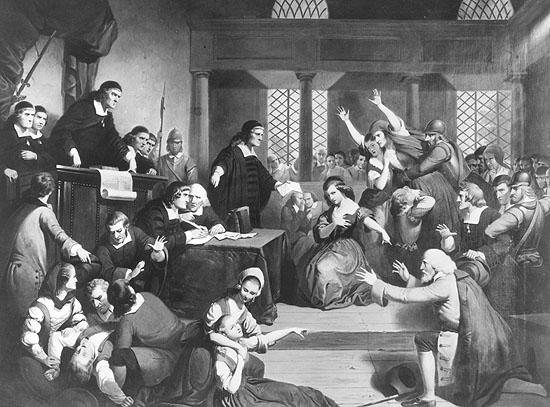
On the day of his public repentance, in 1697, before the assembled congregation of his fellow Puritans in South Church in Boston, Judge Samuel Sewall put on an undershirt of coarse goat hair. It was a voluntary act on Sewall’s part. No minister or judge had compelled him to do it – some, in fact, very much wished he wasn’t doing it – but every day for the rest of his life Judge Samuel Sewell would wear that hair-shirt under his clothes, to needle him with the itch of conscience.
He chose this path of repentance because he had come to realize that he had ignored that itch and scratch of conscience to catastrophic consequence five years before, when he as a judge had sentenced to death twenty innocent people. That year, 1692, was the height of the witch-hunting mania that had erupted in Salem, Massachusetts, and had swept across Puritan New England.
The Devil, you see, they believed, had come unleashed, and he was running loose over the hills and dales. The Devil was seducing folks into doing his dirty work, recruiting covert demonic operatives, regular-seeming folks who were secretly witches and wizards. In particular, the Devil liked to operate among the unsuspecting towns through women who practiced the arts of herbal medicine, and through men who harbored heretical notions outside the dogma of the state church, and through children who became too friendly with their Afro-Caribbean and Indigenous neighbors and were at risk of learning their ways and sharing their sympathies. This disease of devilry was spreading, and all sorts of strange behaviors became symptoms of it.
So, the good, pious Puritans did what good, pious people often do when confronted with threats to their control: They panicked. They felt they had to act quickly, with no time to lose, to stop the spread of this demonic disease. In a rush, they set about purifying their towns of witches.
If you see something, say something. And once you started to look, you could find all kinds of suspicious evidence of witchcraft.
In Salem they were accusing so many people they needed to send out for more judges from Boston to help work through the trial dockets.
One of those judges who responded to the call was Samuel Sewall. He was one of the most learned men in Boston, one of the most well esteemed and wealthiest, and one of the most pious. He had studied at Harvard, back in the early days of that esteemed institution, to become a Puritan minister. He ended up instead becoming a judge and a merchant, and became very successful. He was well known for being rigorous in his faith and devotion and piety. And he wrote about religious matters.
This pious and learned man responded to the call to go to Salem to serve his public duty on a panel of judges. In the course of that work, he and the other judges found a total of 20 women and men guilty of being witches. This included a minister who had been a classmate of Sewall’s at Harvard. Of the convicted in Salem, 19 people were hung, one person was pressed to death under rocks, five died in prison.
When he reflected on it all later, Sewall had to admit that at some point in the proceedings, he started to harbor secret misgivings about the whole thing. But he had pressed on.
There were in fact people at the time who protested all of this, especially in Boston. There were people who recognized that this scapegoating was the ugly fruit of the lower nature of fear and hate. They did not manage to stop it. I don’t know if were active attempts to intervene or how much risk they took or didn’t to try to stop it.
It was a minority opinion at first, to oppose the witch trials. But the horrors of the purge caused more and more people to realize that these were innocents being brutally punished for nothing. This was back in the days of very public executions, so it’s not like it took cell phone videos or body cameras to expose the exercise of state violence. The question was just whether the public and those in power thought that violence was justified.
After the panic died down, pretty quickly the general sentiment shifted and became, “Whoa now, we got a bit carried away there.” But it seems the hope then was to avoid the discomfort of thinking about it too much, and just let the whole episode disappear down the memory hole. “Yeesh, yes, mistakes were made, but let’s just let bygones be bygones and move on.”
However, the conscience of Judge Sewall had begun to itch. He did not let himself forget that he had put innocent people to death. Furthermore, the minister at Sewall’s church, Rev. Samuel Willard, started insisting to everyone that the perpetrating society as a whole learn the moral of this story. Rev. Willard preached from the pulpit that the devil had indeed been at work during the witch trials – not through the so-called witches, but rather through the panic itself about witches which the Puritans had let take possession of them.
I’m reminded of the line from Shakespeare’s play, “A Winter’s Tale,” (which, by the way, had been written decades before this time), in which the character Paulina says, “It is a heretic that makes the fire, not she which burns in ‘t.”
Judge Sewall had begun to realize that it was he who had committed heresy; he had let fear and anger and judgment drive him to violate the good way of Jesus and his Gospel. The itch of Judge Sewall’s conscience became enflamed.
Then, tragically, two of his children died. In that heartbreak, he became convinced that God was punishing him for the sins he had committed during the witch trials. He had sewn in his lower nature and he was reaping corruption.
Sewall responded as he knew God would want: He repented.
He fasted in penance. He humbled himself before his congregation at South Church while Rev. Willard read his public letter of contrition. He donned his hair-shirt.
Most of the people who witnessed this or who heard about it later thought Sewell was making too big of a deal out of it. Wasn’t it being a bit too dramatic to take personal responsibility for what was society’s mistake? He had just been doing his job, after all, in the midst of a peculiar episode that, well, everyone for whatever reason had gotten swept up in. It’s just better to forget about it.
Sewall wouldn’t hear any of that. He took responsibility and he repented for his personal role.
After he repented, Sewall wrote that he felt a spiritual relief deep inside him. He experienced Grace. But he did not treat that Grace as if it were cheap. He kept wearing that hair-shirt.
Now, I want to say that this is more severe an approach to repentance than I want to advocate. I find some ironic humor in the fact that I’m offering this sermon a week after I made a big deal last week about of how important it is to honor our bodies as instruments of prayer through postures and movements that help us experience things like gratitude and awe and praise and love and comfort and strength and serenity. Yet, here I am now talking about one of the many physically harsh practices in the Christian tradition (which can be found in other religions, by the way), that have been called “mortifications of the flesh.” These are forms of corporal punishment against oneself or others. I want to be clear that this is, by and large, not heathy and has, by and large, lost the plot of Grace, God’s Grace which we can find through Jesus.
All that said, this hair-shirt of the repentant witch-judge can serve as an helpful metaphor. When our consciences are troubled, we can feel that in discomfort in our body, an unease, a hitch in our sinews, an itch on our skin. If we settle down and listen to this, prayerfully attending to it, we can realize it’s telling us something that the Spirit wishes us to hear.
Because he listened to the discomforting voice of his conscience, and finally responded by honoring its power, Judge Sewall had indeed experienced the relief of Grace. But he wanted to be sure he never again made the fatal mistake of ignoring the unease of conscience. In wearing that rough shirt, he kept the itch of conscience close to him and as he continued live into the implications of Grace.
Indeed, as time went on, this made him sensitive to the unjust suffering of more and more people, in ways that he hadn’t been before.
In 1700 Samuel Sewall shocked his community by publishing his argument that the institution of slavery was an affront to God. He wrote that people from Africa are children of God just like people from Europe. He wrote that the colonists shouldn’t do to them what they wouldn’t want done to themselves. Therefore, slavery was – and is and ever will be – wrong.
Sewall’s tract was called the “Selling of Joseph.” It was forceful and biblical. It was the first abolitionist tract in America.
It did not make him many friends among his fellow colonists.
Next, he realized the same thing about Native Americans. He wrote that they are just as much children of God as anybody else, and that the colonists shouldn’t do to them what they wouldn’t want done to themselves. That rules out war and theft and slavery and dispossession.
Finally, shortly before he died, Judge Sewall wrote something similar about women.
Now, I’m not going to say that this Puritan’s views on women, or on Africans or Native Americans were totally enlightened. But they were courageous and groundbreaking statements of a conscience and a soul that had become remarkably sensitive to the humanity of those that his society treated as inhuman. Judge Sewall has been remembered for generations for this reason.
It started with his willingness to repent of his role in his society’s sin – and not just confess it or admit it, but to genuinely suffer for it and humble himself and accept grace and the change that it makes on us. He kept that repentance and that grace close with him, working at him, literally against his skin, for the rest of his life. He sewed in the Spirit and he reaped new life, eternal.
As members of the United Church of Christ, we at this church have the Puritans as one of our ancestors in the faith – as different as we are now from them. In time, most of the descendants of the Puritans became New England Congregationalists. In time, most of the Congregationalists became one of the four historic streams of American Protestantism that joined to form the United Church of Christ.
South Church in Boston, Judge Sewall’s church, led at the time by Rev. Samuel Willard, is these days a prominent UCC congregation. It’s now called Old South Church, and has been publicly committed to LGBTQ+ rights, immigrant rights, and racial justice. Same with the UCC church in Salem, MA – they are folks of faith attentive to the human rights of those our society singles out and scapegoates.
Samuel Sewall is emblematic of the kind of evolution, the moral evolution – personal and, at our best, collective – that is possible when people allow the Living God to act on us through history, to hold us accountable to the ways that the forces of sin can possess us, and to help us grow, through Grace, to honor the dignity and sanctity of all people.
As Christians we see the union of the divine and human through the person of Jesus, who died because the violence of both the mob and the state sought to make him a scapegoat. Jesus identified himself with “the least of these,” and told us that however we treat the “least” among us is how we treat him. This may sound nice, but in practice it can be very unsettling.
Our faith should be an itchy and scratchy kind of faith, a faith that does not rest comfortably with the sins of our past or the sins of our present. It’s the kind of faith that does not put off responsibility by saying “Okay, fine, yes, mistakes were made, but let’s let bygones be bygones… and, really, it wasn’t as bad as you’re making it seem … and it’s not fair and in fact very nasty and mean to say negative things that disparage the great Americans of the past.”
Rather it’s the kind of faith that puts on that responsibility, with maturity and humility, grace and courage. It’s the kind of faith that trusts in the redeeming power of God’s Grace to work on us and through us, so that we may live out the Gospel’s power to free us from the ways of violent powers, the powers that produce witch hunts and witch judges, the powers that produce scapegoats and executioners, which still can possess societies and churches and people of faith. This kind of faith isn’t always comfortable, it can be itchy and scratchy and irritating. But it is the path to a peace that surpasses our understanding.
Where are you feeling that itch of conscience? Don’t let yourself become numb to it. Trust God’s Grace to lead us in faithfully responding to it.
Thanks be to God.
Delivered Sunday, July 19, 2026, by Rev. Nathaniel Mahlberg, at the United Church of Christ at Valley Forge.

