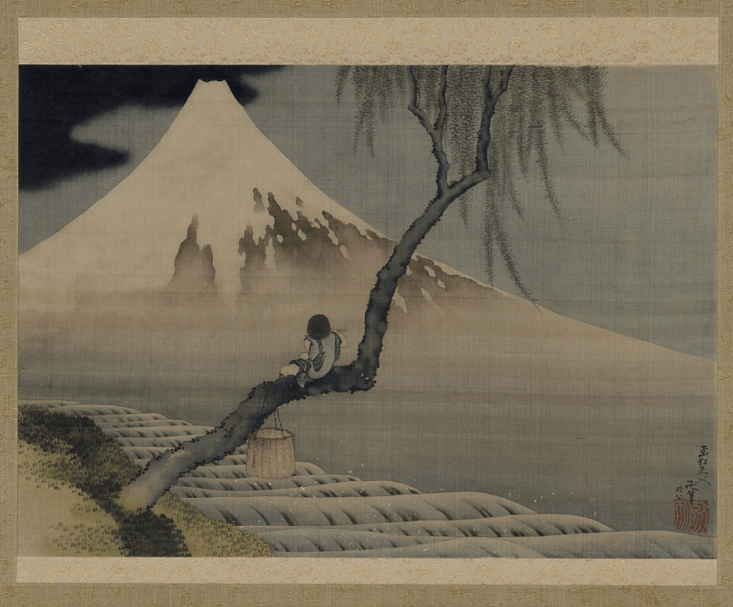
I was a teenager when I first beheld the awe-some and awe-full beauty of Mount Taquoma – “The Mother of all Waters,” as it is called in its various names among the Puyallup and other Salish peoples of the Pacific Northwest.
I will never forget hiking with my family a trail that took us along a huge rocky escarpment in full view of the summit of Taquoma. I paused on this steep talus slope and let my gaze plunge down, down, way down to a thin shimmering ribbon of river, one of the many runs of waters born from the giant ancient glaciers that dwell in the heights of the mountain. After my gaze plunges down to this river, it rises on the other side at an even sharper angle of rock face, up, up as the summit vaults above. To look up that high, your mouth has to fall open. The presence of that mountain tore through every sense I had of dimension. It was too grand, too glorious, too bright and towering and powerful and distant … drawing up from its volcanic roots in the fiery depths of the earth and vaulting impossibly into the heights of the heavens … too beautiful for the limits of my mind.
It blew me open in awe. It was a beauty unbearable to my usual sense of self … so I had to let that sense of self itself break open, until there was nothing but the beauty of the mountain.
Afterward I had a very strong conviction of just how important it is to honor how far beyond the scope of the human the reality is of this mountain. The scope of the human is pathetic before its ancient volcanic power, its power to shape the very landscape of life for countless life-forms through countless generations across countless miles of landscape.
So, I honor its indigenous name, Taquoma, “The Mother of all Waters.”
On Anglo maps the mountain is named for a person who never lived anywhere close to it. “Mt. Rainier” it’s called, named after a 18th century British admiral called Peter Ranier. Peter Ranier managed to survive all of 67 years before he went the way of all flesh. Compare that to the more than 500,000-year existence of this relatively young volcanic mountain, Ranier lived for at most 0.000134% of the life of the mountain that one British surveyor for some reason decided should bear his name. Also funny, I think, is the fact that “Mt. Rainier” is in the state called “Washington,” named after George Washington, whom Peter Rainier fought against in the American War of Independence.
Ah, the ironies of the inflated human ego. However you cut it, the inflated human ego is objectively stupid in view of actual reality.
The wise among humans are those who are comfortable with the dissolving of that ego in humility before what is truly worthy of reverence, and honor. The wise have a healthy dose of respect before what is objectively beyond their power. A volcanic mountain, after all, and Taquoma in particular, can and does kill people, who are either unlucky or unwise. This is a dimension of the astonishment we can feel before its beauty.
This brings to my mind the line from the poet Rainer Maria Rilke (no relation to Rainier), who wrote that,
Beauty is nothing but the beginning of terror, which we are still just able to endure, and we are so awed because it serenely disdains to annihilate us. Every angel is terrifying. – Rainer Maria Rilke, from Duino Elegies, trans. Stephen Mitchell
The indigenous Puyallup and other Salish peoples are much more grounded in reality when they honor this awe in how they speak about this mountain in their various tongues as “The Mother of all Waters.” The mountain has the power to give life and the power to take life.
Yet, for all its power, we know Taquoma is not the mother of all waters … and was itself born of another mother, you could say.
A mountain is not God, after all. Nowhere even close.
Consider that this mountain is relatively young among other mountains and very young in the life of the earth, not to mention in the great span of the cosmos. This great and wonderous volcanic summit is just one of the many passing forms that rise and fall, gather and scatter, shine and dissolve and morph and reform before the “eyes” of the Holy Creator, whom we call “God,” the Sacred Source of existence itself, the Ground of all being.
Just glimpsing a tiny pinprick opening onto a corner of this scope of truly holy Reality is an experience of unbearable beauty, which can shape us to live on behalf of love for this world and for each other.
“Awe before God is the beginning of wisdom,” as the Book of Proverbs teaches.
One of the wonderful and powerful avenues we have to practice this awe is in the practice of beholding the beauty of what is around us. The good news is that we don’t need to go far or wait long to do it. The experience of beauty doesn’t always have to be as intense as the example I led with. Beauty as we know comes in gentle and comforting ways, as well as the awe-some and awe-full. Beholding the beauty of what is around us and within and among gives us a glimpse into both the presence and the transcendence of the Divine, and helps us feel its call upon our lives.
The Gospel of Thomas recounts Jesus teaching: “Turn over a rock, I am there; split a piece of wood, I am there.”
William Blake wrote:
To see a world in a grain of sand
And a heaven in a wild flower,
Hold infinity in the palm of your hand
And eternity in an hour.
And we hear from the Book of Ecclesiastes: “God has made everything beautiful in its own time, and set eternity in our hearts.”
We can taste a little of that eternity when we allow our hearts to open, even a little, to the beauty at the heart of something or someone. That moment of beauty is near at hand.
The Irish philosopher and novelist Iris Murdoch taught about the practice of beholding the beauty of something or someone as the practice of “unselfing.” We must let go of hard boundaries around ourselves to allow in the reality of something or someone who is other than ourselves. It is through beholding the wondrous otherness of something, through what Murdoch calls a “just and loving gaze directed upon an individual reality,” that we experience beauty, and we realize our deeper connections with the being around us and with the Sacred Source of all being and beauty, God.
I’ll quote Murdoch at length:
“Whether admiring a patch of moss, a crystal, flower, or golden beetle, a sky full of clouds, a sea with the serene, vast sigh of its swells, or a butterfly wing with its arrangement of crystalline ribs, contours, and the vibrant bezel of its edges, the diverse scripts and ornamentations of its markings, and the infinite, sweet, delightfully inspired transitions and shadings of its colors – whenever I experience part of nature, whether with my eyes or another of the five senses, whenever I feel drawn in, enchanted, opening myself momentarily to its existence and epiphanies, that very moment allows me to forget the avaricious, blind world of human need, and rather than thinking or issuing orders, rather than acquiring or exploiting, fighting or organizing, all I do in that moment is ‘wonder,’ … while wandering down the path of wonder, I briefly escape the world of separation and enter the world of unity.” (Quote from this article by Jack Maden)
Entering into unity at this can at times be uncomfortable, or scary, because it risks a certain kind of annihilation – even if it’s of the small and petty sense of self on behalf of an enlarged and en-spirited communing self. It takes some trust, and situations that are worthy of that trust. (Driving along narrow switchbacks in the mountains is not the time for rapturous union with the beauty of the landscape. Right? It’s wise to take care to not fall hopelessly in love with beautiful psychopaths. Right?)
Beholding beauty is an act of surrender, so it is worth doing relatively safely, worth caring for as an act of consent.
I shared with you that the poet Rilke wrote that, “every angel is terrifying.” Yet in the biblical stories, every angel that bursts on the scene tells their trembling onlookers, “Do not be afraid.” Be awed yet unafraid. This holy beauty is worthy of your trust.
That holy beauty is always near at hand, in the beauty of the world around us, in the beauty of its various beings, flawed and fabulous as we may be. However it is with our lives and in our times, it is wise to allow ourselves the practice of beholding beauty.
Remember that Jesus taught: “Do not worry, but consider the beauty of the lilies; watch the wild birds of the air.” Witness how God is present even in these little and luminous things, allow that to be an antidote to anxiety.
Especially when times are tough, we can engage in awe-filled practices that heighten our connection to that which is bigger than us, remind us that we are not alone, and offer us respite and resilience.
If you need science to confirm ancient wisdom:
“When we naturally notice and appreciate the beauty around us, it can lead to all kinds of different benefits. Studies show it can make us feel more satisfied in life, have a stronger sense of meaning, and act with more kindness towards others and the environment.” – Shuka Kalantari, about the research of Rene Proyer (creator of the 9 beautiful things practice), “Why We Should Seek Beauty in the Everyday Life (The Science of Happiness Podcast),” Greater Good Magazine
So, let’s take a few minutes to do just that. We’ll show you a couple works of art. Let’s give ourselves the gift of some time to simply behold their beauty. Allow ourselves to let go of ourselves and enter into its reality.
The first two works of art are Japanese woodcut prints of natural beauty. The last work of art is an example of “moral beauty.”
Kawase Hasui “Spring Moon at Ninomiya Beach”
Kitaoka Fumio “Waterfall in Autumn”
[Delivered Sunday, September 20, 2026, by Rev. Nathaniel Mahlberg, at the United Church of Christ at Valley Forge]
You can learn more about the practice of contemplative beholding here, courtesy of Joel Upton.
More about the science of awe here, courtesy of Dacher Keltner

